Functional evidence implicating a novel TOR1A mutation in idiopathic, late-onset focal dystonia
- PMID: 19955557
- PMCID: PMC2891583
- DOI: 10.1136/jmg.2009.072082
Functional evidence implicating a novel TOR1A mutation in idiopathic, late-onset focal dystonia
Abstract
Background: TOR1A encodes a chaperone-like AAA-ATPase whose Delta GAG (Delta E) mutation is responsible for an early onset, generalised dystonia syndrome. Because of the established role of the TOR1A gene in heritable generalised dystonia (DYT1), a potential genetic contribution of TOR1A to the more prevalent and diverse presentations of late onset, focal dystonia has been suggested.
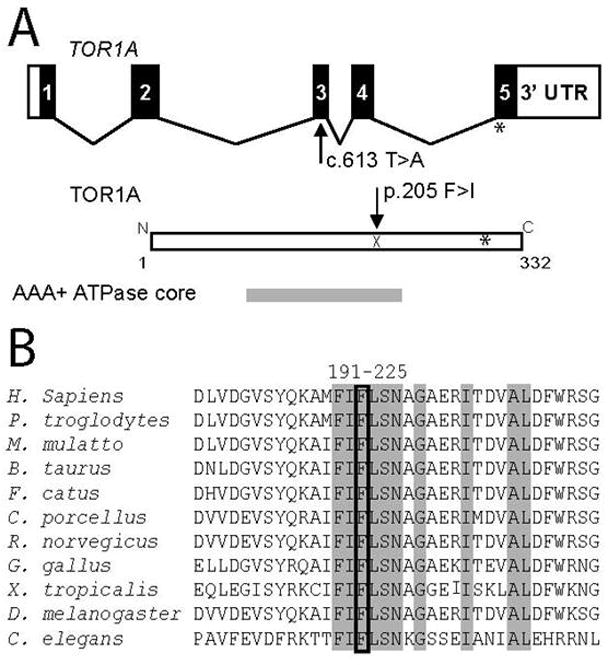
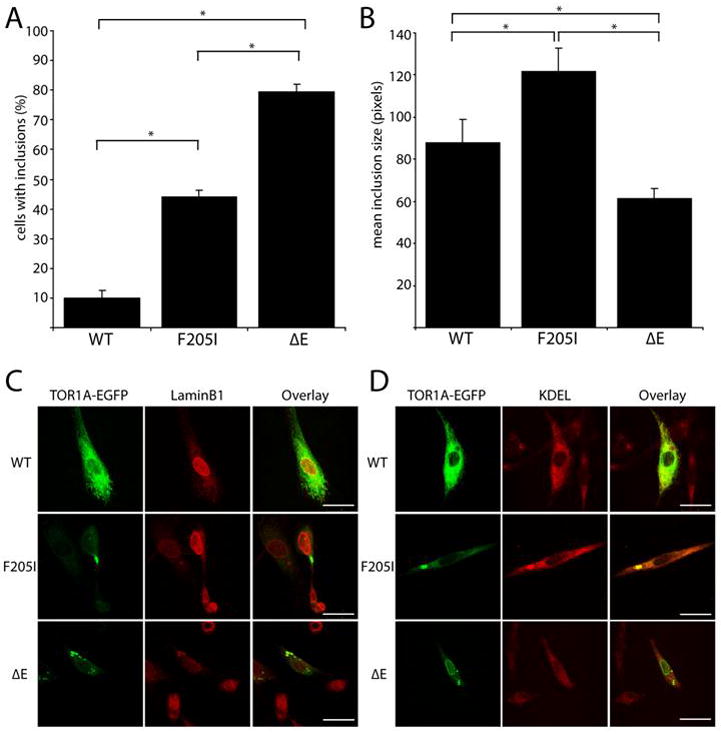
Results: A novel TOR1A missense mutation (c.613T-->A, p.F205I) in a patient with late onset, focal dystonia is reported. The mutation occurs in a highly evolutionarily conserved region encoding the AAA-ATPase domain. Expression assays revealed that expression of F205I or Delta E, but not wildtype TOR1A, produced frequent intracellular inclusions.
Conclusions: A novel, rare TOR1A variant has been identified in an individual with late onset, focal dystonia and evidence provided that the mutation impairs TOR1A function. Together these findings raise the possibility that this novel TOR1A variant may contribute to the expression of dystonia. In light of these findings, a more comprehensive genetic effort is warranted to identify the role of this and other rare TOR1A variants in the expression of late onset, focal dystonia.
Conflict of interest statement
Figures
References
-
- Defazio G, Berardelli A, Hallett M. Do primary adult-onset focal dystonias share aetiological factors? Brain. 2007;130(Pt 5):1183–93. - PubMed
-
- Ozelius LJ, Hewett JW, Page CE, Bressman SB, Kramer PL, Shalish C, de Leon D, Brin MF, Raymond D, Corey DP, Fahn S, Risch NJ, Buckler AJ, Gusella JF, Breakefield XO. The early-onset torsion dystonia gene (DYT1) encodes an ATP-binding protein. Nat Genet. 1997;17(1):40–8. - PubMed
-
- Clarimon J, Asgeirsson H, Singleton A, Jakobsson F, Hjaltason H, Hardy J, Sveinbjornsdottir S. Torsin A haplotype predisposes to idiopathic dystonia. Ann Neurol. 2005;57(5):765–7. - PubMed
-
- Clarimon J, Brancati F, Peckham E, Valente EM, Dallapiccola B, Abruzzese G, Girlanda P, Defazio G, Berardelli A, Hallett M, Singleton AB. Assessing the role of DRD5 and DYT1 in two different case-control series with primary blepharospasm. Mov Disord. 2007;22(2):162–6. - PubMed
-
- Kamm C, Asmus F, Mueller J, Mayer P, Sharma M, Muller UJ, Beckert S, Ehling R, Illig T, Wichmann HE, Poewe W, Mueller JC, Gasser T. Strong genetic evidence for association of TOR1A/TOR1B with idiopathic dystonia. Neurology. 2006;67(10):1857–9. - PubMed
Publication types
MeSH terms
Substances
Grants and funding
LinkOut - more resources
Full Text Sources
Other Literature Sources
Molecular Biology Databases