. 2010 Feb 5;285(6):3540-3547.
doi: 10.1074/jbc.M109.058396. Epub 2009 Dec 2.

TRAMP complex enhances RNA degradation by the nuclear exosome component Rrp6

Affiliations

TRAMP complex enhances RNA degradation by the nuclear exosome component Rrp6

Kevin P Callahan et al. J Biol Chem. .

Abstract

The RNA-processing exosome contains ribonucleases that degrade aberrant RNAs in archael and eukaryotic cells. In Saccharomyces cerevisiae, the nuclear/nucleolar 3'-5' exoribonuclease Rrp6 distinguishes the nuclear exosome from the cytoplasmic exosome. In vivo, the TRAMP complex enhances the ability of the nuclear exosome to destroy some aberrant RNAs. Previous reports showed that purified TRAMP enhanced RNA degradation by the nuclear exosome in vitro. However, the exoribonucleolytic component(s) of the nuclear exosome enhanced by TRAMP remain unidentified. We show that TRAMP does not significantly enhance RNA degradation by purified exosomes lacking Rrp6 in vitro, suggesting that TRAMP activation experiments with nuclear exosome preparations reflect, in part, effects on the activity of Rrp6. Consistent with this, we show that incubation of purified TRAMP with recombinant Rrp6 results in a 10-fold enhancement of the rate of RNA degradation. This increased activity results from enhancement of the hydrolytic activity of Rrp6 because TRAMP cannot enhance the activity of an Rrp6 mutant lacking a key amino acid side chain in its active site. We observed no ATP or polyadenylation dependence for the enhancement of Rrp6 activity by TRAMP, suggesting that neither the poly(A) polymerase activity of Trf4 nor the helicase activity of Mtr4 plays a role in the enhancement. These findings identify TRAMP as an exosome-independent enhancer of Rrp6 activity.


Figures
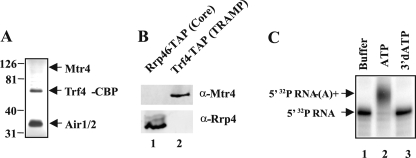
FIGURE 1.
FIGURE 1.
TRAMP polyadenylates a synthetic 7 S RNA in vitro. A, silver-stained polyacrylamide gel of 1.4 μg of TRAMP purified from a TRF4-TAP strain. The positions of molecular mass markers are shown on the left, and the identities of TRAMP subunits are shown on the right. B, Western blot comparison of 1 μg of affinity-purified TRAMP (lane 1) and 1.2 μg of affinity-purified core exosome (lane 2) using polyclonal antibodies to Rrp4 and Mtr4. C, TRAMP (0.3 pmol) incubated in a 10-μl reaction in the presence of 3 fmol of 5′ [32P]RNA substrate and either buffer, ATP (500 μm) or 3′-dATP (500 μm) for 60 min at 30 °C. The products and substrates were separated by denaturing PAGE and analyzed by storage phosphorimaging. The panel is a composite of lanes taken from a single experiment.
FIGURE 2.
FIGURE 2.
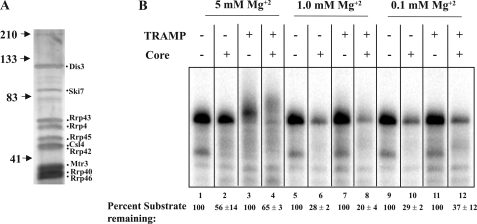
TRAMP does not enhance RNA degradation by the core exosome. A, silver-stained polyacrylamide gel of 2.5 μg of core exosome purified from an RRP46-TAP strain. The positions of molecular mass markers are shown on the left, and the inferred identities of exosome subunits are shown on the right. B, TRAMP (0.4 pmol) and/or core exosome (0.4 pmol) incubated in a 10-μl reactions in the presence of 3 fmol of 5′ [32P]RNA substrate, ATP (500 μm), and the indicated concentrations of Mg2+ (Mg2OAc) for 60 min at 30 °C and analyzed as Fig. 1. The values listed below the lane numbers represent the average ± S.E. for the amount of substrate remaining after incubation and are calculated from the results of two independent experiments.
FIGURE 3.
FIGURE 3.
TRAMP enhances RNA degradation by recombinant Rrp6. A, Coomassie Blue-stained SDS-PAGE analysis of 2.75 μg of GST-Rrp6 purified from E. coli. The positions of molecular size markers are indicated at left. B, indicated quantities of GST-Rrp6 incubated with 0.3 pmol of TRAMP and 3 fmol of 5′ [32P]RNA substrate for 60 min at 30 °C. The reactions were stopped, and the products were separated by denaturing PAGE. The gel was visualized and quantitated by storage phosphorimaging. The values listed below the lane numbers represent the amount of RNA substrate remaining at the end of incubation. C, time course analysis of the effect of TRAMP on GST-Rrp6 degradation activity. TRAMP (0.3 pmol) and Rrp6 (0.3 pmol) were incubated with 3 fmol of 5′ [32P]RNA substrate at 30 °C for the indicated amounts of time and analyzed as in B. D, graphic display of the average rate of product formation by GST-Rrp6 in the presence and absence of TRAMP from the experiment shown in C and two additional measurements. Product was defined as RNAs shorter than the substrate and was quantified by storage phosphorimaging analysis. Error bars represent the S.D. from the three measurements.
FIGURE 4.
FIGURE 4.
TRAMP enhances of the exoribonuclease activity of Rrp6. A, GST-Rrp6 (0.3 pmol) or GST-Rrp6-6p was incubated in a 10-μl reaction with or without TRAMP (0.4 pmol) in the presence of 3 fmol of 5′ [32P]RNA substrate for 60 min at 30 °C and analyzed as described in the legend to Fig. 1. The panel is a composite of lanes taken from a single experiment. The values listed below the lane numbers represent the percentage of the RNA substrate remaining at the end of incubation. B, GST-Rrp6 and GST-Rrp6 + TRAMP were incubated as above with an RNA substrate uniformly labeled with 5′ [α-32P]guanosine, and the reaction products were separated by thin layer chromatography. The panel is a composite of lanes taken from a single experiment. The values listed below the lane numbers represent amount of product produced.
FIGURE 5.
FIGURE 5.
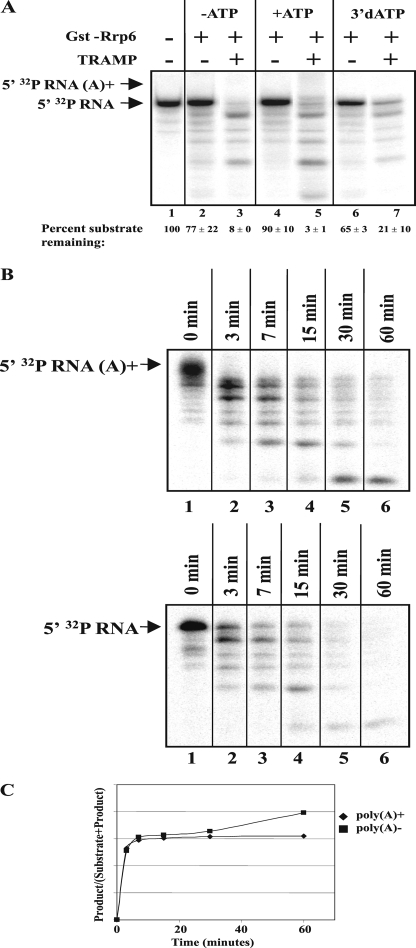
TRAMP enhancement of the nuclease activity of Rrp6 does not require ATP or the presence of a poly(A) tail. A, GST-Rrp6 (0.3 pmol) was incubated with or without TRAMP (0.3 pmol in a 10-μl reaction in the presence of 3 fmol of 5′ [32P]RNA substrate and either buffer, ATP (500 μm), or 3′-dATP (500 μm) for 60 min at 30 °C and analyzed as described in the legend of Fig. 3. The values listed below the lane numbers represent the average ± S.E. for the amount of substrate remaining after incubation and are calculated from the results of two independent experiments. B, 5′ [32P]RNA substrate was preincubated with TRAMP in the presence (upper panel) or the absence (lower panel) of ATP. The reactions were phenol-extracted to remove TRAMP, and the RNA substrate was concentrated by ethanol precipitation. The RNAs were then incubated in the presence of GST-Rrp6 (1 pmol) for 60 min and analyzed as described in the legend of Fig. 3. C, graphic display of the rate of product formation by GST-Rrp6 for the poly(A)+ and poly(A) substrates in the experiments shown in B. Product was defined as RNAs shorter than the substrate and was quantified by storage phosphorimaging analysis.
FIGURE 6.
FIGURE 6.
TRAMP depleted of Mtr4 enhances RNA degradation by Rrp6. A, Western blot comparison of 0.7 μg of affinity-purified TRAMP and 0.7 μg of affinity-purified high salt wash (HSW) TRAMP using polyclonal antibodies to Mtr4 and CBP that detects the Trf4-CBP fusion protein. B and C, GST-Rrp6 (0.3 pmol) incubated with or without TRAMP (0.4 pmol) or high salt wash TRAMP (HSW TRAMP) (0.4 pmol) in a 10-μl reaction in the presence of 3 fmol of 5′ [32P]RNA substrate in either ATP (500 μm) (B) or buffer (C) for 60 min at 30 °C and analyzed as described in the legend to Fig. 1. The values listed below the lane numbers in B and C represent the amount of substrate remaining after incubation.

References

    1. Doma M. K., Parker R. (2007) Cell 131, 660–668 - PubMed
    1. Vanacova S., Stefl R. (2007) EMBO Rep. 8, 651–657 - PMC - PubMed
    1. Butler J. S. (2002) Trends Cell Biol. 12, 90–96 - PubMed
    1. Houseley J., Tollervey D. (2006) EMBO Rep. 7, 205–211 - PMC - PubMed
    1. Lorentzen E., Conti E. (2005) Mol. Cell 20, 473–481 - PubMed

Publication types

MeSH terms

LinkOut - more resources