Review
. 2009 Dec;119(12):3502-11.
doi: 10.1172/JCI40599. Epub 2009 Dec 1.

Inflammasomes: too big to miss

Affiliations
Review

Inflammasomes: too big to miss

Andrea Stutz et al. J Clin Invest. 2009 Dec.

Abstract

Inflammation is the coordinated immune response to harmful stimuli that appear during infections or after tissue damage. Cells of the innate immune system are the central players in mediating inflammatory tissue responses. These cells are equipped with an array of signaling receptors that detect foreign molecular substances or altered endogenous molecules that appear under situations of stress. This review provides an overview of recent progress in elucidating the molecular mechanisms that lead to inflammatory reactions. We discuss the current knowledge of the mechanisms leading to the activation of cytoplasmic, multimolecular protein complexes, termed "inflammasomes," which regulate the activity of caspase-1 and the maturation and release of IL-1beta.


Figures
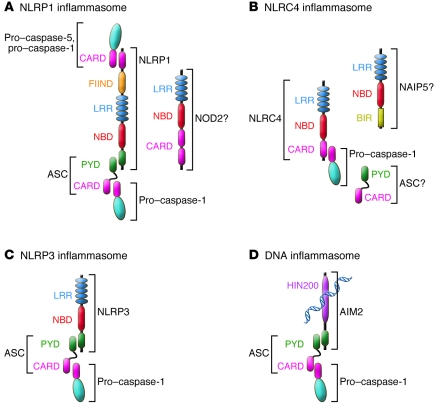
Figure 1
Figure 1. Graphical depiction of known inflammasomes.
(A) NLRP1 contains, in addition to the NLR-typical LRR and NBD domains, a PYD, a FIIND, and a CARD. NLRP1 can recruit pro–caspase-1 and -5 and possibly forms a complex with NOD2. Recruitment of ASC enhances activation of pro–caspase-1. (B) NLRC4 contains a CARD that can directly recruit pro–caspase-1. Reports further demonstrate a role for ASC and possibly NAIP5 in NLRC4 inflammasome activation. (C) NLRP3 activates pro–caspase-1 via recruitment of ASC. (D) AIM2 is a bipartite protein consisting of a PYD and DNA-binding HIN200 domain and recognizes cytoplasmic double-stranded DNA and assembles the DNA inflammasome with ASC and pro–caspase-1.
Figure 2
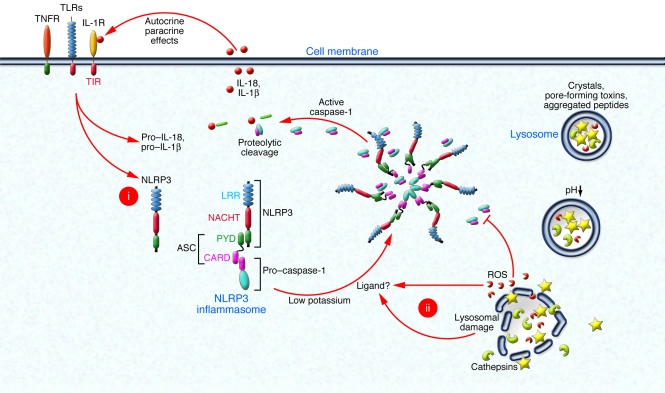
Figure 2. Inflammasomes form large multimolecular complexes that control the activity of caspase-1.
(i) Activation of cytokine receptors or pattern recognition receptors such as TLRs leads to the induction of pro–IL-1β and NLRP3. (ii) In a second step, NLRP3 inflammasome assembly is triggered by low intracellular potassium levels and the binding of a putative ligand that is generated by proteolytic activity after lysosomal damage or by the action of ROS. The assembled NLRP3 inflammasome results in activation of caspase-1, which proteolytically activates IL-1β family cytokines. The produced pro-inflammatory IL-1β family cytokines can act on other cell types or act in a feed-forward loop. High intracellular oxygen tension can also lead to direct deactivation of caspase-1.
Figure 3
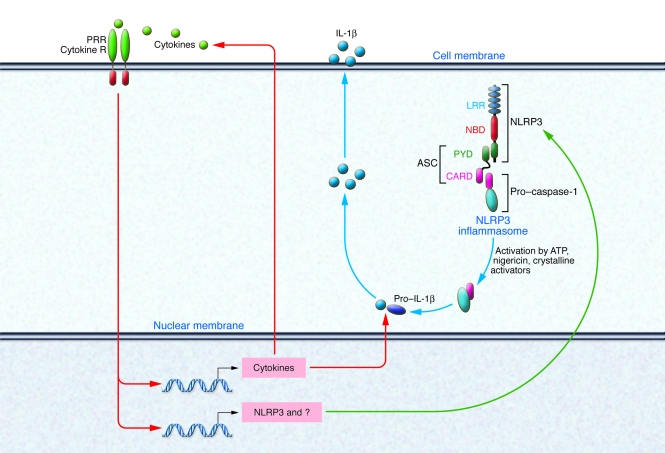
Figure 3. Priming is essential for the activation of the NLRP3 inflammasome and IL-1β secretion.
PRR and cytokine receptors (R) activate the expression of the pro-forms of the IL-1 cytokine family and other cytokines. In addition, NLRP3 and possibly other proteins needed for IL-1β secretion are induced. NLRP3 upregulation is required for its activation by ATP, pore-forming toxins, or crystals.

References

    1. Akahoshi T., Murakami Y., Kitasato H. Recent advances in crystal-induced acute inflammation. Curr. Opin. Rheumatol. 2007;19:146–150. - PubMed
    1. Duncan J.A., et al. Cryopyrin/NALP3 binds ATP/dATP, is an ATPase, and requires ATP binding to mediate inflammatory signaling. Proc. Natl. Acad. Sci. U. S. A. 2007;104:8041–8046. - PMC - PubMed
    1. Ye Z., et al. ATP binding by monarch-1/NLRP12 is critical for its inhibitory function. Mol. Cell. Biol. 2008;28:1841–1850. - PMC - PubMed
    1. Ting J.P.Y., et al. The NLR gene family: a standard nomenclature. Immunity. 2008;28:285–287. - PMC - PubMed
    1. Zou H., Li Y., Liu X., Wang X. An APAF-1.cytochrome c multimeric complex is a functional apoptosome that activates procaspase-9. J. Biol. Chem. 1999;274:11549–11556. - PubMed

Publication types

MeSH terms