


Evidence for a role of progesterone in menstrual cycle-related variability in prepulse inhibition in healthy young women
- PMID: 19956084
- PMCID: PMC3055354
- DOI: 10.1038/npp.2009.195
Evidence for a role of progesterone in menstrual cycle-related variability in prepulse inhibition in healthy young women
Abstract
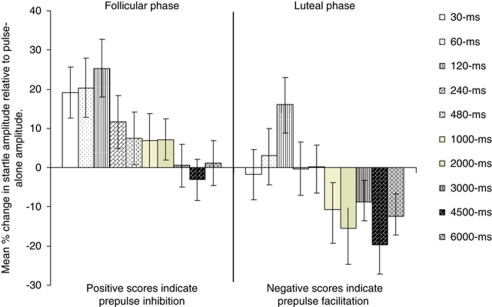
Prepulse inhibition (PPI) of the startle response is sensitive to sex, with healthy young women showing less PPI compared with age-matched men, and varies according to the menstrual cycle phase in women. Relatively less is known regarding sex and hormonal influences in prepulse facilitation (PPF). Menstrual phase-related variability in PPI is suggested to be mediated by fluctuating estrogen level, based on the observations of more PPI in women during the follicular, relative to the luteal, phase. No study has directly assessed the relationship between fluctuating hormones and PPI or PPF levels over the human ovarian cycle. To examine the roles of circulating ovarian hormones in PPI and PPF, 16 non-smoking regularly menstruating healthy women were tested during both the follicular and luteal phases on PPI and PPF and provided saliva samples for measurement of 17beta-estradiol (estrogen), progesterone and testosterone. The results showed higher levels of 17beta-estradiol and progesterone during the luteal, relative to the follicular, phase; and more PPI during the follicular phase and more PPF during the luteal phase with comparable startle amplitude and habituation during the two phases. A larger increase in progesterone was associated with a smaller decrease in PPI from the follicular to the luteal phase. No significant associations were found between changes in PPI/PPF and estrogen levels. The findings confirm lower PPI during the luteal, compared with the follicular, phase and suggest a role for progesterone, more specifically an antipsychotic-like PPI-restoration action of progesterone, during the luteal phase in PPI of young women.
Figures
References
-
- Aasen A, Kolli L, Kumari V. Sex effects in prepulse inhibition and facilitation of the acoustic startle response: implications for pharmacological and treatment studies. J Psychopharmacol. 2005;19:39–45. - PubMed
-
- Abel K, Waikar M, Pedro B, Hemsley D, Geyer M. Repeated testing of prepulse inhibition and habituation of the startle reflex: a study in healthy human controls. J Psychopharmacol. 1998;12:330–337. - PubMed
-
- Anthony BJ.1985In the blink of an eye: implications of reflex modification for information processingIn: Ackles PK, Jenings JR, Coles MGH (eds).Advances in PsychophysiologyVol. 1JAI Press: Greenwich, CT; 167–218.
-
- Barbaccia ML. Neurosteroidogenesis: relevance to neurosteroid actions in brain and modulation by psychotropic drugs. Crit Rev Neurobiol. 2004;16:67–74. - PubMed
-
- Barbaccia ML, Affricano D, Purdy RH, Maciocco E, Spiga F, Biggio G. Clozapine, but not haloperidol, increases brain concentrations of neuroactive steroids in the rat. Neuropsychopharmacol. 2001;25:489–497. - PubMed
Publication types
MeSH terms
Substances
LinkOut - more resources
Full Text Sources
