


A visual summary of the EUROCARE-4 results: a UK perspective
- PMID: 19956154
- PMCID: PMC2790703
- DOI: 10.1038/sj.bjc.6605400
A visual summary of the EUROCARE-4 results: a UK perspective
Abstract
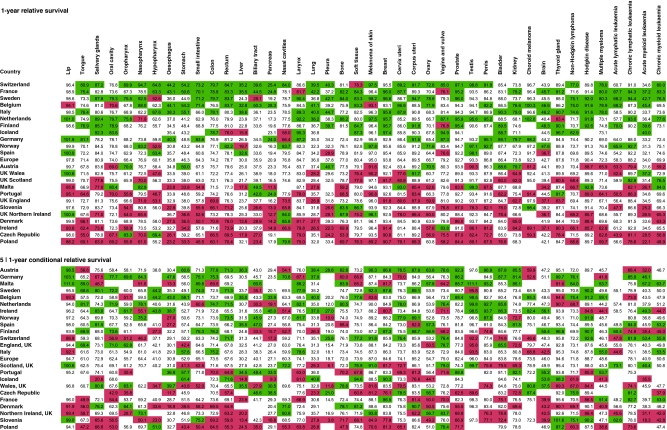
Background: This paper provides a one-page visual summary of the previously published relative survival estimates for 42 types of cancers in 23 countries in Europe.
Methods: The cancer patients in these analyses were 15 years or older at the time of their diagnosis in the period 1995-1999. Follow-up was to the end of 2003 and relative survival estimates were computed by the cohort method.
Results: The analysis of 1-year survival had good discriminatory power and visibly separated a group of countries with consistently high survival estimates (Switzerland, France, Sweden, Belgium and Italy) and another group of countries with lower estimates (Poland, Czech Republic, Ireland, Denmark and United Kingdom-Northern Ireland). After the first year, there was less variation between the countries.
Conclusion: To more fully understand the UK situation, a rational comparison would select countries with data-quality, prosperity and healthcare systems that are similar to the United Kingdom. In otherwise comparable populations, a pronounced difference in 1-year survival is most likely to be due to variation in a strong prognostic factor, which exerts its effect in the short term. A likely explanation for the short-term survival deficit in the United Kingdom compared with the Nordic countries is a less favourable stage distribution in the United Kingdom. However, the present superficial analysis does not exclude possible functions for other factors relating to the organisation and quality of cancer care services.
Figures
References
-
- Berrino F, De Angelis R, Sant M, Rosso S, Bielska-Lasota M, Coebergh JW, Santaquilani M, EUROCARE Working Group (2007) Survival for eight major cancers and all cancers combined for European adults diagnosed in 1995–1999: results of the EUROCARE-4 study. Lancet Oncol 8: 773–783 - PubMed
-
- Brenner H, Hakulinen T (2009) Up-to-date cancer survival: period analysis and beyond. Int J Cancer 124: 1384–1390 - PubMed
-
- Corazziari I, Quinn M, Capocaccia R (2004) Standard cancer patient population for age standardising survival ratios. Eur J Cancer 40: 2307–2316 - PubMed
MeSH terms
LinkOut - more resources
Full Text Sources
