


Associative learning during early adulthood enhances later memory retention in honeybees
- PMID: 19956575
- PMCID: PMC2779852
- DOI: 10.1371/journal.pone.0008046
Associative learning during early adulthood enhances later memory retention in honeybees
Abstract
Background: Cognitive experiences during the early stages of life play an important role in shaping the future behavior in mammals but also in insects, in which precocious learning can directly modify behaviors later in life depending on both the timing and the rearing environment. However, whether olfactory associative learning acquired early in the adult stage of insects affect memorizing of new learning events has not been studied yet.
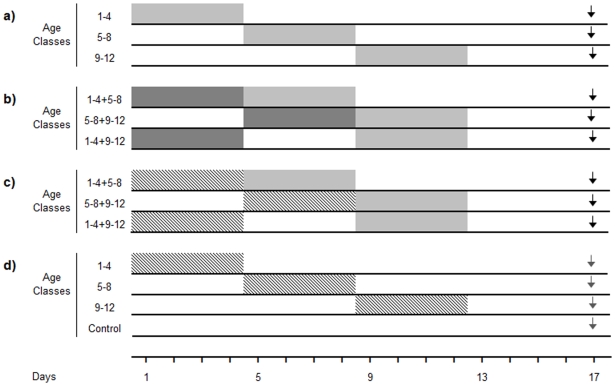
Methodology: Groups of adult honeybee workers that experienced an odor paired with a sucrose solution 5 to 8 days or 9 to 12 days after emergence were previously exposed to (i) a rewarded experience through the offering of scented food, or (ii) a non-rewarded experience with a pure volatile compound in the rearing environment.
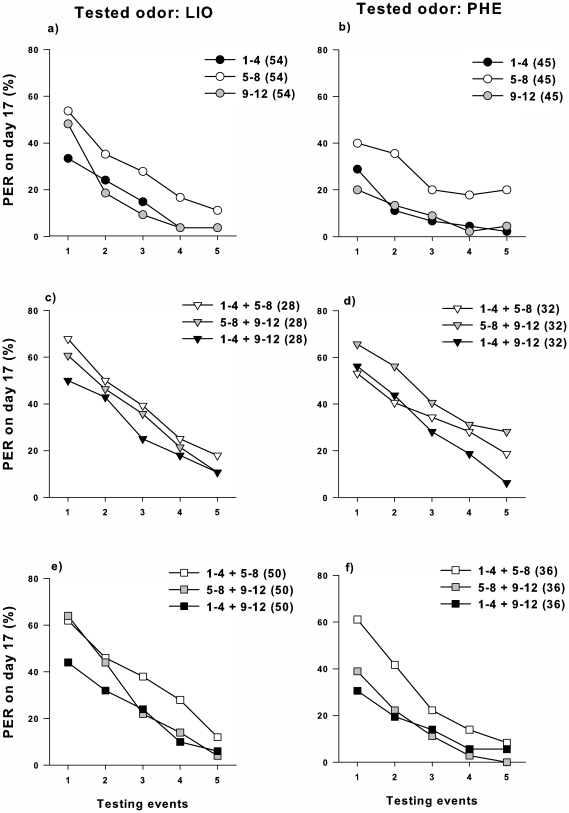
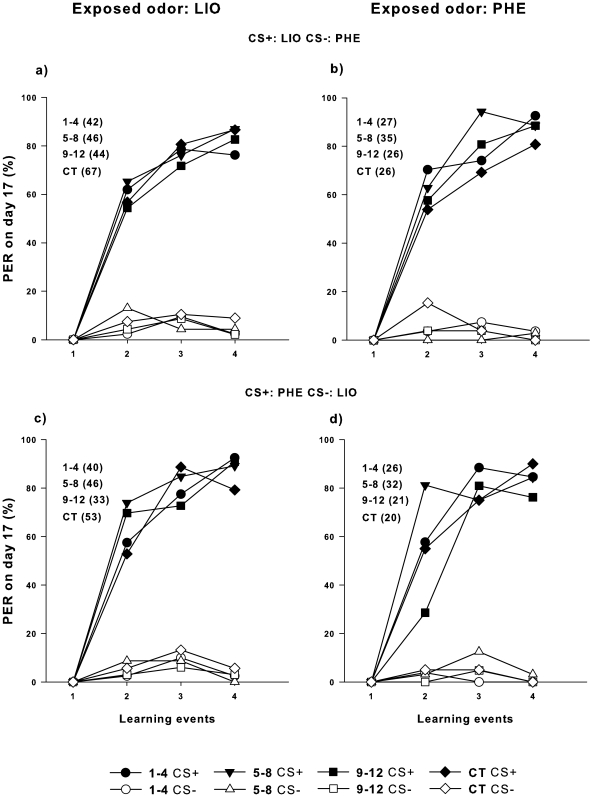
Principal findings: Early rewarded experiences (either at 1-4 or 5-8 days of adult age) enhanced retention performance in 9-12-day-conditioned bees when they were tested at 17 days of age. The highest retention levels at this age, which could not be improved with prior rewarded experiences, were found for memories established at 5-8 days of adult age. Associative memories acquired at 9-12 days of age showed a weak effect on retention for some pure pre-exposed volatile compounds; whereas the sole exposure of an odor at any younger age did not promote long-term effects on learning performance.
Conclusions: The associative learning events that occurred a few days after adult emergence improved memorizing in middle-aged bees. In addition, both the timing and the nature of early sensory inputs interact to enhance retention of new learning events acquired later in life, an important matter in the social life of honeybees.
Conflict of interest statement
Figures
References
-
- Lorenz K. Der Kumpan in der Umwelt des Vogels. Zeitschrift für Ornithologie. 1935;83:137–213, 289–413.
-
- Oitzl MS, Workel JO, Fluttert M, Frosch F, De Kloet ER. Maternal deprivation affects behaviour from youth to senescence: Amplification of individual differences in spatial learning and memory in senescent Brown Norway rats. Eur J Neurosci. 2000;12(10):3771–3780. - PubMed
-
- Iso H, Simoda S, Matsuyama T. Environmental change during postnatal development alters behaviour, cognitions and neurogenesis of mice. Behav Brain Res. 2007;179:90–98. (DOI 10.1016/j.bbr.2007.01.025) - PubMed
-
- Neal WR. The effect of environmental deprivation on speech and language development: Implications for child care workers. Child Care Quarterly. 1972;1:157–172.
-
- Bialystok E. Bilingualism in development: language, literacy, and cognition. 2001. Cambridge University Press.
Publication types
MeSH terms
Substances
LinkOut - more resources
Full Text Sources
Medical
