


Comparison of mantoux and tine tuberculin skin tests in BCG-vaccinated children investigated for tuberculosis
- PMID: 19956612
- PMCID: PMC2779491
- DOI: 10.1371/journal.pone.0008085
Comparison of mantoux and tine tuberculin skin tests in BCG-vaccinated children investigated for tuberculosis
Abstract
Background: Tuberculin skin tests (TSTs) are long-established screening methods for tuberculosis (TB). We aimed to compare agreement between the intradermal Mantoux and multipuncture percutaneous Tine methods and to quantify risk factors for a positive test result.
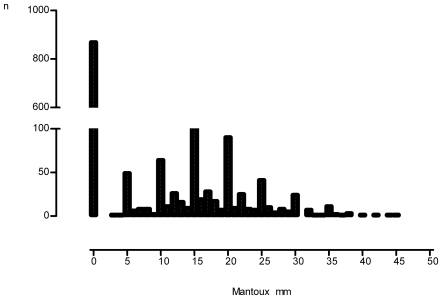
Methodology/principal findings: 1512 South African children younger than 5 years of age who were investigated for tuberculosis (TB) during a Bacille Calmette Guerin (BCG) trial were included in this analysis. Children underwent both Mantoux and Tine tests. A positive test was defined as Mantoux >or=15 mm or Tine >or= Grade 3 for the binary comparison. Agreement was evaluated using kappa (binary) and weighted kappa (hierarchical). Multivariate regression models identified independent risk factors for TST positivity. The Mantoux test was positive in 430 children (28.4%) and the Tine test in 496 children (32.8%, p<0.0001), with observed binary agreement 87.3% (kappa 0.70) and hierarchical agreement 85.0% (weighted kappa 0.66). Among 173 children culture-positive for Mycobacterium tuberculosis, Mantoux was positive in 49.1% and Tine in 54.9%, p<0.0001 (kappa 0.70). Evidence of digit preference was noted for Mantoux readings at 5 mm threshold intervals. After adjustment for confounders, a positive culture, suggestive chest radiograph, and proximity of TB contact were risk factors for a positive test using both TST methods. There were no independent associations between ethnicity, gender, age, or over-crowding, and TST result.
Conclusions/significance: The Tine test demonstrated a higher positive test rate than the Mantoux, with substantial agreement between TST methods among young BCG-vaccinated children. TB disease and exposure factors, but not demographic variables, were independent risk factors for a positive result using either test method. These findings suggest that the Tine might be a useful screening tool for childhood TB in resource-limited countries.
Conflict of interest statement
Figures
References
-
- Shingadia D, Novelli V. The tuberculin skin test: a hundred, not out? Arch Dis Child. 2008;93:189–190. - PubMed
-
- Rosenthal SR, Nikurs L, Yordy E, Hoder B, Thorne M. The tuberculin tine test compared to the Mantoux test with 5, 10, and 100 tuberculin units. Pediatrics. 1965;36:385–393. - PubMed
-
- Hesseling AC, Gie RP. Scoring systems for the diagnosis of childhood tuberculosis: are we making progress? Int J Tuberc Lung Dis. 2007;11:245. - PubMed
-
- Menzies D, Pai M, Comstock G. Meta-analysis: new tests for the diagnosis of latent tuberculosis infection: areas of uncertainty and recommendations for research. Ann Intern Med. 2007;146:340–354. - PubMed
-
- Mazurek GH, Villarino ME. Guidelines for using the QuantiFERON-TB test for diagnosing latent Mycobacterium tuberculosis infection. Centers for Disease Control and Prevention. MMWR Recomm Rep. 2003;52:15–18. - PubMed
Publication types
MeSH terms
Substances
LinkOut - more resources
Full Text Sources
Medical
