


Loss of PDZK1 causes coronary artery occlusion and myocardial infarction in Paigen diet-fed apolipoprotein E deficient mice
- PMID: 19956623
- PMCID: PMC2779610
- DOI: 10.1371/journal.pone.0008103
Loss of PDZK1 causes coronary artery occlusion and myocardial infarction in Paigen diet-fed apolipoprotein E deficient mice
Abstract
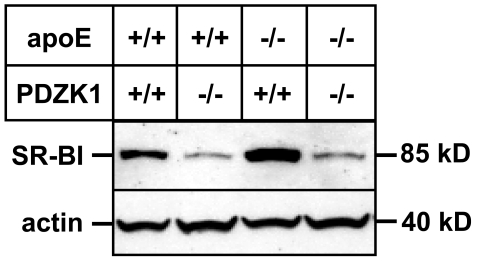
Background: PDZK1 is a four PDZ-domain containing protein that binds to the carboxy terminus of the HDL receptor, scavenger receptor class B type I (SR-BI), and regulates its expression, localization and function in a tissue-specific manner. PDZK1 knockout (KO) mice are characterized by a marked reduction of SR-BI protein expression ( approximately 95%) in the liver (lesser or no reduction in other organs) with a concomitant 1.7 fold increase in plasma cholesterol. PDZK1 has been shown to be atheroprotective using the high fat/high cholesterol ('Western') diet-fed murine apolipoprotein E (apoE) KO model of atherosclerosis, presumably because of its role in promoting reverse cholesterol transport via SR-BI.
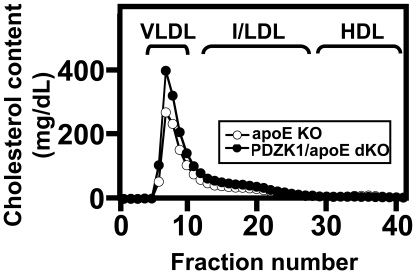
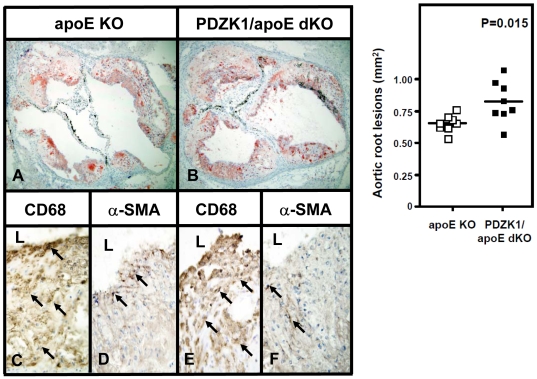
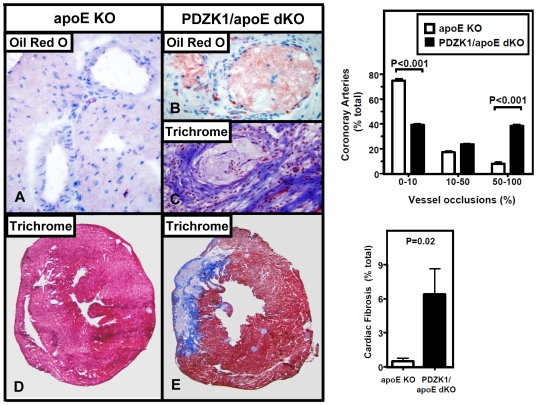
Principal findings: Here, we have examined the effects of PDZK1 deficiency in apoE KO mice fed with the atherogenic 'Paigen' diet for three months. Relative to apoE KO, PDZK1/apoE double KO (dKO) mice showed increased plasma lipids (33% increase in total cholesterol; 49 % increase in unesterified cholesterol; and 36% increase in phospholipids) and a 26% increase in aortic root lesions. Compared to apoE KO, dKO mice exhibited substantial occlusive coronary artery disease: 375% increase in severe occlusions. Myocardial infarctions, not observed in apoE KO mice (although occasional minimal fibrosis was noted), were seen in 7 of 8 dKO mice, resulting in 12 times greater area of fibrosis in dKO cardiac muscle.
Conclusions: These results show that Paigen-diet fed PDZK1/apoE dKO mice represent a new animal model useful for studying coronary heart disease and suggest that PDZK1 may represent a valuable target for therapeutic intervention.
Conflict of interest statement
Figures
References
-
- Kumar V, Abbas A, Fausto N. Elsevier and Saunders; 2005. Robbin's and Cotran pathologic basis of disease. pp. 516–525.
-
- Chase A, Jackson C, Angelini G, Suleiman M. Coronary artery disease progression is associated with increased resistance of hearts and myocytes to cardiac insults. Crit Care Med. 2007;35:2344–2351. - PubMed
-
- Zhang S, Reddick R, Piedrahita J, Maeda N. Spontaneous hypercholesterolemia and arterial lesions in mice lacking apolipoprotein E. Science. 1992;258:468–471. - PubMed
-
- Nakashima Y, Plump A, Raines E, Breslow J, Ross R. ApoE-deficient mice develop lesions of all phases of atherosclerosis throughout the arterial tree. Arterioscler Thromb. 1994;14:133–140. - PubMed
-
- Plump A, Smith J, Hayek T, Aalto-Setala K, Walsh A, et al. Severe hypercholesterolemia and atherosclerosis in apolipoprotein E-deficient mice created by homologous recombination in ES cells. Cell. 1992;71:343–353. - PubMed
Publication types
MeSH terms
Substances
Grants and funding
LinkOut - more resources
Full Text Sources
Other Literature Sources
Medical
Molecular Biology Databases
Research Materials
Miscellaneous
