


The extract of Ginkgo biloba EGb 761 reactivates a juvenile profile in the skeletal muscle of sarcopenic rats by transcriptional reprogramming
- PMID: 19956636
- PMCID: PMC2778626
- DOI: 10.1371/journal.pone.0007998
The extract of Ginkgo biloba EGb 761 reactivates a juvenile profile in the skeletal muscle of sarcopenic rats by transcriptional reprogramming
Abstract
Background: Sarcopenia is a major public health problem in industrialized nations, placing an increasing burden on public healthcare systems because the loss of skeletal muscle mass and strength that characterizes this affection increases the dependence and the risk of injury caused by sudden falls in elderly people. Albeit exercise and caloric restriction improve sarcopenia-associated decline of the muscular performances, a more suitable and focused pharmacological treatment is still lacking.
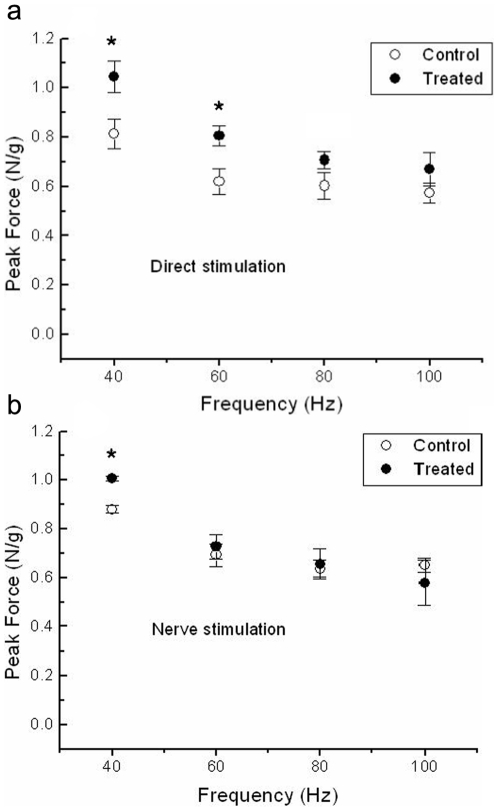
Methodology/principal findings: In order to evaluate such a possible treatment, we investigated the effects of EGb 761, a Ginkgo biloba extract used in chronic age-dependent neurological disorders, on the function of the soleus muscle in aged rats. EGb 761 induced a gain in muscular mass that was associated with an improvement of the muscular performances as assessed by biochemical and electrophysiological tests. DNA microarray analysis shows that these modifications are accompanied by the transcriptional reprogramming of genes related to myogenesis through the TGFbeta signaling pathway and to energy production via fatty acids and glucose oxidation. EGb 761 restored a more juvenile gene expression pattern by regenerating the aged muscle and reversing the age-related metabolic shift from lipids to glucose utilization.
Conclusions/significance: Thus, EGb 761 may represent a novel treatment for sarcopenia both more manageable and less cumbersome than exercise and caloric restriction.
Conflict of interest statement
Figures



 indicates up-regulation of gene expression by EGb 761.
  indicates down-regulation of gene expression by EGb 761. → = activation. --
 = inhibition. Activins and BMPs may be diverted into alternative pathways through interaction with soluble and membrane-bound binding proteins Activin, myostatin and BMPs signal via type II activin receptor. The access of these TGF-β2 superfamily members to their type II receptors is blocked by extracellular binding proteins (follistatine, Fstl1 and α2-macroglubulin) and membrane-bound pseudoreceptors (BAMBI for activin signaling).
 indicates up-regulation of gene expression by EGb 761.
  indicates down-regulation of gene expression by EGb 761. → = activation. ----
 = inhibition. FA (Free Fatty Acids) are taken up by the fatty acid transporter protein Cd36 and activated to fatty acyl-coenzyme A (FA-CoA). FA-CoA oxidation would increase the ratios of acetyl-CoA/CoA and of NADH/NAD+, which inhibit the pyruvate dehydogenase (PDH) complex by activating the pyruvate dehydrogenase kinase 4 (Pdk4). Increase FA oxidation products as citrate should further inhibit phosphofructokinase (Pfk) and hexokinase. These changes would slow down oxidation of glucose and pyruvate and glycogen stock is maintained. In the same time, fatty acid synthase (Fasn) and mitochondrial 3-oxoacyl-Coenzyme A thiolase (Acaa2) are inhibited resulting in the lipid synthesis inhibition and a preferential use of these lipids for ATP synthesis.
References
-
- Rosenberg IH. Summary comments. Am J Clin Nutr. 1989;50:1231–1233.
-
- Navarro A, Lopez-Cepero JM, Sanchez del Pino MJ. Skeletal muscle and aging. Front Biosci. 2001;6:D26–44. - PubMed
-
- Hepple RT. Sarcopenia–A Critical Perspective. Sci Aging Knowledge Environ. 2003;46:pe31. - PubMed
-
- Marzetti E, Lawler JM, Hiona A, Manini T, Seo AY, et al. Modulation of age-induced apoptotic signaling and cellular remodeling by exercise and calorie restriction in skeletal muscle. Free Rad Biol Med. 2008;44:160–168. - PubMed
-
- Lynch GS. Emerging drugs for sarcopenia: age-related muscle wasting. Expert Opin Emerg Drugs. 2004;9:345–361. - PubMed
Publication types
MeSH terms
Substances
LinkOut - more resources
Full Text Sources
