


Fibroblast Growth Factor 23 (FGF23) and Disorders of Phosphate Metabolism
- PMID: 19956747
- PMCID: PMC2775677
- DOI: 10.1155/2009/496514
Fibroblast Growth Factor 23 (FGF23) and Disorders of Phosphate Metabolism
Abstract
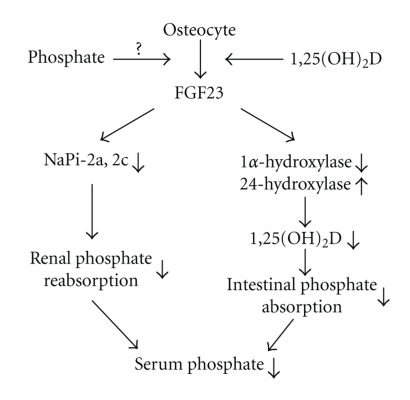
Derangements in serum phosphate level result in rickets/osteomalacia or ectopic calcification indicating that healthy people without these abnormalities maintain serum phosphate within certain ranges. These results indicate that there must be a regulatory mechanism of serum phosphate level. Fibroblast growth factor 23 (FGF23) was identified as the last member of FGF family. FGF23 is produced by bone and reduces serum phosphate level by suppressing phosphate reabsorption in proximal tubules and intestinal phosphate absorption through lowering 1,25-dihydroxyvitamin D level. It has been shown that excess and deficient actions of FGF23 result in hypophosphatemic rickets/osteomalacia and hyperphosphatemic tumoral calcinosis, respectively. These results indicate that FGF23 works as a hormone, and several disorders of phosphate metabolism can be viewed as endocrine diseases. It may become possible to treat patients with abnormal phosphate metabolism by pharmacologically modifying the activity of FGF23.
Figures
References
-
- Yamashita T, Yoshioka M, Itoh N. Identification of a novel fibroblast growth factor, FGF-23, preferentially expressed in the ventrolateral thalamic nucleus of the brain. Biochemical and Biophysical Research Communications. 2000;277(2):494–498. - PubMed
-
- Itoh N, Ornitz DM. Evolution of the FGF and FGFr gene families. Trends in Genetics. 2004;20(11):563–569. - PubMed
LinkOut - more resources
Full Text Sources
Other Literature Sources
Medical
