


Effects of distant metastasis and peripheral CA 15-3 on the induction of spontaneous T cell responses in breast cancer patients
- PMID: 19957084
- PMCID: PMC11030215
- DOI: 10.1007/s00262-009-0801-9
Effects of distant metastasis and peripheral CA 15-3 on the induction of spontaneous T cell responses in breast cancer patients
Abstract
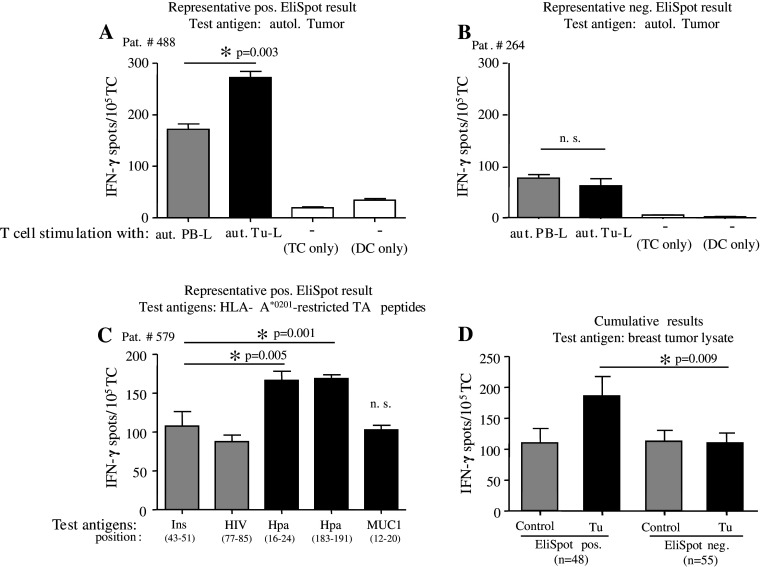
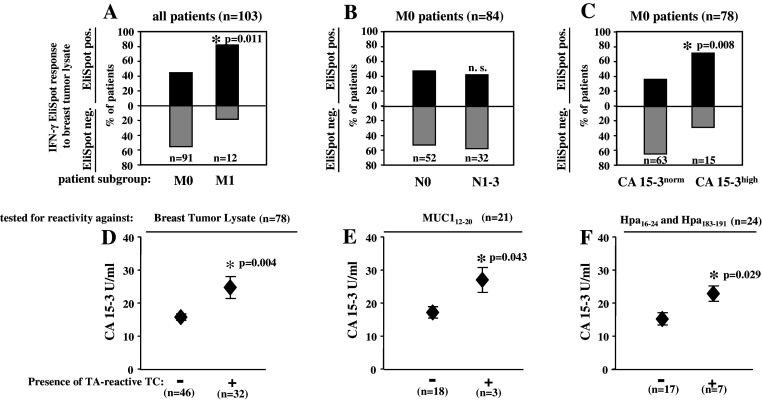
Tumor-specific memory T cells are detectable in the bone marrow (BM) of a majority of breast cancer patients. In vitro they can be reactivated to IFN-gamma producing, cytotoxic effector cells and reject autologous, xenotransplanted tumors in NOD/SCID mice after specific restimulation with autologous dendritic cells (DC). In this study, we demonstrate the presence of specific tumor-reactive BM memory T cells in altogether 56 out of 129 primarily operated breast cancer patients by short-term IFN-gamma EliSpot assays with unstimulated T cells and tumor antigen presenting, autologous DCs. We observed tumor-reactive BM memory T cells predominantly in patients with primarily metastatic disease (P = 0.011) or with increased concentrations of tumor marker CA 15-3 in the peripheral blood (P = 0.004), respectively. Memory T cell reactivity against HLA-A(*0201)-restricted peptides from the tumor-associated antigens MUC1, Hpa(16-24) and Hpa(183-191) was also detected particularly in patients with elevated peripheral CA 15-3 concentrations (P < 0.05). Altogether these data indicate that the systemic presence of tumor-derived antigens promotes an induction of tumor-specific cellular immune responses in the human BM.
Figures
References
-
- Bablok W, Passing H, Bender R, Schneider B. A general regression procedure for method transformation. Application of linear regression procedures for method comparison studies in clinical chemistry, part III. J Clin Chem Clin Biochem. 1988;26:783–790. - PubMed
-
- Beckhove P, Feuerer M, Dolenc M, Schuetz F, Choi C, Sommerfeldt N, Schwendemann J, Ehlert K, Altevogt P, Bastert G, Schirrmacher V, Umansky V. Specifically activated memory T cell subsets from cancer patients recognize and reject xenotransplanted autologous tumors. J Clin Invest. 2004;114:67–76. - PMC - PubMed
-
- Braun S, Pantel K, Müller P, Janni W, Hepp F, Kentenich CR, Gastroph S, Wischnik A, Dimpfl T, Kindermann G, Riethmüller G, Schlimok G. Cytokeratin-positive cells in the bone marrow and survival of patients with stage I, II, or III breast cancer. N Engl J Med. 2000;342:525–533. doi: 10.1056/NEJM200002243420801. - DOI - PubMed
-
- Brossart P, Heinrich KS, Stuhler G, Behnke L, Reichardt VL, Stevanovic S, Muhm A, Rammensee HG, Kanz L, Brugger W. Identification of HLA-A2-restricted T-cell epitopes derived from the MUC1 tumor antigen for broadly applicable vaccine therapies. Blood. 1999;93:4309–4317. - PubMed
MeSH terms
Substances
LinkOut - more resources
Full Text Sources
Medical
Research Materials
Miscellaneous
