


Serum antibodies against frameshift peptides in microsatellite unstable colorectal cancer patients with Lynch syndrome
- PMID: 19957108
- PMCID: PMC4198384
- DOI: 10.1007/s10689-009-9307-z
Serum antibodies against frameshift peptides in microsatellite unstable colorectal cancer patients with Lynch syndrome
Abstract
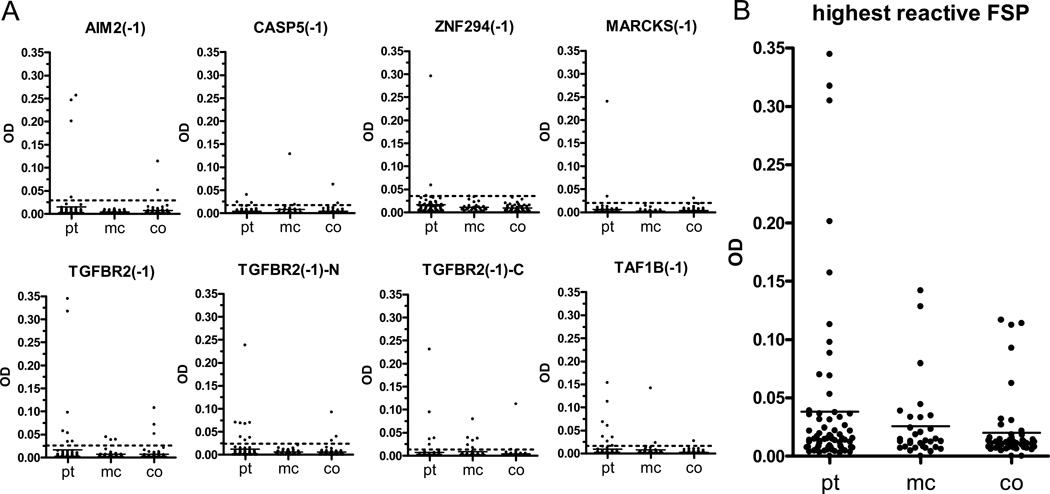
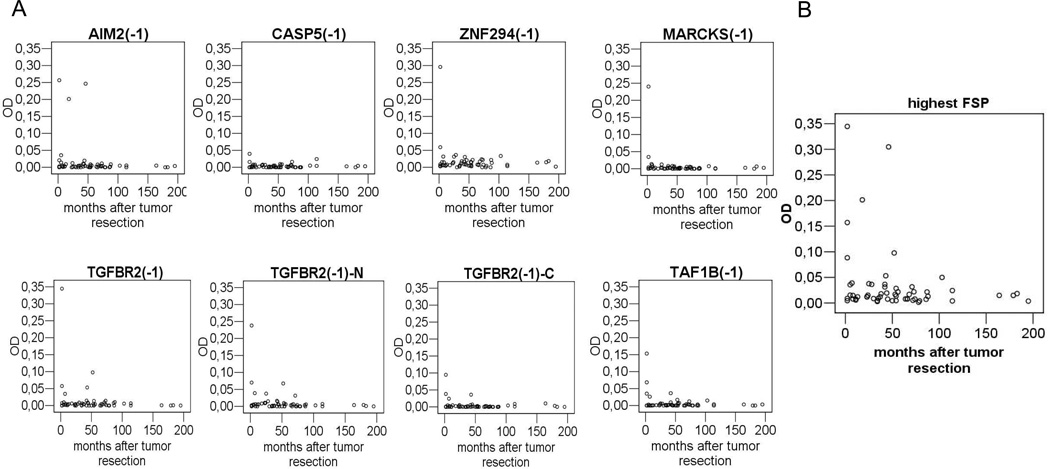
High level microsatellite instability (MSI-H) occurs in about 15% of colorectal cancer (CRCs), either as sporadic cancers or in the context of hereditary non-polyposis cancer or Lynch syndrome. In MSI-H CRC, mismatch repair deficiency leads to insertion/deletion mutations at coding microsatellites and thus to the translation of frameshift peptides (FSPs). FSPs are potent inductors of T cell responses in vitro and in vivo. The present study aims at the identification of FSP-specific humoral immune responses in MSI-H CRC and Lynch syndrome. Sera from patients with history of MSI-H CRC (n = 69), healthy Lynch syndrome mutation carriers (n = 31) and healthy controls (n = 52) were analyzed for antibodies against FSPs using peptide ELISA. Reactivities were measured against FSPs derived from genes frequently mutated in MSI-H CRCs, AIM2, TGFBR2, CASP5, TAF1B, ZNF294, and MARCKS. Antibody reactivity against FSPs was significantly higher in MSI-H CRC patients than in healthy controls (P = 0.036, Mann-Whitney) and highest in patients with shortest interval between tumor resection and serum sampling. Humoral immune responses in patients were most frequently directed against FSPs derived from mutated TAF1B (11.6%, 8/69) and TGFBR2 (10.1%, 7/69). Low level FSP-specific antibodies were also detected in healthy mutation carriers. Our results show that antibody responses against FSPs are detectable in MSI-H CRC patients and healthy Lynch syndrome mutation carriers. Based on the high number of defined FSP antigens, measuring FSP-specific humoral immune responses is a highly promising tool for future diagnostic application in MSI-H cancer patients.
Figures
References
-
- Ionov Y, Peinado MA, Malkhosyan S, et al. Ubiquitous somatic mutations in simple repeated sequences reveal a new mechanism for colonic carcinogenesis. Nature. 1993;363:558–561. - PubMed
-
- Thibodeau SN, Bren G, Schaid D. Microsatellite instability in cancer of the proximal colon. Science. 1993;260:816–819. - PubMed
-
- Lynch HT, de la Chapelle A. Hereditary colorectal cancer. N Engl J Med. 2003;348:919–932. - PubMed
Publication types
MeSH terms
Substances
Grants and funding
LinkOut - more resources
Full Text Sources
Other Literature Sources
Medical
Miscellaneous
