. 2010 Apr 20;26(8):5364-73.
doi: 10.1021/la9037843.

Aliphatic hyperbranched polyester: a new building block in the construction of multifunctional nanoparticles and nanocomposites

Affiliations

Aliphatic hyperbranched polyester: a new building block in the construction of multifunctional nanoparticles and nanocomposites

Santimukul Santra et al. Langmuir. .

Abstract

Herein we report the design and synthesis of multifunctional hyperbranched polyester-based nanoparticles and nanocomposites with properties ranging from magnetic, fluorescence, antioxidant and X-ray contrast. The fabrication of these nanostructures was achieved using a novel aliphatic and biodegradable hyperbranched polyester (HBPE) synthesized from readily available diethyl malonate. The polymer's globular structure with functional surface carboxylic groups and hydrophobic cavities residing in the polymer's interior allows for the formation of multifunctional polymeric nanoparticles, which are able to encapsulate a diversity of hydrophobic cargos. Via simple surface chemistry modifications, the surface carboxylic acid groups were modified to yield nanoparticles with a variety of surface functionalizations, such as amino, azide and propargyl groups, which mediated the conjugation of small molecules. This capability achieved the engineering of the HBPE nanoparticle surface for specific cell internalization studies and the formation of nanoparticle assemblies for the creation of novel nanocomposites that retained, and in some cases enhanced, the properties of the parental nanoparticle building blocks. Considering these results, the HBPE polymer, nanoparticles and composites should be ideal for biomedical, pharmaceutical, nanophotonics applications.


Figures
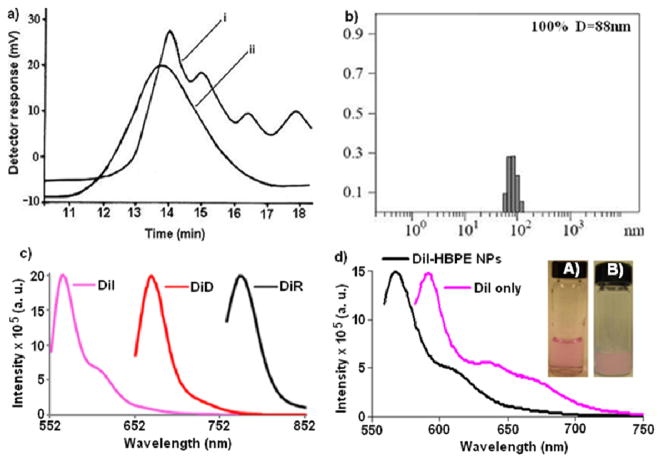
Figure 1
Figure 1
Characterization of HBPE 5 and HBPE nanoparticles 9. a) GPC traces of HBPE 5, showing the formation of (i) oligomers and low-molecular weight polymers before applying vacuum and (ii) high molecular weight polymer after applying vacuum. b) Determination of the hydrodynamic diameter of HBPE nanoparticles 9 using DLS, showing an average diameter of 88 nm. c) Fluorescence emission spectra of different dye (DiI, DiD and DiR)-encapsulated HBPE nanoparticles (9) in PBS buffer. d) Comparing the fluorescence emission spectrum of DiI-HBPE NPs (9) with that of free DiI dye in solution, inset: images showing A) DiI dye alone in DMF solution and B) DiI encapsulating HBPE nanoparticles (9) in PBS.
Figure 2
Figure 2
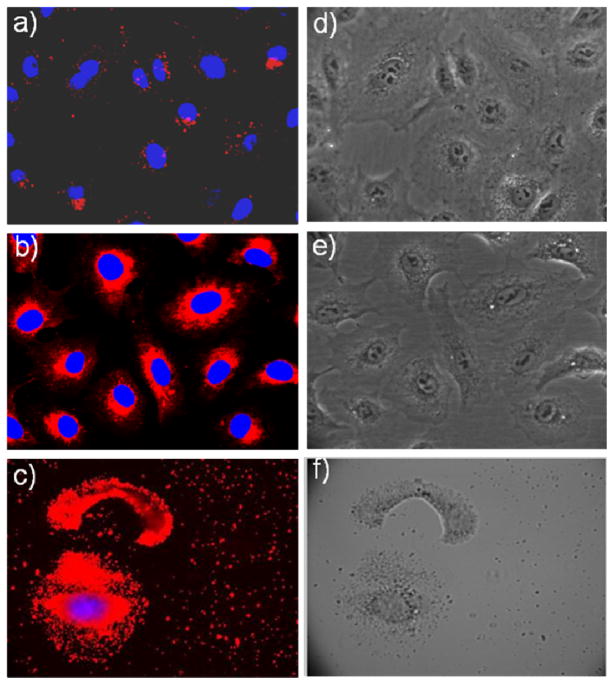
Assessment of DiI-encapsulating HBPE nanoparticles’ cellular uptake via confocal laser-scanning microscopy. a) No internalization was observed in cells incubated with carboxylated HBPE nanoparticles (9), b) enhanced internalization was observed with folate-clicked HBPE nanoparticles (13). Cells incubated with c) Taxol-encapsulating folate HBPE nanoparticles (13) induced Taxol-mediated mitotic arrest, leading to cell death, d–f) corresponding bright field confocal images of the A549 cells treated with corresponding functional HBPE nanoparticles. Nuclei stained with DAPI (blue). These observations confirmed the targeting capability and receptor mediated internalization of our theranostic HBPE nanoparticles.
Figure 3
Figure 3
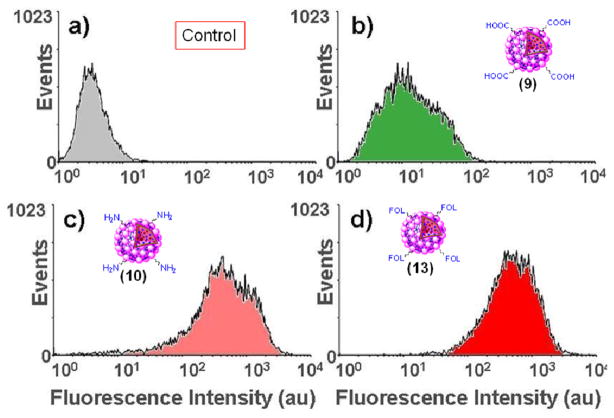
Assessment of HBPE nanoparticle’s cell association via flow cytometry (FACS). a) Absence of fluorescence emission was observed in control non-treated A549 cells (1× PBS), whereas b) partial association was observed for carboxylated HBPE nanoparticles (9). c) Aminated (10) and d) folate-clicked (13) nanoparticles interacted more profoundly with the cells, as indicated by higher levels of fluorescence emission.
Figure 4
Figure 4
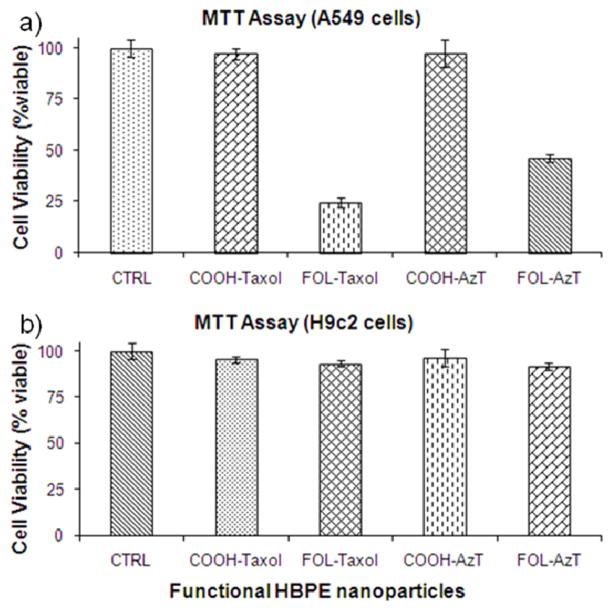
Determination of the theranostic HBPE nanoparticles’ toxicity through the MTT assay. a) The folate-decorated Taxol-and AzT-encapsulating HBPE nanoparticles induced a significant reduction in cell (A549) viability. b) Determination of the specificity of the theranostic HBPE nanoparticles’ toxicity using H9c2 cells. Results indicated no toxicity of the HBPE nanoparticles in H9c2 cells, does not over-express folate receptor. Control cells were treated with 1× PBS. Average values of four measurements are depicted ± standard error.
Figure 5
Figure 5
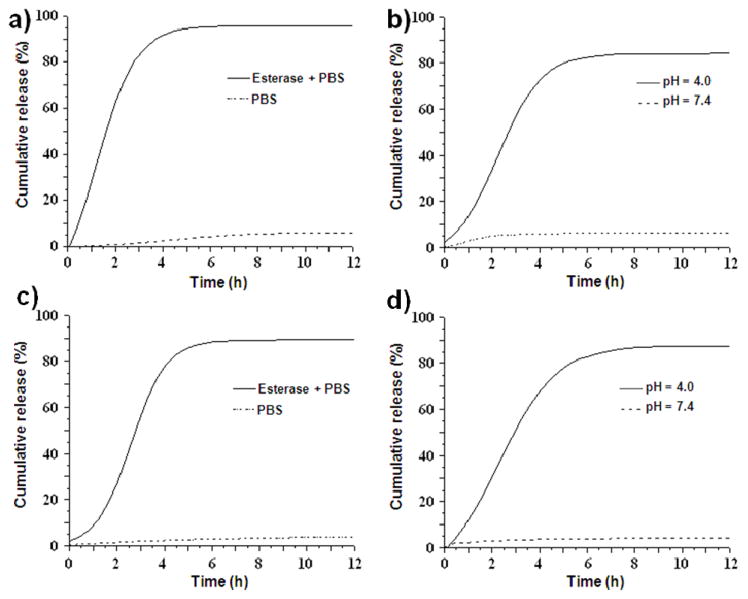
Drug and dye release profiles of Taxol and DiI co-encapsulating HBPE nanoparticles (13) in PBS (pH = 7.4) at 37 °C. Release of Taxol (a & b) and DiI (c & d) were observed in the presence of an esterase enzyme (a & c) and at pH 4.0 (b & d).
Figure 6
Figure 6
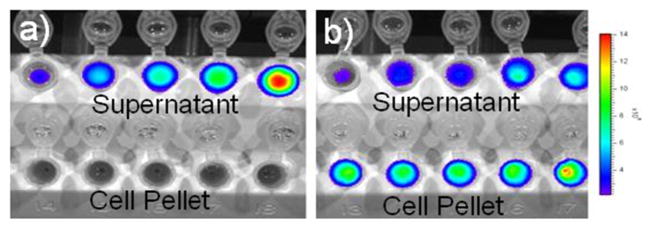
Fluorescence images of the cellular uptake of DiR-encapsulating a) carboxylated (9) and b) folate-derivatized (13) HBPE nanoparticles taken from a Xenogen IVIS system.
Figure 7
Figure 7
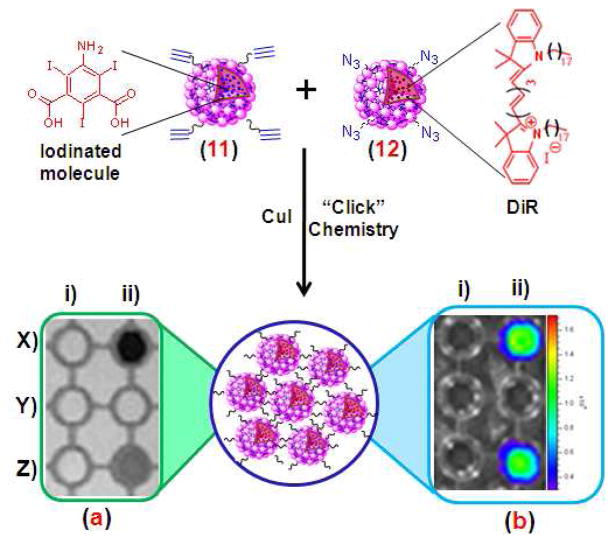
Schematic representation of the “click” chemistry mediated water-based syntheses of an X-ray blocking (a) and highly fluorescent (b) polymeric nanocomposite (NCs) encapsulating a tri-iodinated molecule and DiR, respectively. Nanocomposites without iodinated molecule (a: X-i and Z-i) and DiR (b: X-i and Z-i) showed no X-ray blocking and fluorescence properties, respectively. Y-I and Y-ii contained PBS.
Figure 8
Figure 8
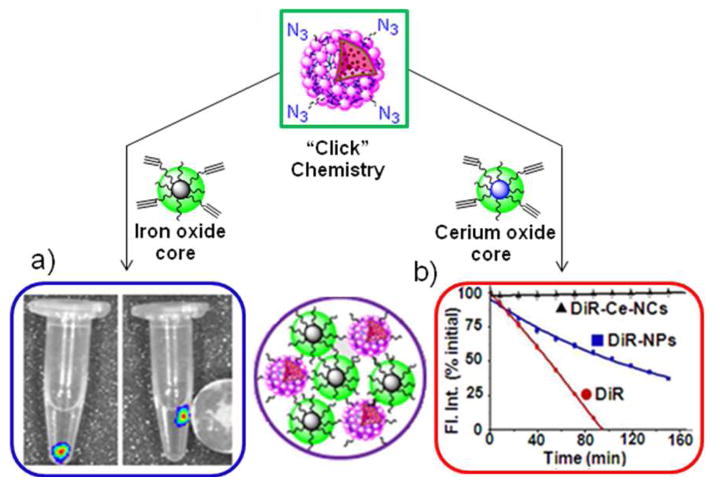
Schematic representation of the syntheses of a magnetic and fluorescent (a) and free radical scavenging (b) polymeric-metallic nanocomposite (NCs) containing iron oxide and cerium oxide nanoparticles, respectively, using “click” chemistry.
Figure 9
Figure 9
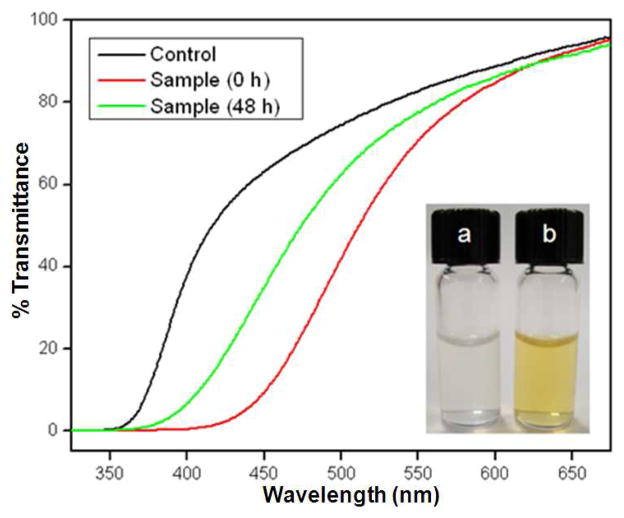
Autocatalytic activity of nanocomposite containing cerium oxide nanoparticles. Upon addition of hydrogen peroxide, a rapid color change from clear (a) to yellow (b) was observed, corresponding to a concomitant red shift in the UV/Vis transmittance spectrum. Gradually, as the system regenerated a shift in the transmittance curve towards its original control value was seen.
Scheme 1
Scheme 1
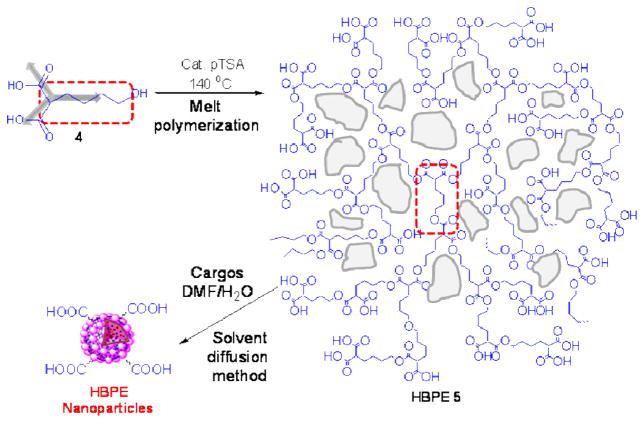
Schematic representation of the three dimensional structure of the aliphatic hyperbranched polymer (HBPE 5) and its HBPE nanoparticles. The monomer 4 has three-bond connectivity (the arrows) to grow three-dimensionally under polymerization conditions, resulting in a highly branched polymer with hydrophobic cavities in the polymeric structure.
Scheme 2
Scheme 2
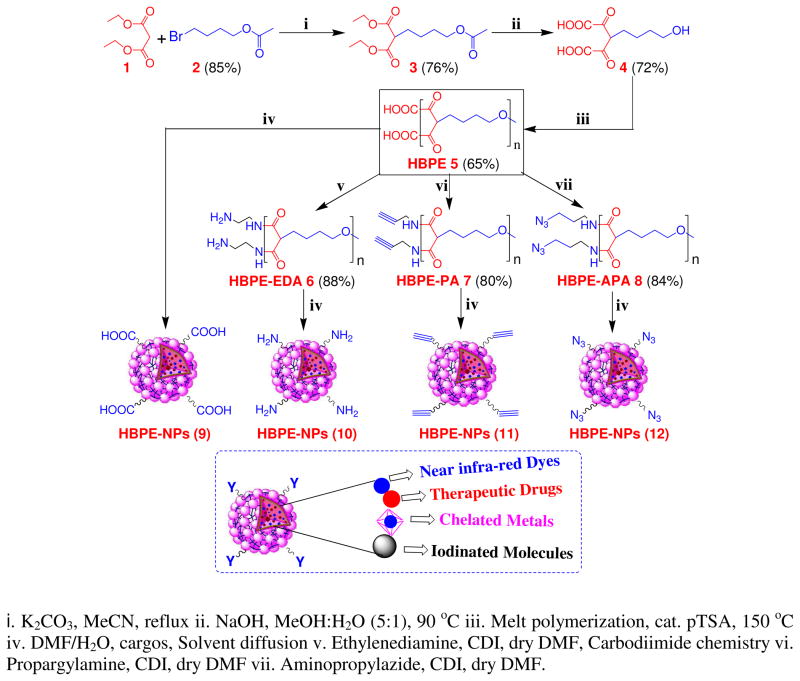
Schematic representation of the syntheses of functional hyperbranched polyesters (5–8) and HBPE nanoparticles (HBPE-NPs 9–12) using the melt polymerization technique and the solvent diffusion method, respectively. “Click” and carbodiimide chemistry has been used for the syntheses of the library of functional HBPE nanoparticles.

References

    1. Nayak S, Lee H, Chmielewski J, Lyon LA. J Am Chem Soc. 2004;126:10258–10259. - PubMed
    1. Kim CK, Ghosh P, Pagliuca C, Zhu ZJ, Menichetti S, Rotello VM. J Am Chem Soc. 2009;131:1360–1361. - PMC - PubMed
    1. You CC, Miranda OR, Gider B, Ghosh PS, Kim IB, Erdogan B, Krovi SA, Bunz UH, Rotello VM. Nat Nanotechnol. 2007;2:318–323. - PubMed
    1. Marder SR, Kippelen B, Jen AKY, Peyghambarian N. Nature. 1997;388:845–851.
    1. Peer D, Karp JM, Hong S, Farokhzad OC, Margalit R, Langer R. Nat Nanotechnol. 2007;2:751–760. - PubMed

Publication types