


An exploration of cognitive subgroups in Alzheimer's disease
- PMID: 19958568
- PMCID: PMC2903844
- DOI: 10.1017/S1355617709991160
An exploration of cognitive subgroups in Alzheimer's disease
Abstract
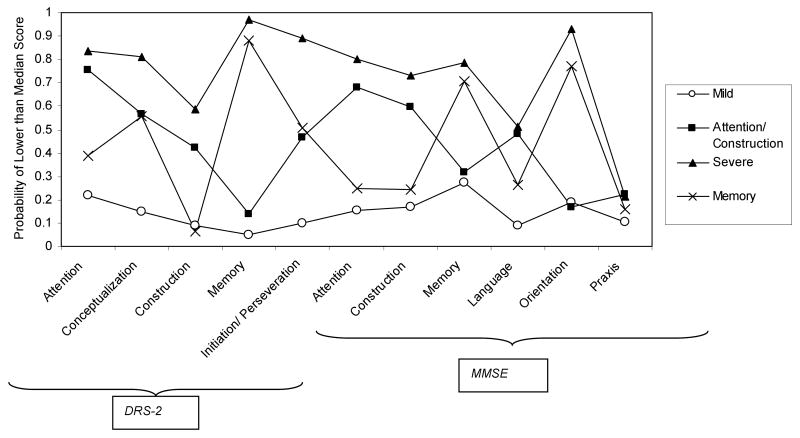
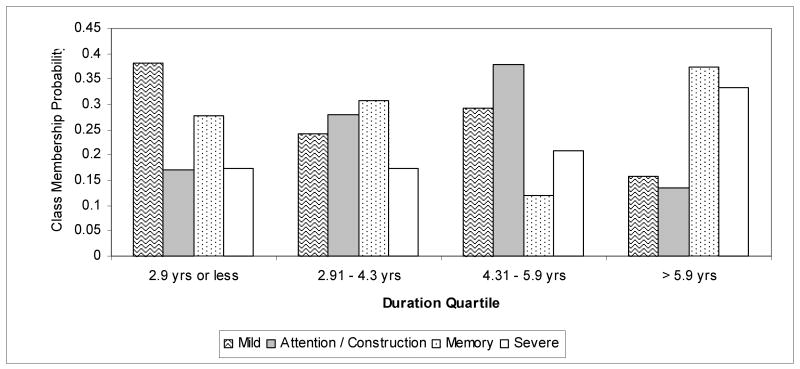
Heterogeneity is observed in the patterns of cognition in Alzheimer's disease (AD). Such heterogeneity might suggest the involvement of different etiological pathways or different host responses to pathology. A total of 627 subjects with mild/moderate AD underwent cognitive assessment with the Mini-Mental State Examination (MMSE) and the Dementia Rating Scale-2 (DRS-2). Latent class analysis (LCA) was performed on cognition subscale data to identify and characterize cognitive subgroups. Clinical, demographic, and genetic factors were explored for association with class membership. LCA suggested the existence of four subgroups; one group with mild and another with severe global impairment across the cognitive domains, one group with primary impairments in attention and construction, and another group with primary deficits in memory and orientation. Education, disease duration, age, Apolipoprotein E-epsilon4 (APOE epsilon4) status, gender, presence of grasp reflex, white matter changes, and early or prominent visuospatial impairment were all associated with class membership. Our results support the existence of heterogeneity in patterns of cognitive impairment in AD. Our observation of classes characterized by predominant deficits in attention/construction and memory respectively deserves further exploration as does the association between membership in the attention/construction class and APOE epsilon4 negative status.
Figures
References
-
- Alladi S, Xuereb J, Bak T, Nestor P, Knibb J, Patterson K, et al. Focal cortical presentations of Alzheimer's disease. Brain. 2007;130:2636–2645. - PubMed
-
- American Psychiatric Association. Diagnostic and statistical manual of mental disorders. 4th. Washington, DC: 1994.
-
- Bondi MW, Salmon DP, Monsch AU, Galasko D, Butters N, Klauber MR, et al. Episodic memory changes are associated with the APOE-epsilon 4 allele in nondemented older adults. Neurology. 1995;45:2203–2206. - PubMed
-
- Braak H, Braak E, Authors FN, Braak E. Neuropathological stageing of Alzheimer-related changes. Acta Neuropathologica. 1991;82:239–259. [Review] [63 refs] - PubMed
-
- Bretsky P, Guralnik JM, Launer L, Albert M, Seeman TE, MacArthur Studies of Successful Aging et al. The role of APOE-epsilon4 in longitudinal cognitive decline: MacArthur Studies of Successful Aging. Neurology. 2003;60:1077–1081. - PubMed
Publication types
MeSH terms
Substances
Grants and funding
LinkOut - more resources
Full Text Sources
Medical
Research Materials
Miscellaneous
