


Obstructive sleep apnea as a risk factor for type 2 diabetes
- PMID: 19958890
- PMCID: PMC2799991
- DOI: 10.1016/j.amjmed.2009.04.026
Obstructive sleep apnea as a risk factor for type 2 diabetes
Abstract
Purpose: Cross-sectional studies have documented the co-occurrence of obstructive sleep apnea (hereafter, sleep apnea) with glucose intolerance, insulin resistance, and type 2 diabetes mellitus (hereafter, diabetes). It has not been determined, however, whether sleep apnea is independently associated with the subsequent development of diabetes, accounting for established risk factors.
Methods: This observational cohort study examined 1233 consecutive patients in the Veteran Affairs Connecticut Healthcare System referred for evaluation of sleep-disordered breathing; 544 study participants were free of preexisting diabetes and completed a full, attended, diagnostic polysomnogram. The study population was divided into quartiles based on severity of sleep apnea as measured by the apnea-hypopnea index. The main outcome was incident diabetes defined as fasting glucose level >126 mg/dL and a corresponding physician diagnosis. Compliance with positive airway pressure therapy, and its impact on the main outcome, also was examined.
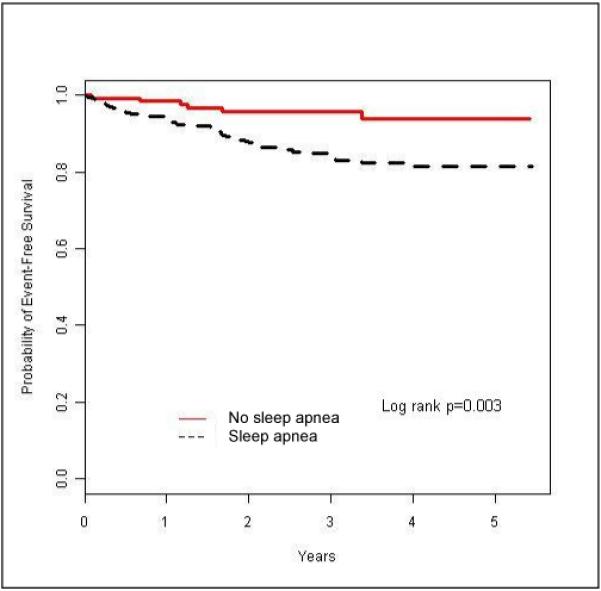
Results: In unadjusted analysis, increasing severity of sleep apnea was associated with an increased risk of diabetes (P for linear trend <.001). After adjusting for age, sex, race, baseline fasting blood glucose, body mass index, and weight change, an independent association was found between sleep apnea and incident diabetes (hazard ratio per quartile 1.43; confidence interval 1.10-1.86). Among patients with more severe sleep apnea (upper 2 quartiles of severity), 60% had evidence of regular positive airway pressure use, and this treatment was associated with an attenuation of the risk of diabetes (log-rank test P=.04).
Conclusion: Sleep apnea increases the risk of developing diabetes, independent of other risk factors. Among patients with more severe sleep apnea, regular positive airway pressure use may attenuate this risk.
Figures

References
-
- Diagnosis and classification of diabetes mellitus. Diabetes Care. 2005 Jan;28(Suppl 1):S37–42. - PubMed
-
- Young T, Palta M, Dempsey J, Skatrud J, Weber S, Badr S. The occurrence of sleep-disordered breathing among middle-aged adults. N Engl J Med. 1993 Apr 29;328(17):1230–1235. - PubMed
-
- Drager LF, Bortolotto LA, Figueiredo AC, Krieger EM, Lorenzi GF. Effects of continuous positive airway pressure on early signs of atherosclerosis in obstructive sleep apnea. Am J Respir Crit Care Med. 2007 Oct 1;176(7):706–712. - PubMed
-
- Marin JM, Carrizo SJ, Vicente E, Agusti AG. Long-term cardiovascular outcomes in men with obstructive sleep apnoea-hypopnoea with or without treatment with continuous positive airway pressure: an observational study. Lancet. 2005 Mar 19–25;365(9464):1046–1053. - PubMed
-
- Peppard P, Young T, Palta M, Skatrud JB. Prospective study of the association between sleep-disordered breathing and hypertension. NEJM. 2000;342(19):1378–1384. - PubMed
Publication types
MeSH terms
Grants and funding
LinkOut - more resources
Full Text Sources
Other Literature Sources
Medical
