


Loss of laterality in chronic cocaine users: an fMRI investigation of sensorimotor control
- PMID: 19959345
- PMCID: PMC2794910
- DOI: 10.1016/j.pscychresns.2009.07.009
Loss of laterality in chronic cocaine users: an fMRI investigation of sensorimotor control
Abstract
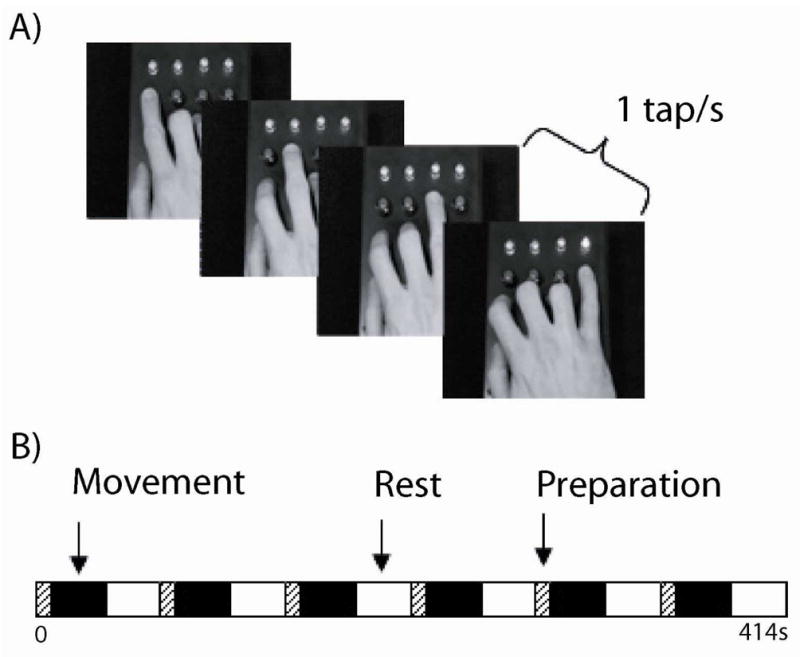
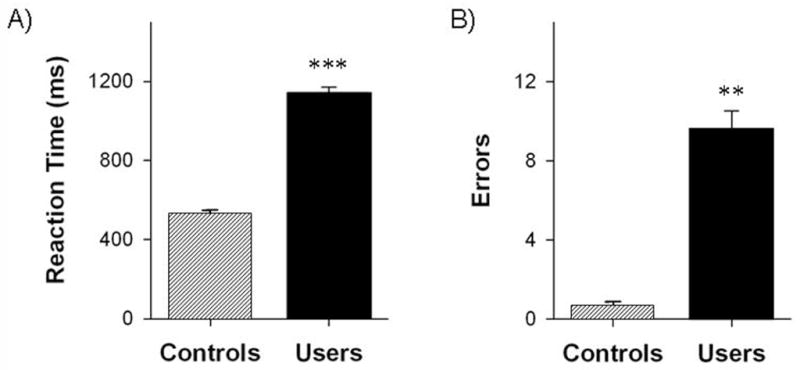
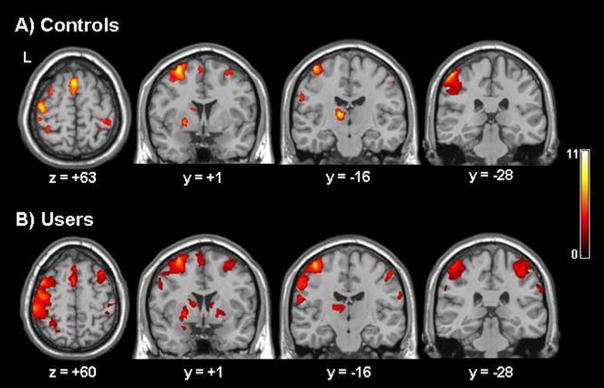
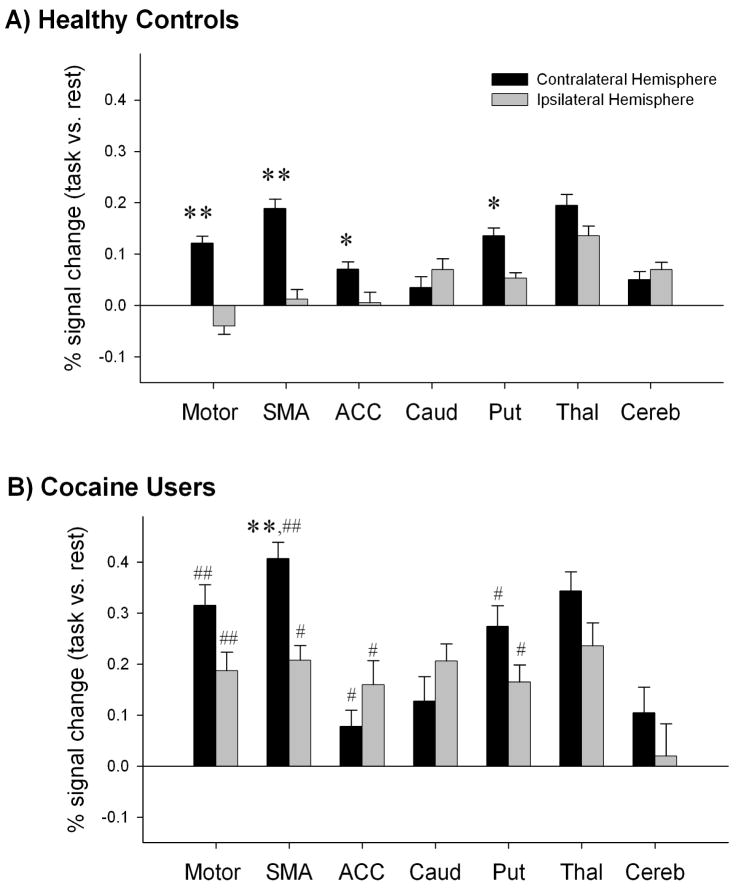
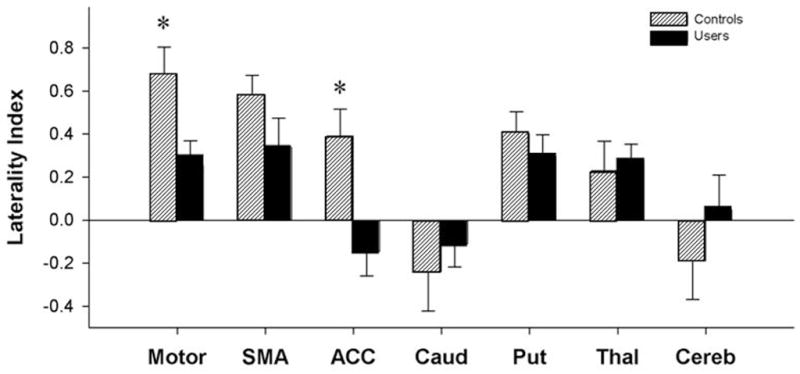
Movement disturbances are often overlooked consequences of chronic cocaine abuse. The purpose of this study was to systematically investigate sensorimotor performance in chronic cocaine users and characterize changes in brain activity among movement-related regions of interest (ROIs) in these users. Functional magnetic resonance imaging data were collected from 14 chronic cocaine users and 15 age- and gender-matched controls. All participants performed a sequential finger-tapping task with their dominant, right hand interleaved with blocks of rest. For each participant, percent signal change from rest was calculated for seven movement-related ROIs in both the left and right hemisphere. Cocaine users had significantly longer reaction times and higher error rates than controls. Whereas the controls used a left-sided network of motor-related brain areas to perform the task, cocaine users activated a less lateralized pattern of brain activity. Users had significantly more activity in the ipsilateral (right) motor and premotor cortical areas, anterior cingulate cortex and the putamen than controls. These data demonstrate that, in addition to the cognitive and affective consequences of chronic cocaine abuse, there are also pronounced alterations in sensorimotor control in these individuals, which are associated with functional alterations throughout movement-related neural networks.
Conflict of interest statement
The authors have no conflicts of interest to declare.
Figures
References
-
- Ashburner J, Friston KJ. Unified segmentation. Neuroimage. 2005;26:839–851. - PubMed
-
- Babiloni C, Carducci F, Del Gratta C, Demartin M, Romani GL, Babiloni F, Rossini PM. Hemispherical asymmetry in human SMA during voluntary simple unilateral movements. An fMRI study. Cortex. 2003;39:293–305. - PubMed
-
- Bauer LO. Resting hand tremor in abstinent cocaine-dependent, alcohol-dependent, and polydrug-dependent patients. Alcohol Clin Exp Res. 1996;20:1196–1201. - PubMed
-
- Boecker H, Kleinschmidt A, Requardt M, Hanicke W, Merboldt KD, Frahm J. Functional cooperativity of human cortical motor areas during self-paced simple finger movements. A high-resolution MRI study. Brain. 1994;117 (Pt 6):1231–1239. - PubMed
Publication types
MeSH terms
Substances
Grants and funding
LinkOut - more resources
Full Text Sources
Medical
