


Smoking outcome expectancies mediate the association between sensation seeking, peer smoking, and smoking among young adolescents
- PMID: 19959571
- PMCID: PMC2802571
- DOI: 10.1093/ntr/ntp174
Smoking outcome expectancies mediate the association between sensation seeking, peer smoking, and smoking among young adolescents
Abstract
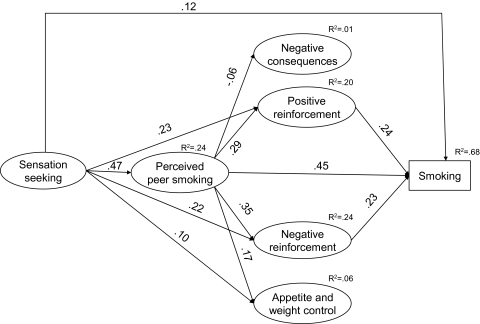
Background: Sensation seeking is a strong correlate of smoking among adolescents, yet the research on mediators of this association is not well established. The proposed model of the present study includes antecedent variables (sensation seeking), mediators (perceived peer smoking, outcome expectancies including negative consequences, positive reinforcement, negative reinforcement, and appetite-and-weight control), and one outcome variable (smoking cigarettes during the past 30 days).
Methods: Self-reported data obtained from Hungarian high-school students (ninth grade, N = 2,565, mean age 15.3 years, SD = 0.56) were analyzed with structural equation modeling. Before testing of the main model, the construct validity of mediators (outcome expectancy scales) was supported with confirmatory factor analysis (CFA) and structural equation modeling. The final model was tested with structural equation modeling, and the goodness-of-fit indices and the proportion of direct and indirect effects were analyzed.
Results: Our mediational model had an excellent model fit, and this study supported both the proposed sensation seeking-->positive and negative reinforcement-->smoking behavior pathways and sensation seeking-->perceived peer smoking-->positive and negative reinforcement-->smoking behavior pathways. The total indirect effect explains 76% of sensation seeking and smoking association. Results support the notion that positive and negative reinforcement expectancies mediate between sensation seeking and smoking.
Discussion: Results support the notion that perceived peer smoking, positive and negative reinforcement expectancies mediate between sensation seeking and smoking.
Figures
References
-
- Anderson CB, Pollak KI, Wetter DW. Relations between self-generated positive and negative expected smoking outcomes and smoking behavior: An exploratory study among adolescents. Psychology of Addictive Behaviors. 2002;16:196–204. - PubMed
-
- Arnett JJ. The myth of peer influence in adolescent smoking initiation. Health Education & Behavior. 2007;34:594–607. - PubMed
-
- Audrain-McGovern J, Tercyak KP, Shields AE, Bush A, Espinel CF, Lerman C. Which adolescents are most receptive to tobacco industry marketing? Implications for counter-advertising campaigns. Health Communication. 2003;15:499–513. - PubMed
-
- Baron RM, Kenny DA. The moderator-mediator variable distinction in social psychological research: Conceptual, strategic, and statistical considerations. Journal of Personality and Social Psychology. 1986;51:1173–1182. - PubMed
-
- Brandon TH, Baker TB. The smoking consequences questionnaire: The subjective expected utility of smoking in college students. Psychological Assessment. 1991;3:484–491.
Publication types
MeSH terms
Grants and funding
LinkOut - more resources
Full Text Sources
Medical
Miscellaneous
