


Sweetening the pot: adding glycosylation to the biomarker discovery equation
- PMID: 19959616
- PMCID: PMC2849286
- DOI: 10.1373/clinchem.2009.136333
Sweetening the pot: adding glycosylation to the biomarker discovery equation
Abstract
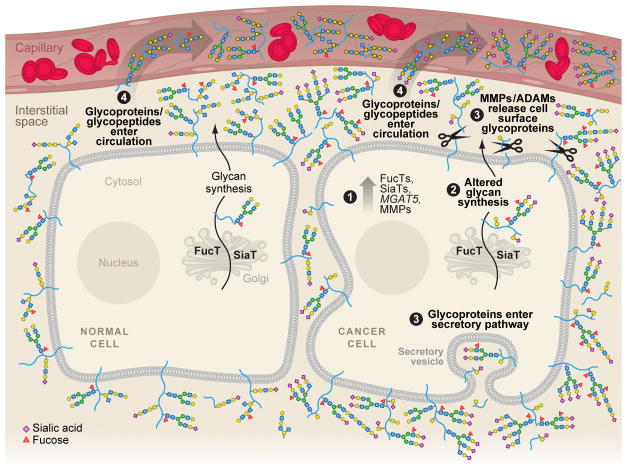
Background: Cancer has profound effects on gene expression, including a cell's glycosylation machinery. Thus, tumors produce glycoproteins that carry oligosaccharides with structures that are markedly different from the same protein produced by a normal cell. A single protein can have many glycosylation sites that greatly amplify the signals they generate compared with their protein backbones.
Content: In this article, we survey clinical tests that target carbohydrate modifications for diagnosing and treating cancer. We present the biological relevance of glycosylation to disease progression by highlighting the role these structures play in adhesion, signaling, and metastasis and then address current methodological approaches to biomarker discovery that capitalize on selectively capturing tumor-associated glycoforms to enrich and identify disease-related candidate analytes. Finally, we discuss emerging technologies--multiple reaction monitoring and lectin-antibody arrays--as potential tools for biomarker validation studies in pursuit of clinically useful tests.
Summary: The future of carbohydrate-based biomarker studies has arrived. At all stages, from discovery through verification and deployment into clinics, glycosylation should be considered a primary readout or a way of increasing the sensitivity and specificity of protein-based analyses.
Figures
References
-
- Meezan E, Wu HC, Black PH, Robbins PW. Comparative studies on the carbohydrate-containing membrane components of normal and virus-transformed mouse fibroblasts. II. Separation of glycoproteins and glycopeptides by sephadex chromatography. Biochemistry. 1969;8:2518–24. - PubMed
-
- Backstrom M, Thomsson KA, Karlsson H, Hansson GC. Sensitive liquid chromatography-electrospray mass spectrometry allows for the analysis of the O-glycosylation of immunoprecipitated proteins from cells or tissues: application to MUC1 glycosylation incancer. J Proteome Res. 2009;8:538–45. - PubMed
-
- Goldberg D, Bern M, Parry S, Sutton-Smith M, Panico M, Morris HR, Dell A. Automated N-glycopeptide identification using a combination of single-and tandem-MS. J Proteome Res. 2007;6:3995–4005. - PubMed
-
- Harvey DJ. Structural determination of N-linked glycans by matrix-assisted laser desorption/ionization and electrospray ionization mass spectrometry. Proteomics. 2005;5:1774–86. - PubMed
Publication types
MeSH terms
Substances
Grants and funding
LinkOut - more resources
Full Text Sources
Other Literature Sources
