Smoking behavior 1 year after computed tomography screening for lung cancer: Effect of physician referral for abnormal CT findings
- PMID: 19959699
- PMCID: PMC2789354
- DOI: 10.1158/1055-9965.EPI-09-0895
Smoking behavior 1 year after computed tomography screening for lung cancer: Effect of physician referral for abnormal CT findings
Abstract
Background: Computed tomography (CT) lung cancer screening offers a unique clinical setting in which to promote smoking cessation. Focusing on outcomes related to the reporting of CT abnormality, we examined the natural history of smoking in the Pittsburgh Lung Screening Study.
Methods: Pittsburgh Lung Screening Study recruited 50- to 79-year-old current and former cigarette smokers living in the Pittsburgh area. We examined self-reported smoking outcomes 1 year after study entry in a subgroup that contained 2,094 active cigarette smokers without interval lung cancer diagnosis (50.7% women; median age, 57 years; 40-year median duration of cigarette smoking; and 65.2% > or =20 cigarettes/d). Analyses compared efforts to quit in relation to physician referral for abnormal CT.
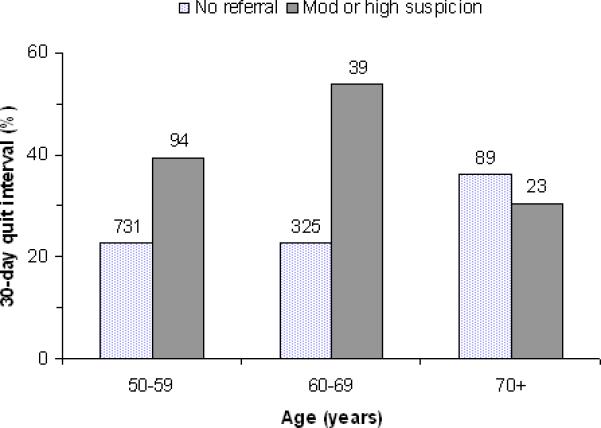
Results: Since study entry, 58.5% [95% confidence interval (95% CI), 56.3-60.6%] reported any quit attempt and 27.2% (95% CI, 25.3-29.1%) reported any quit interval >30 days. One year after study entry, 15.5% (95% CI, 14.0-17.1%) reported not smoking for >30 days. Comparing persons referred because of CT abnormalities creating moderate or high lung cancer suspicion (n = 156; 7.4%) to persons not referred for any reason (n = 1145; 54.7%), propensity score-adjusted fractions with any quit attempt and with any quit interval >30 days increased 18.8% (95% CI, 11.1-26.5%) and 17.7% (95% CI, 9.4-26.0%), respectively. The fraction quit >30 days at 1 year increased 12.2% (95% CI, 4.9-19.5%).
Conclusions: Persons who experienced referral because of abnormal CT reported more smoking cessation.
Figures
References
-
- Centers for Disease Control and Prevention Cigarette smoking among adults--United States, 2007. MMWR Morb Mortal. 2008;57:1221–6. - PubMed
-
- Manser R. Screening for lung cancer: a review. Curr Opin Pulm Med. 2004;10:266–71. - PubMed
-
- Diederich S, Wormanns D. Impact of low-dose CT on lung cancer screening. Lung Cancer. 2004;45(Suppl 2):S13–9. - PubMed