


Distributed lag and spline modeling for predicting energy expenditure from accelerometry in youth
- PMID: 19959770
- PMCID: PMC2822669
- DOI: 10.1152/japplphysiol.00374.2009
Distributed lag and spline modeling for predicting energy expenditure from accelerometry in youth
Abstract
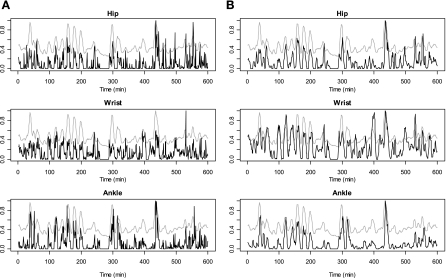
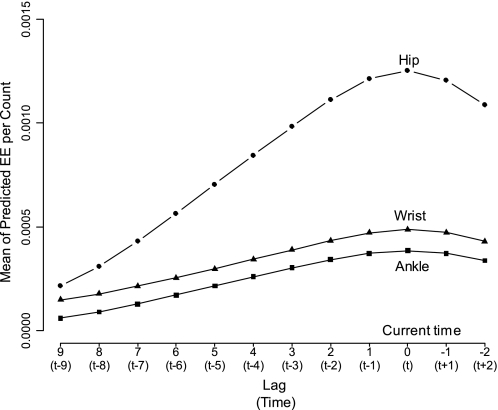
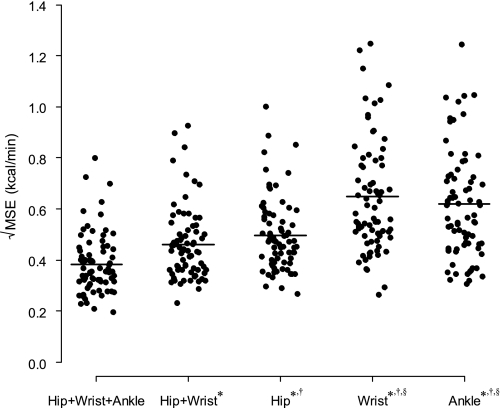
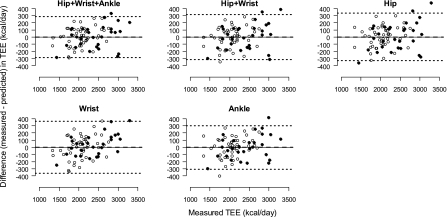
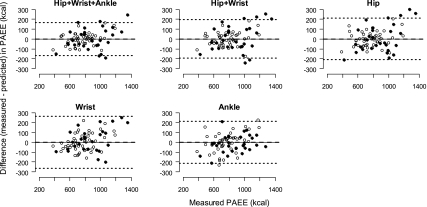
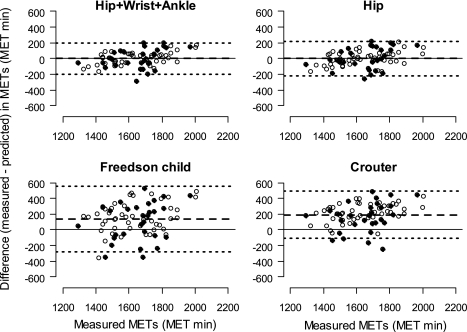
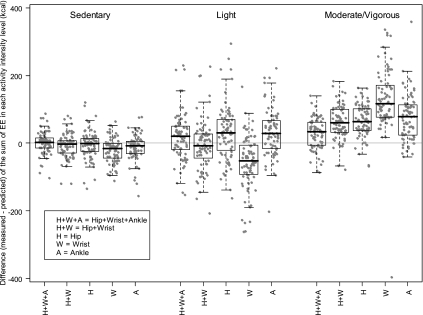
Movement sensing using accelerometers is commonly used for the measurement of physical activity (PA) and estimating energy expenditure (EE) under free-living conditions. The major limitation of this approach is lack of accuracy and precision in estimating EE, especially in low-intensity activities. Thus the objective of this study was to investigate benefits of a distributed lag spline (DLS) modeling approach for the prediction of total daily EE (TEE) and EE in sedentary (1.0-1.5 metabolic equivalents; MET), light (1.5-3.0 MET), and moderate/vigorous (> or = 3.0 MET) intensity activities in 10- to 17-year-old youth (n = 76). We also explored feasibility of the DLS modeling approach to predict physical activity EE (PAEE) and METs. Movement was measured by Actigraph accelerometers placed on the hip, wrist, and ankle. With whole-room indirect calorimeter as the reference standard, prediction models (Hip, Wrist, Ankle, Hip+Wrist, Hip+Wrist+Ankle) for TEE, PAEE, and MET were developed and validated using the fivefold cross-validation method. The TEE predictions by these DLS models were not significantly different from the room calorimeter measurements (all P > 0.05). The Hip+Wrist+Ankle predicted TEE better than other models and reduced prediction errors in moderate/vigorous PA for TEE, MET, and PAEE (all P < 0.001). The Hip+Wrist reduced prediction errors for the PAEE and MET at sedentary PA (P = 0.020 and 0.021) compared with the Hip. Models that included Wrist correctly classified time spent at light PA better than other models. The means and standard deviations of the prediction errors for the Hip+Wrist+Ankle and Hip were 0.4 +/- 144.0 and 1.5 +/- 164.7 kcal for the TEE, 0.0 +/- 84.2 and 1.3 +/- 104.7 kcal for the PAEE, and -1.1 +/- 97.6 and -0.1 +/- 108.6 MET min for the MET models. We conclude that the DLS approach for accelerometer data improves detailed EE prediction in youth.
Figures
References
-
- Actigraph Actigraph GT1M Monitor/ ActiTrainer and ActiLife Lifestyle Monitor Software User Manuel. Pensacola, FL: Actigraph, LLC, 2007
-
- Bland JM, Altman DG. Statistical methods for assessing agreement between two methods of clinical measurement. Lancet 1: 307–310, 1986 - PubMed
-
- Chen KY, Bassett DR., Jr The technology of accelerometry-based activity monitors: current and future. Med Sci Sports Exercise 37: S490–500, 2005 - PubMed
-
- Cleveland WS. Robust locally weighted regression and smoothing scatterplots. J Am Stat Assoc 74: 829–836, 1979
Publication types
MeSH terms
Grants and funding
LinkOut - more resources
Full Text Sources
Medical
Miscellaneous
