


The mechanisms underlying the generation of the colonic migrating motor complex in both wild-type and nNOS knockout mice
- PMID: 19959818
- PMCID: PMC2822500
- DOI: 10.1152/ajpgi.00399.2009
The mechanisms underlying the generation of the colonic migrating motor complex in both wild-type and nNOS knockout mice
Abstract
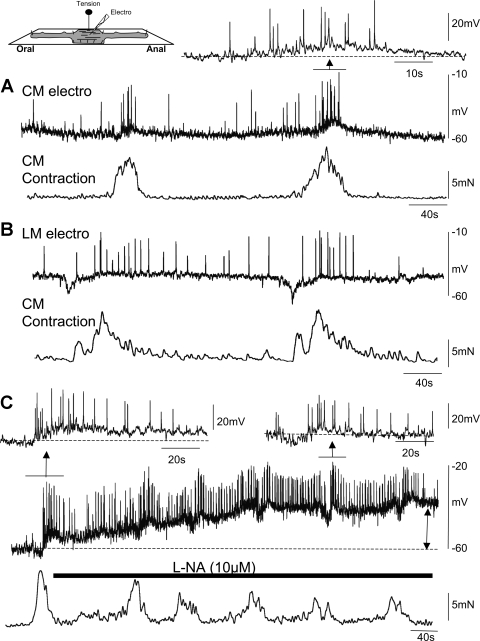
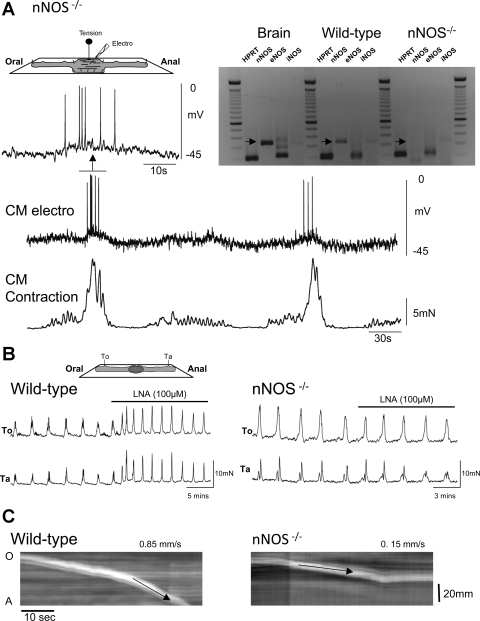
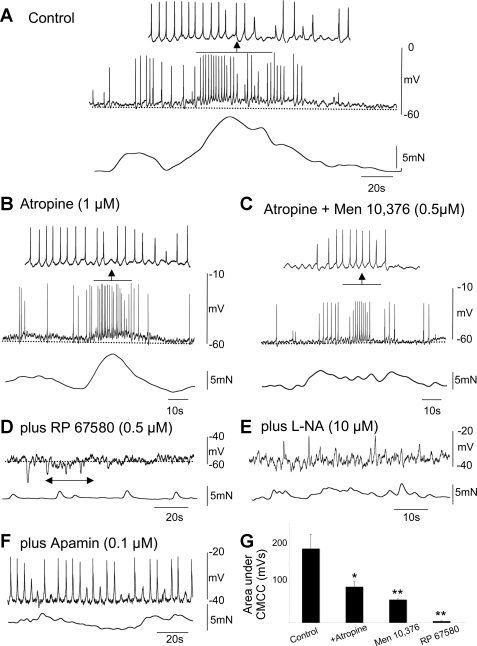
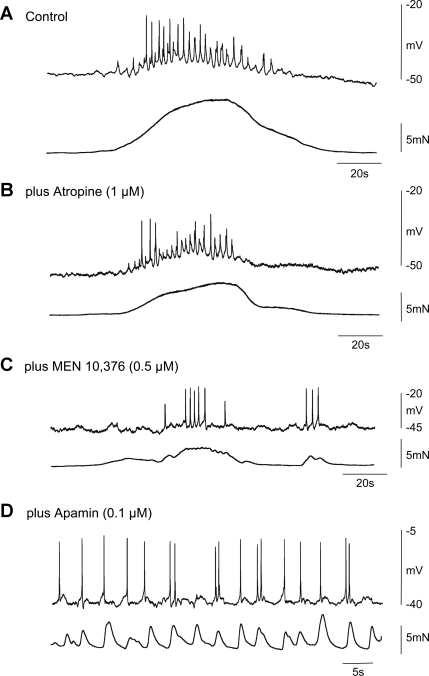
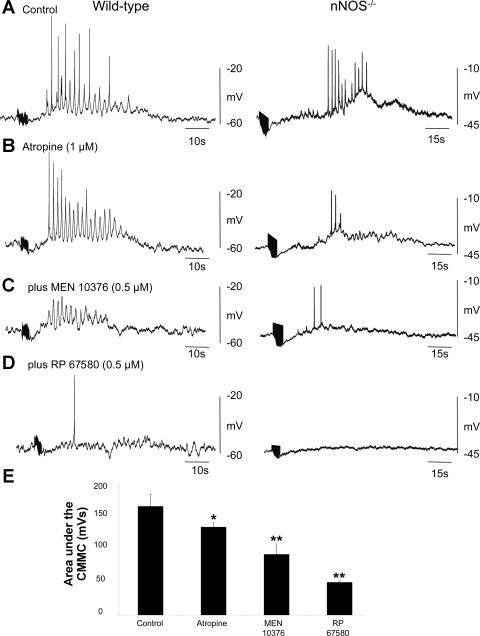
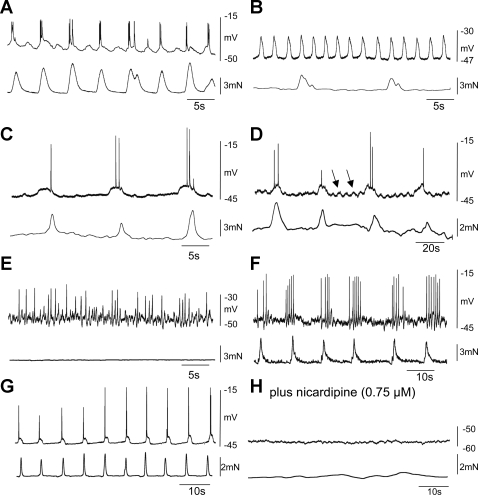
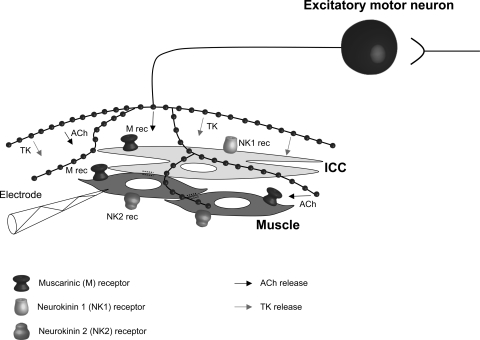
Colonic migrating motor complexes (CMMCs) propel fecal contents and are altered in diseased states, including slow-transit constipation. However, the mechanisms underlying the CMMCs are controversial because it has been proposed that disinhibition (turning off of inhibitory neurotransmission) or excitatory nerve activity generate the CMMC. Therefore, our aims were to reexamine the mechanisms underlying the CMMC in the colon of wild-type and neuronal nitric oxide synthase (nNOS)(-/-) mice. CMMCs were recorded from the isolated murine large bowel using intracellular recordings of electrical activity from circular muscle (CM) combined with tension recording. Spontaneous CMMCs occurred in both wild-type (frequency: 0.3 cycles/min) and nNOS(-/-) mice (frequency: 0.4 cycles/min). CMMCs consisted of a hyperpolarization, followed by fast oscillations (slow waves) with action potentials superimposed on a slow depolarization (wild-type: 14.0 +/- 0.6 mV; nNOS(-/-): 11.2 +/- 1.5 mV). Both atropine (1 microM) and MEN 10,376 [neurokinin 2 (NK2) antagonist; 0.5 microM] added successively reduced the slow depolarization and the number of action potentials but did not abolish the fast oscillations. The further addition of RP 67580 (NK1 antagonist; 0.5 microM) blocked the fast oscillations and the CMMC. Importantly, none of the antagonists affected the resting membrane potential, suggesting that ongoing tonic inhibition of the CM was maintained. Fecal pellet propulsion, which was blocked by the NK2 or the NK1 antagonist, was slower down the longer, more constricted nNOS(-/-) mouse colon (wild-type: 47.9 +/- 2.4 mm; nNOS(-/-): 57.8 +/- 1.4 mm). These observations suggest that excitatory neurotransmission enhances pacemaker activity during the CMMC. Therefore, the CMMC is likely generated by a synergistic interaction between neural and interstitial cells of Cajal networks.
Figures
References
-
- Albertí E, Mikkelsen HB, Wang XY, Díaz M, Larsen JO, Huizinga JD, Jiménez M. Pacemaker activity and inhibitory neurotransmission in the colon of Ws/Ws mutant rats. Am J Physiol Gastrointest Liver Physiol 292: G1499–G1510, 2007 - PubMed
-
- Bayguinov PO, Hennig GW, Smith TK. Calcium imaging of myenteric neurons and ICC during local mucosal reflexes and the colonic migrating motor complex in the murine colon (Abstract). Neurogastroenterol Motil 21: 319, 2009
-
- Christensen J, Anuras S, Arthur C. Influence of intrinsic nerves on electromyogram of cat colon in vitro. Am J Physiol 234: E641–E647, 1978 - PubMed
Publication types
MeSH terms
Substances
Grants and funding
LinkOut - more resources
Full Text Sources
Molecular Biology Databases
