


Review
doi: 10.3748/wjg.15.5633.
Emerging role of microRNAs in liver diseases
Affiliations
- PMID: 19960558
- PMCID: PMC2789214
- DOI: 10.3748/wjg.15.5633
Item in Clipboard
Review
Emerging role of microRNAs in liver diseases
World J Gastroenterol.
.
Abstract
MicroRNAs are a class of small non-coding RNAs that are found in plants, animals, and some viruses. They modulate the gene function at the post-transcriptional level and act as a fine tuner of various processes, such as development, proliferation, cell signaling, and apoptosis. They are associated with different types and stages of cancer. Recent studies have shown the involvement of microRNAs in liver diseases caused by various factors, such as Hepatitis C, Hepatitis B, metabolic disorders, and by drug abuse. This review highlights the role of microRNAs in liver diseases and their potential use as therapeutic molecules.
Figures
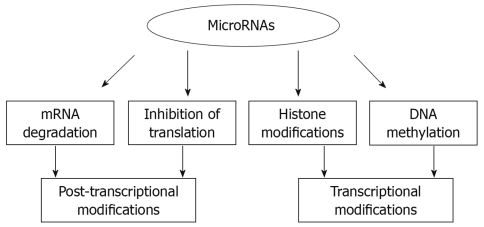
Various modes of gene regulation by miRNAs.
References
-
- Volpe TA, Kidner C, Hall IM, Teng G, Grewal SI, Martienssen RA. Regulation of heterochromatic silencing and histone H3 lysine-9 methylation by RNAi. Science. 2002;297:1833–1837. - PubMed
-
- Voinnet O. Induction and suppression of RNA silencing: insights from viral infections. Nat Rev Genet. 2005;6:206–220. - PubMed
-
- Zamore PD, Haley B. Ribo-gnome: the big world of small RNAs. Science. 2005;309:1519–1524. - PubMed
-
- Ambros V. The functions of animal microRNAs. Nature. 2004;431:350–355. - PubMed
-
- Lee RC, Feinbaum RL, Ambros V. The C. elegans heterochronic gene lin-4 encodes small RNAs with antisense complementarity to lin-14. Cell. 1993;75:843–854. - PubMed
Publication types
MeSH terms
Substances
Grants and funding
LinkOut - more resources
Full Text Sources
Other Literature Sources
Medical
