


Determination of the Plasmodium vivax relapse pattern in Camopi, French Guiana
- PMID: 19961585
- PMCID: PMC2793261
- DOI: 10.1186/1475-2875-8-278
Determination of the Plasmodium vivax relapse pattern in Camopi, French Guiana
Abstract
Background: Malaria is a major public health problem in French Guiana, where Plasmodium vivax has become the dominant malaria species since 2000. As in others endemic areas, it is important to specify the pattern of vivax malaria relapses and to try to discriminate efficiently re-infections from relapses.
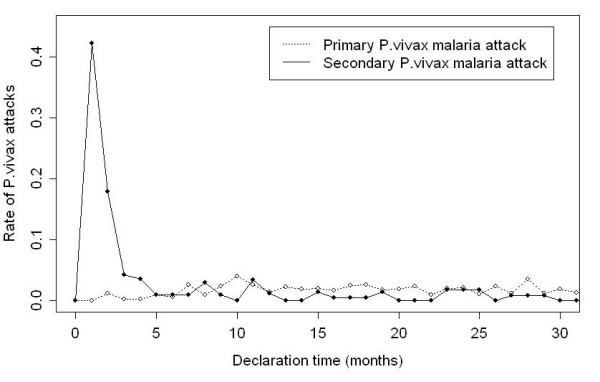
Methods: This study was conducted in children born between January 1, 2001 and December 31, 2008 in Camopi, an Amerindian village located in the Amazon forest (n = 325), using an open cohort design. Primary and secondary attack rates of P. vivax were calculated using survival analysis. With the difference between the primary and secondary rates, this study aimed to estimate indirectly P. vivax relapse rate and evaluate its time evolution.
Results: Of the 1042 malaria attacks recorded, 689 (66%) were due to P. vivax (without mixed infection). One hundred and fifty one children had their primary attack with P. vivax and 106 had their two first attacks with P. vivax. In the absence of primaquine treatment, it was shown that P. vivax relapses mainly occurred during the first three months after the first attack. Thirty percent of children never had a relapse, 42% had a relapse before the first month after primary attack, 59% before the second month and 63% before the third month.
Conclusion: This study confirmed that the relapse pattern in Camopi was compatible with the pattern described for the P. vivax Chesson (tropical) strain. In addition, due to the relapse rate time evolution, a simple arbitrary classification rule could be constructed: before 90 days after the primary attack, the secondary attack is a relapse; after 90 days, it is a re-infection. Adapted management of malaria cases based on these results could be devised.
Figures
References
-
- Mendis K, Sina BJ, Marchesini P, Carter R. The neglected burden of Plasmodium vivax malaria. Am J Trop Med Hyg. 2001;64:97–106. - PubMed
-
- Yeom JS, Ryu SH, Oh S, Lee WJ, Kim TS, Kim KH, Kim YA, Ahn SY, Cha JE, Park JW. Status of Plasmodium vivax malaria in the Republic of Korea during 2001-2003. Am J Trop Med Hyg. 2005;73:604–608. - PubMed
-
- Sumawinata IW, Bernadeta, Leksana B, Sutamihardja A, Purnomo, Subianto B, Sekartuti, Fryauff DJ, Baird JK. Very high risk of therapeutic failure with chloroquine for uncomplicated Plasmodium falciparum and P. vivax malaria in Indonesian Papua. Am J Trop Med Hyg. 2003;68:416–420. - PubMed
Publication types
MeSH terms
Substances
LinkOut - more resources
Full Text Sources
Research Materials
