


Cost-effectiveness analysis of hospital infection control response to an epidemic respiratory virus threat
- PMID: 19961669
- PMCID: PMC3044543
- DOI: 10.3201/eid1512.090902
Cost-effectiveness analysis of hospital infection control response to an epidemic respiratory virus threat
Abstract
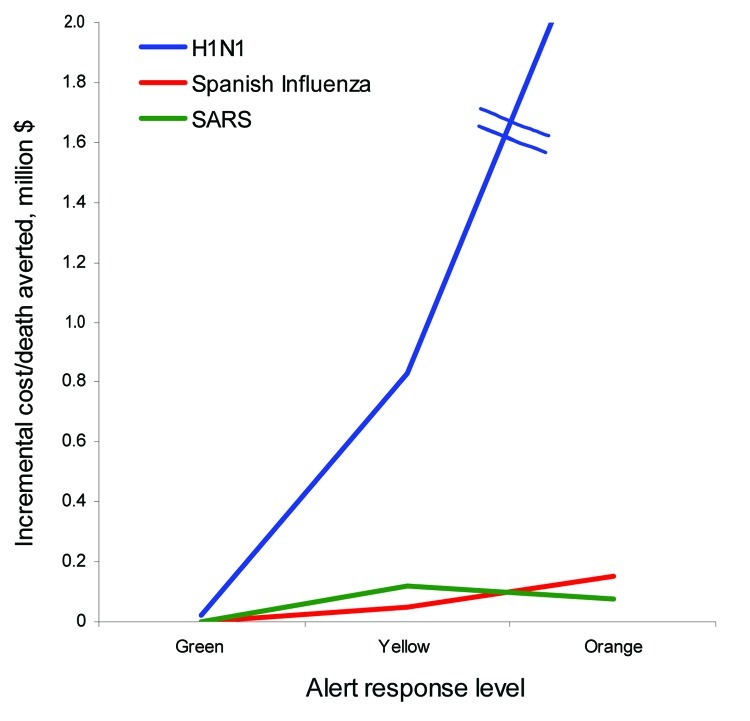
The outbreak of influenza A pandemic (H1N1) 2009 prompted many countries in Asia, previously strongly affected by severe acute respiratory syndrome (SARS), to respond with stringent measures, particularly in preventing outbreaks in hospitals. We studied actual direct costs and cost-effectiveness of different response measures from a hospital perspective in tertiary hospitals in Singapore by simulating outbreaks of SARS, pandemic (H1N1) 2009, and 1918 Spanish influenza. Protection measures targeting only infected patients yielded lowest incremental cost/death averted of 23,000 (US dollars) for pandemic (H1N1) 2009. Enforced protection in high-risk areas (Yellow Alert) and full protection throughout the hospital (Orange Alert) averted deaths but came at an incremental cost of up to $2.5 million/death averted. SARS and Spanish influenza favored more stringent measures. High case-fatality rates, virulence, and high proportion of atypical manifestations impacted cost-effectiveness the most. A calibrated approach in accordance with viral characteristics and community risks may help refine responses to future epidemics.
Figures
References
-
- World Health Organization. Epidemic and pandemic alert and response (EPR) [cited 2009 Aug 29]. Available from http://www.who.int/csr/don/2009_08_28/en/index.html
-
- Leong HN, Chan KP, Oon LL, Koay ES, Ng LC, Lee MA, et al. Clinical and laboratory findings of SARS in Singapore. Ann Acad Med Singapore. 2006;35:332–9. - PubMed
-
- Singapore Ministry of Health. Influenza pandemic plan [cited 2009 May 22]. Available from http://www.moh.gov.sg/mohcorp/uploadedFiles/News/Current_Issues/2007/Mai...
MeSH terms
LinkOut - more resources
Full Text Sources
Medical
Miscellaneous