


doi: 10.3201/eid1512.090864.
Mopeia virus-related arenavirus in natal multimammate mice, Morogoro, Tanzania
Affiliations
- PMID: 19961688
- PMCID: PMC3044542
- DOI: 10.3201/eid1512.090864
Item in Clipboard
Mopeia virus-related arenavirus in natal multimammate mice, Morogoro, Tanzania
Emerg Infect Dis.
2009 Dec.
Abstract
A serosurvey involving 2,520 small mammals from Tanzania identified a hot spot of arenavirus circulation in Morogoro. Molecular screening detected a new arenavirus in Natal multimammate mice (Mastomys natalensis), Morogoro virus, related to Mopeia virus. Only a small percentage of mice carry Morogoro virus, although a large proportion shows specific antibodies.
Figures
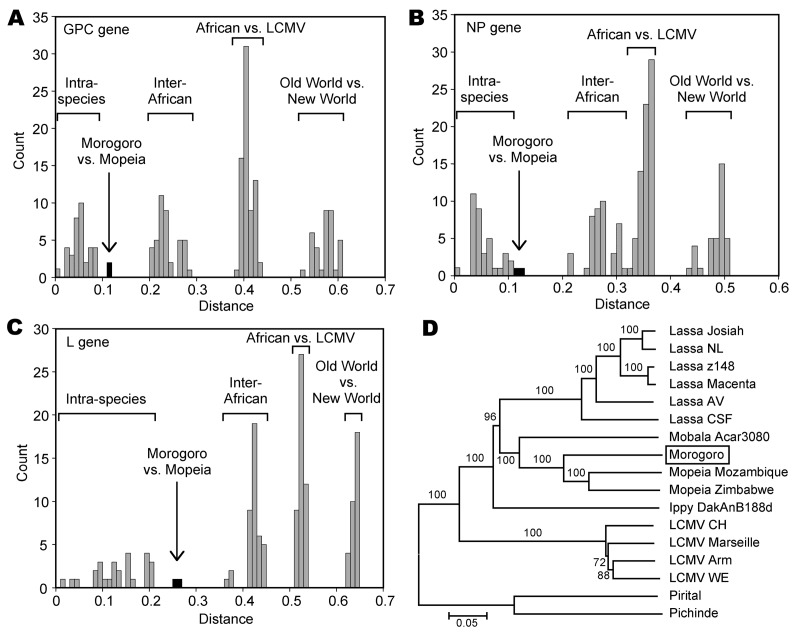
Genetic distances and phylogenetic relationship among arenaviruses, including Morogoro virus. Amino acid sequence diversity was calculated using p distance. Full-length glycoprotein precursor (GPC), nucleoprotein (NP), and large (L) gene amino acid sequences of the following arenaviruses were pairwise compared: Lassa virus (strains Josiah, NL, Z148, Macenta, AV, and CSF), Mobala Acar3080, Morogoro 3017/2004, Mopeia virus (strains Mozambique and Zimbabwe), Ippy DakAnB188d, lymphocytic choriomeningitis virus (LCMV) (strains CH-5692, Marseille, Armstrong, and WE for all genes; Traub and Pasteur for GPC and NP only), Pirital, and Pichinde. Frequency histograms of pairwise distances are shown for A) GPC gene; B) NP gene; and C) L gene. The ranges for intraspecies distances (i.e., pairwise differences between strains of the same virus species); distances between different African arenavirus species; between African arenaviruses and LCMV; and between Old World and New World viruses are marked above the bars. Bars representing the distances between Morogoro virus and the most closely related viruses (Mopeia virus strains) are filled in black. D) Phylogeny of Old World arenaviruses based on full-length L gene amino acid sequences. The tree was inferred by using the neighbor-joining method implemented in the MEGA software package (www.megasoftware.net ). The New World arenaviruses Pirital and Pichinde were used as outgroups. Numbers represent bootstrap support (1,000 replications). Identical trees with respect to the phylogenetic position of Morogoro virus (shown in the box) were obtained with full-length GPC and NP amino acid sequences (not shown). Scale bar indicates nucleotide substitutions per site.
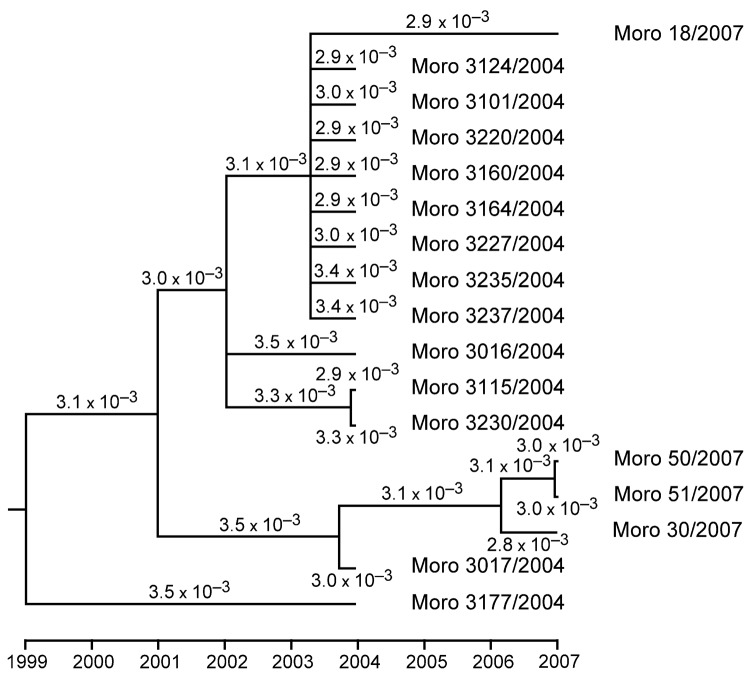
Phylogenetic tree and molecular clock of Morogoro virus based on partial large gene sequences of 17 strains (340 nucleotides; GenBank accession nos. EU914104 and EU914107–EU914122). Phylogeny was inferred with the BEAST v1.4.8 package (11) under assumption of a relaxed lognormal molecular clock and general time reversible substitution model with gamma-distributed substitution rate variation among sites. Branches with posterior probability <0.5 were collapsed. The substitution rate per site and year is indicated for each branch. Node ages and rates are median values. Variation in rates among branches is low as calculated with Tracer program (beast.bio.ed.ac.uk/Tracer) indicating a molecular clock in the evolution of Morogoro virus. The same tree topology with similar substitution rates was obtained when assuming the Hasegawa-Kishino-Yano substitution model (not shown).
References
-
- Johnson KM, Taylor P, Elliott LH, Tomori O. Recovery of a Lassa-related arenavirus in Zimbabwe. Am J Trop Med Hyg. 1981;30:1291–3. - PubMed
Publication types
MeSH terms
LinkOut - more resources
Full Text Sources
Molecular Biology Databases