


doi: 10.3201/eid1512.090280.
Age patterns of persons with campylobacteriosis, England and Wales, 1990-2007
Affiliations
- PMID: 19961698
- PMCID: PMC3044522
- DOI: 10.3201/eid1512.090280
Item in Clipboard
Age patterns of persons with campylobacteriosis, England and Wales, 1990-2007
Emerg Infect Dis.
2009 Dec.
Abstract
To explore hypotheses for age-related changes in the incidence of Campylobacter infections in England and Wales during 1990-2007, we analyzed electronic laboratory data. Disease incidence was reduced among children, and the greatest increase in risk was for those >/=60 years of age. Risk factors for campylobacteriosis in the elderly population should be identified.
Figures
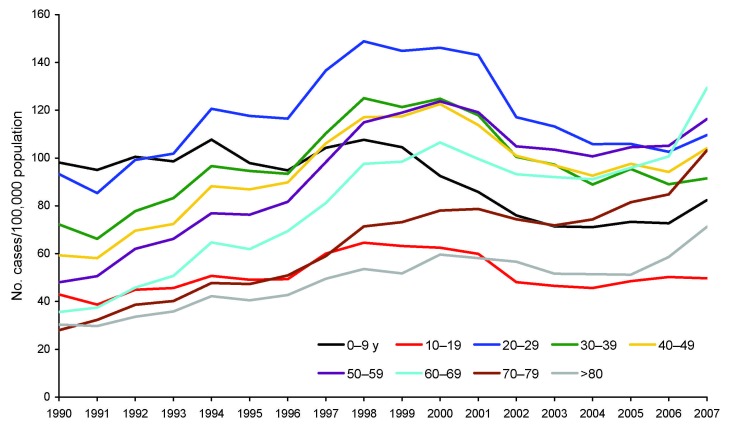
Incidence of laboratory-reported campylobacteriosis, England and Wales, by age group, 1990–2007.
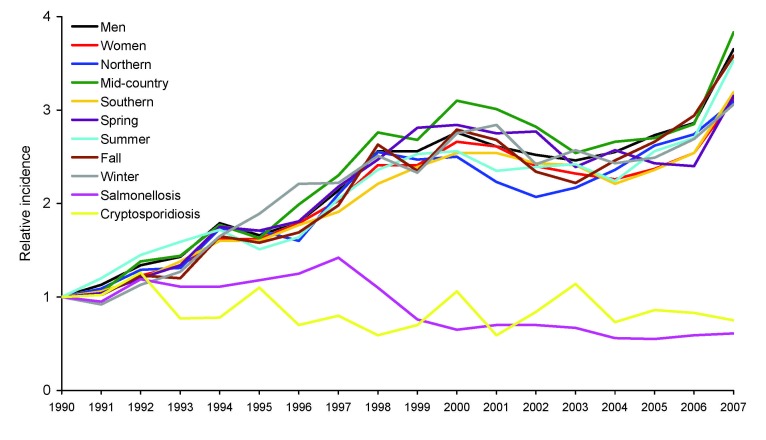
Relative incidence of campylobacteriosis by sex, region, and season, compared with rates of salmonellosis and cryptosporidiosis, among patients > 60 years of age, England and Wales, 1991–2007. Northern, northwest, northeast, as well as Yorkshire and the Humber regions; mid-country, Wales, West Midlands, East Midlands, and East of England regions; southern, London as well as southeast and southwest regions. Salmonellosis includes nontyphoidal salmonellae, with age data available for 356,270 of 380,915 case-patients (94%); cryptosporidiosis includes age data for 76,462 of 79,808 case-patients (96%).
References
-
- Skirrow MB, Blaser MJ. Clinical aspects of Campylobacter infection. In: Nachamkin I, Blaser MJ, editors. Campylobacter, 2nd ed. Washington: ASM Press; 2000. p. 69–88.
-
- Communicable Disease Surveillance Center. Campylobacter sentinel surveillance: the first year. Commun Dis Rep CDR Wkly [serial online]. 2000;11(35) [cited 2001 Aug 31]. Available from http://www.hpa.org.uk/cdr/archives/2001/cdr3501.pdf
-
- Vandenberg O, Skirrow MB, Butzler JP. Campylobacter and Arcobacter. In: Borriello SP, Murray PR, Funke G, editors. Topley & Wilson’s microbiology and microbial infections. Bacteriology, vol. 2, 10th ed. London: Hodder Arnold; 2005. p. 1541–62.
MeSH terms
LinkOut - more resources
Full Text Sources
Medical