


Detection and identification of crowded mirror-image letters in normal peripheral vision
- PMID: 19961868
- PMCID: PMC2822048
- DOI: 10.1016/j.visres.2009.11.017
Detection and identification of crowded mirror-image letters in normal peripheral vision
Abstract
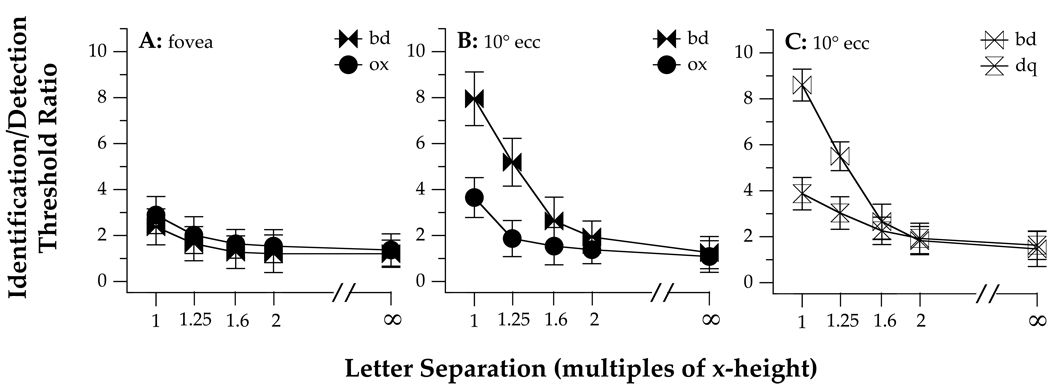
Performance for discriminating single mirror-image letters in peripheral vision can be as good as that in central vision, provided that letter size is scaled appropriately [Higgins, K. E., Arditi, A., & Knoblauch, K. (1996). Detection and identification of mirror-image letter pairs in central and peripheral vision. Vision Research, 36, 331-337]. In this study, we asked whether or not there is a reduction in performance for discriminating mirror-image letters when the letters are flanked closely by other letters, compared with unflanked (single) letters; and if so, whether or not this effect is greater in peripheral than in central vision. We compared contrast thresholds for detecting and identifying mirror-image letters "b" and "d" for a range of letter separations, at the fovea and 10 degrees eccentricity, for letters that were scaled in size. For comparison, thresholds were also determined for a pair of non-mirror-image letters "o" and "x". Our principal finding is that there is an additional loss in sensitivity for identifying mirror-image letters ("bd"), compared with non-mirror-image letters ("ox"), when the letters are flanked closely by other letters. The effect is greater in peripheral than central vision. An auxiliary experiment comparing thresholds for letters "d" and "q" vs. "b" and "d" shows that the additional loss in sensitivity for identifying crowded mirror-image letters cannot be attributed to the similarity in letter features between the two letters, but instead, is specific to the axis of symmetry. Our results suggest that in the presence of proximal objects, there is a specific loss in sensitivity for processing broad-band left-right mirror images in peripheral vision.
Copyright (c) 2009 Elsevier Ltd. All rights reserved.
Figures


References
-
- Barrett BT, Morrill P, Whitaker D. Compound grating discrimination in extrafoveal and amblyopic vision. Experimental Brain Research. 2000;131:225–235. - PubMed
-
- Beard BL, Levi DM, Klein SA. Vernier acuity with non -simultaneous targets: the cortical magnification factor estimated by psychophysics. Vision Research. 1997;37:325–346. - PubMed
-
- Bennett PJ, Banks MS. Sensitivity loss in odd -symmetric mechanisms and phase anomalies in peripheral vision. Nature. 1987;326:873–876. - PubMed
-
- Bennett PJ, Banks MS. The effects of contrast, spatial scale, and orientation on foveal and peripheral phase discrimination. Vision Research. 1991;31:1759–1786. - PubMed
Publication types
MeSH terms
Grants and funding
LinkOut - more resources
Full Text Sources
