. 2010 Feb 15;49(4):3210-8.
doi: 10.1016/j.neuroimage.2009.11.065. Epub 2009 Dec 1.

Competition between learned reward and error outcome predictions in anterior cingulate cortex

Affiliations

Competition between learned reward and error outcome predictions in anterior cingulate cortex

William H Alexander et al. Neuroimage. .

Abstract

The anterior cingulate cortex (ACC) is implicated in performance monitoring and cognitive control. Non-human primate studies of ACC show prominent reward signals, but these are elusive in human studies, which instead show mainly conflict and error effects. Here we demonstrate distinct appetitive and aversive activity in human ACC. The error likelihood hypothesis suggests that ACC activity increases in proportion to the likelihood of an error, and ACC is also sensitive to the consequence magnitude of the predicted error. Previous work further showed that error likelihood effects reach a ceiling as the potential consequences of an error increase, possibly due to reductions in the average reward. We explored this issue by independently manipulating reward magnitude of task responses and error likelihood while controlling for potential error consequences in an Incentive Change Signal Task. The fMRI results ruled out a modulatory effect of expected reward on error likelihood effects in favor of a competition effect between expected reward and error likelihood. Dynamic causal modeling showed that error likelihood and expected reward signals are intrinsic to the ACC rather than received from elsewhere. These findings agree with interpretations of ACC activity as signaling both perceptions of risk and predicted reward.


Figures

Figure 1
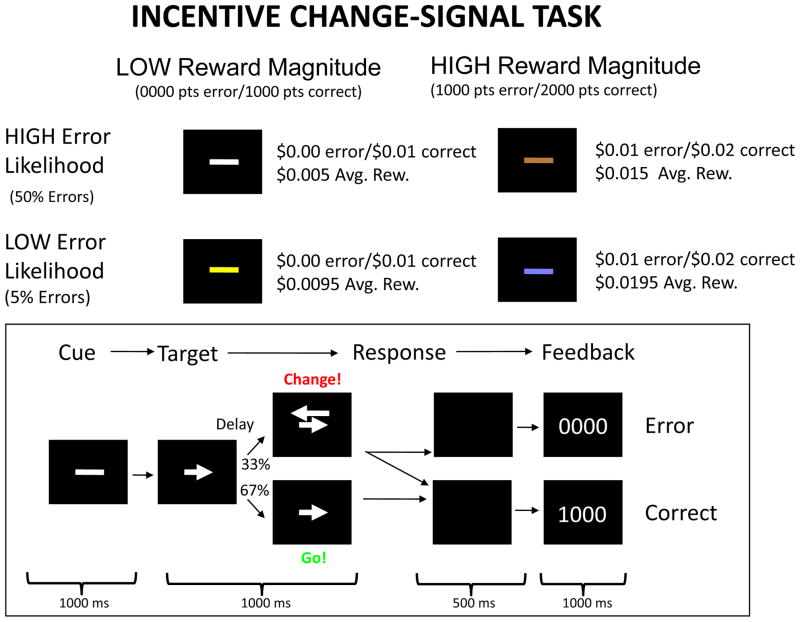
Figure 1. Incentive Change Signal Task
A modified version of the Change Signal Task presented in Brown & Braver, 2007. Subjects earn $0.01 for correct trial and $0.00 for incorrect trials in the low reward magnitude condition, and $0.02 for correct trials and $0.01 for incorrect trials in the high reward magnitude condition. Error rates were controlled at 50% for the high error likelihood condition and 5% for the low error likelihood condition.
Figure 2
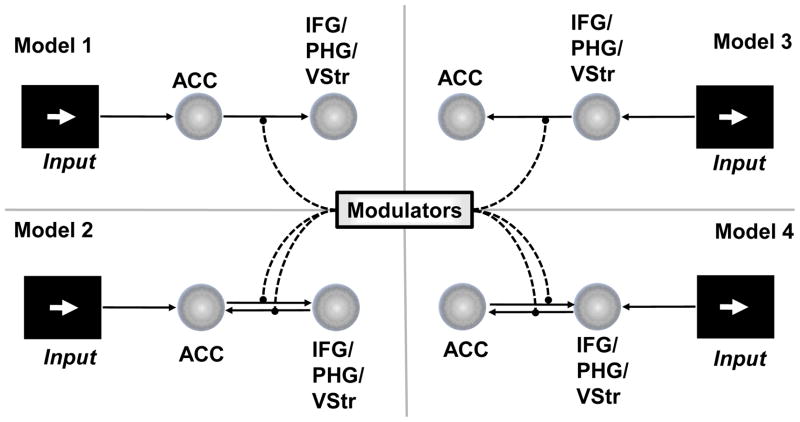
Figure 2. Dynamic Causal Modeling
DCM models were created to examine the causal structure (if any) between ACC and extracingulate regions. Information between two areas may flow in a single direction (Models 1 and 3), or information may originally be available to one region, and the subsequent activity of both regions is influenced by reciprocal connectivity (Models 2 & 4). Furthermore, effective connectivity between the two regions might be modulated by one or more task variables.
Figure 3
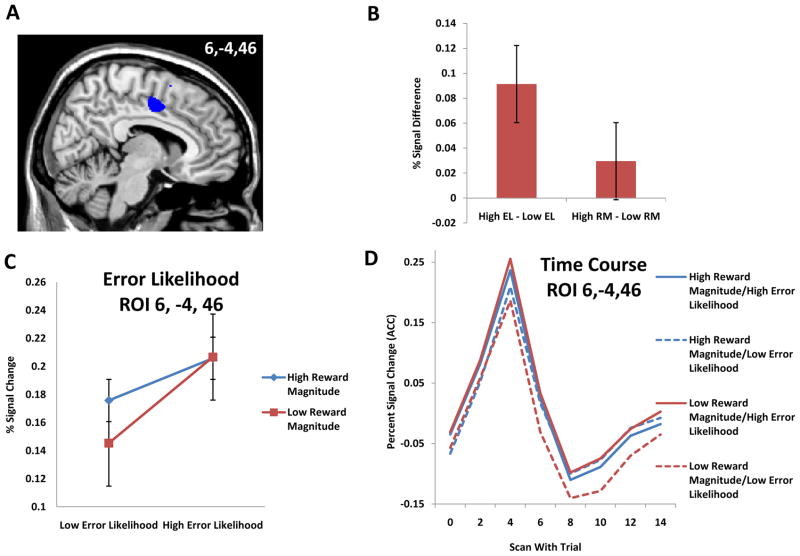
Figure 3. Reward Magnitude and Error Likelihood
A) Error likelihood effects were observed in dorsal ACC. No other areas showed significant activation for error likelihood. B) Tests for main effects of error likelihood and reward magnitude within this region confirm error likelihood effects, but show no significant difference in activity for reward magnitude. Error bars reflect standard error. C) ACC responds to both reward magnitude and error likelihood. However, these effects appear to saturate for high levels of RM and EL. Error bars reflect standard error. All analyses were for correct, go trials only.
Figure 4
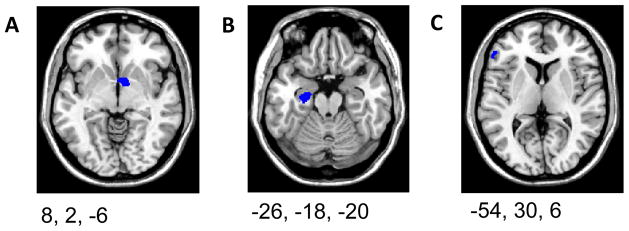
Figure 4. Main Effect of Reward Magnitude
Three clusters (left panels) showed significant activation for reward magnitude (High RM - Low RM): A) ventral striatum, B) parahippocampal gyrus, C) inferior frontal gyrus.

References

    1. Aarts E, Roelofs A, et al. Anticipatory activity in anterior cingulate cortex can be independent of conflict and error likelihood. J Neurosci. 2008;28(18):4671–8. - PMC - PubMed
    1. Amador N, Schlag-Rey M, et al. Reward-predicting and reward-detecting neuronal activity in the primate supplementary eye field. J Neurophysiol. 2000;84(4):2166–70. - PubMed
    1. Amiez C, Joseph JP, et al. Anterior cingulate error-related activity is modulated by predicted reward. Eur J Neurosci. 2005;21(12):3447–52. - PMC - PubMed
    1. Amiez C, Joseph JP, et al. Reward encoding in the monkey anterior cingulate cortex. Cereb Cortex. 2006;16(7):1040–55. - PMC - PubMed
    1. Beckmann M, Johansen-Berg H, et al. Connectivity-based parcellation of human cingulate cortex and its relation to functional specialization. J Neurosci. 2009;29(4):1175–90. - PMC - PubMed

Publication types