


Hypertension in long-term survivors of pediatric hematopoietic cell transplantation
- PMID: 19961945
- PMCID: PMC2839006
- DOI: 10.1016/j.bbmt.2009.11.018
Hypertension in long-term survivors of pediatric hematopoietic cell transplantation
Abstract
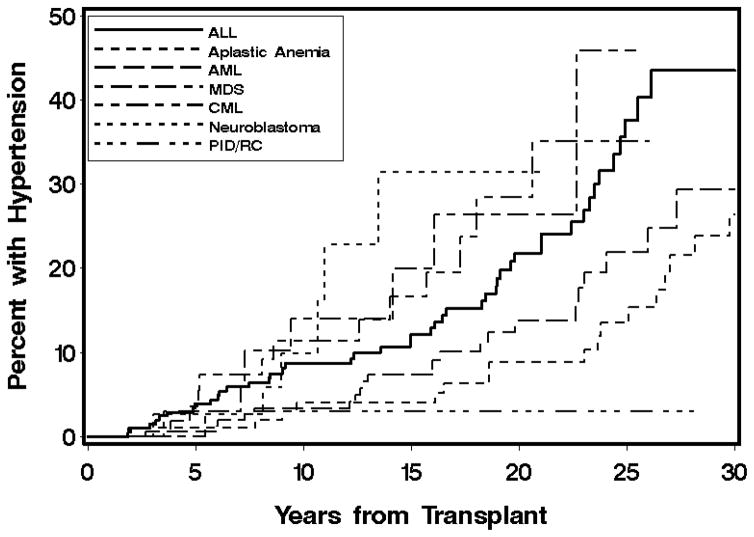
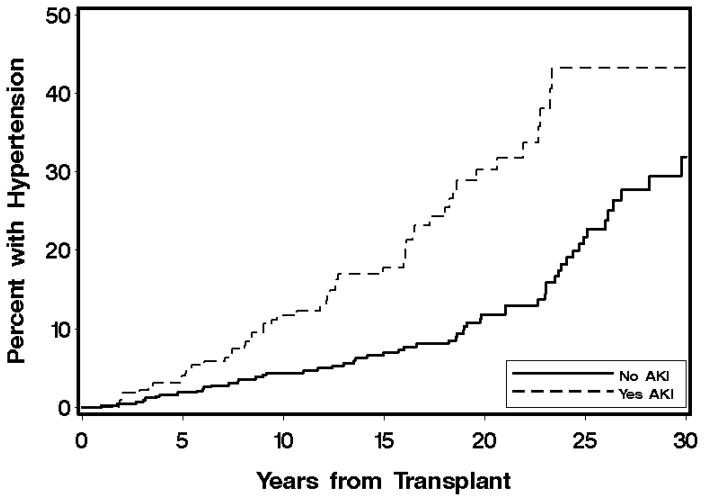
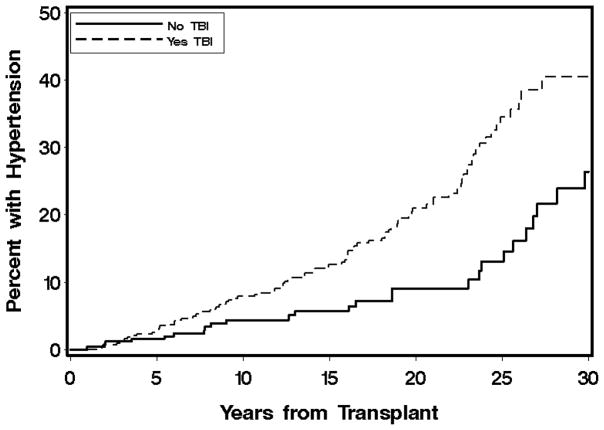
A retrospective study was conducted to determine risk factors for the development of hypertension (HTN) and to describe the prevalence among long-term survivors of pediatric hematopoietic cell transplant (HCT). Records of 689 pediatric patients who survived 5 years or more after HCT, from 1969 to 2004, were reviewed for development of HTN. In children, HTN was defined as either a systolic or diastolic pressure > or =95th percentile according to age, sex, and height. In adults, HTN was defined as systolic pressures > or =140 mmHg and/or diastolic pressures > or =90 mmHg in nondiabetic adults and systolic pressures > or =130 and/or diastolic pressures > or =80 in diabetic adults. Multivariate Cox regression models were used to estimate the hazard ratio (HR) of risk factors associated with HTN. All patients included were off immunosuppressive therapy. Patients had been treated with total body irradiation (TBI) (n = 482, 70%) or non-TBI regimens (n = 207, 30%) followed by autologous (n = 87), related (n = 484), or unrelated donor HCT (n = 118). Median follow-up was 16 (range: 5-36) years. HTN developed in 120 patients with a 30-year cumulative incidence of 36%. Risk factors associated with HTN were acute kidney injury (AKI; doubling of baseline creatinine by day 100 after HCT) (HR = 2.5; 95% confidence interval (CI) 1.7-3.7, P < .0001), TBI in the preparative regimen (HR = 2.1; 95% CI 1.3-3.3, P = .001), donor type (autologous HR = 2.4; 95% CI 1.3-4.4 and unrelated donor HR = 1.8; 95% CI 1.0-3.2, P = .01), obesity (HR = 4.0; 95% CI 2.3-6.8, P < .0001), diabetes (HR = 6.7; 95% CI 3.9-11.0, P < 0.0001), and history of growth hormone therapy (HR = 1.6; 95% CI 1.0-2.5, P = .05). Patients with a positive history of hepatitis C infection were less likely to develop HTN (HR = 0.5; 95% CI 0.3-0.9, P = .009). Prevalence of HTN was 15% overall and among survivors 11-17 years and 18-39 years old, the prevalence was 10% and 14% or triple and double that of the general U.S. population, respectively. Pediatric HCT survivors are more likely to develop HTN than the general population and should be monitored for HTN throughout adulthood.
Copyright (c) 2010 American Society for Blood and Marrow Transplantation. Published by Elsevier Inc. All rights reserved.
Figures
References
-
- Kumar M, Kedar A, Neiberger RE. Kidney function in long-term pediatric survivors of acute lymphoblastic leukemia following allogeneic bone marrow transplantation. Ped Hematol Oncol. 1996;13:375–379. - PubMed
-
- Leahey AM, Teunissen H, Friedman DL, Moshang T, Lange BJ, Meadows AT. Late effects of chemotherapy compared to bone marrow transplantation in the treatment of pediatric acute myeloid leukemia and myelodysplasia. Med Pediatr Oncol. 1999;32:163–169. - PubMed
-
- Frisk P, Bratteby LE, Carlson K, Lonnerholm G. Renal function after autologous bone marrow transplantation in children: a long-term prospective study. Bone Marrow Transplant. 2002;29:129–136. - PubMed
-
- Kist-van Holthe JE, Bresters D, Ahmed-Ousenkova YM, et al. Long-term renal function after hemopoietic stem cell transplantation in children. Bone Marrow Transplant. 2005;36:605–610. - PubMed
-
- Ong KL, Cheung BM, Man YB, Lau CP, Lam KS. Prevalence, awareness, treatment, and control of hypertension among United States adults 1999–2004. Hypertension. 2007;49:69–75. - PubMed
Publication types
MeSH terms
Grants and funding
LinkOut - more resources
Full Text Sources
Other Literature Sources
Medical
