


Monitoring protein interactions and dynamics with solvatochromic fluorophores
- PMID: 19962774
- PMCID: PMC2818466
- DOI: 10.1016/j.tibtech.2009.11.002
Monitoring protein interactions and dynamics with solvatochromic fluorophores
Abstract
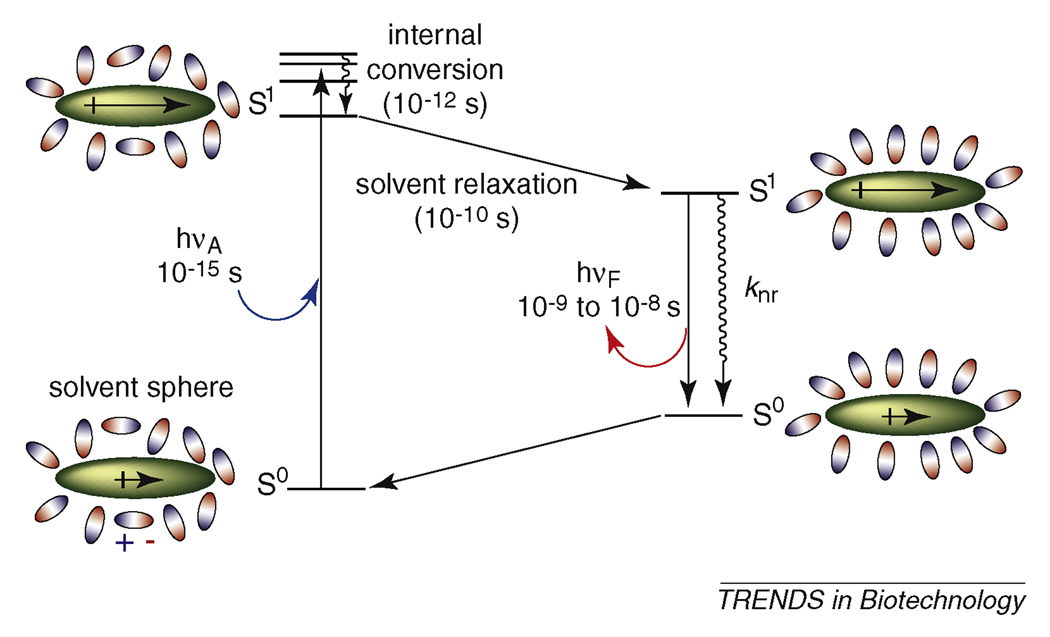
Solvatochromic fluorophores possess emission properties that are sensitive to the nature of the local microenvironment. These dyes have been exploited in applications ranging from the study of protein structural dynamics to the detection of protein-binding interactions. Although the solvatochromic indole fluorophore of tryptophan has been utilized extensively for in vitro studies to advance our understanding of basic protein biochemistry, the emergence of new extrinsic synthetic dyes with improved properties, in conjunction with recent developments in site-selective methods to incorporate these chemical tools into proteins, now open the way for studies in more complex systems. Herein, we discuss recent technological advancements and their application in the design of powerful reporters, which serve critical roles in modern cell biology and assay development.
2009 Elsevier Ltd. All rights reserved.
Figures
References
-
- Jares-Erijman EA, Jovin TM. FRET imaging. Nat. Biotechnol. 2003;21:1387–1395. - PubMed
-
- Goulko AA, et al. Fluorescence polarization: recent bioanalytical applications, pitfalls, and future trends. In: Wolfbeis OS, editor. Springer Series on Fluorescence. 1st edn. Springer; 2008. pp. 303–322.
-
- Krichevsky O, Bonnet G. Fluorescence correlation spectroscopy: the technique and its applications. Rep. Prog. Phys. 2002;65:251–297.
-
- Janzen WP. High throughput screening: methods and protocols. Humana Press; 2002. - PubMed
Publication types
MeSH terms
Substances
Grants and funding
LinkOut - more resources
Full Text Sources
Other Literature Sources
