


Intraflagellar transport: it's not just for cilia anymore
- PMID: 19962875
- PMCID: PMC3789623
- DOI: 10.1016/j.ceb.2009.10.010
Intraflagellar transport: it's not just for cilia anymore
Abstract
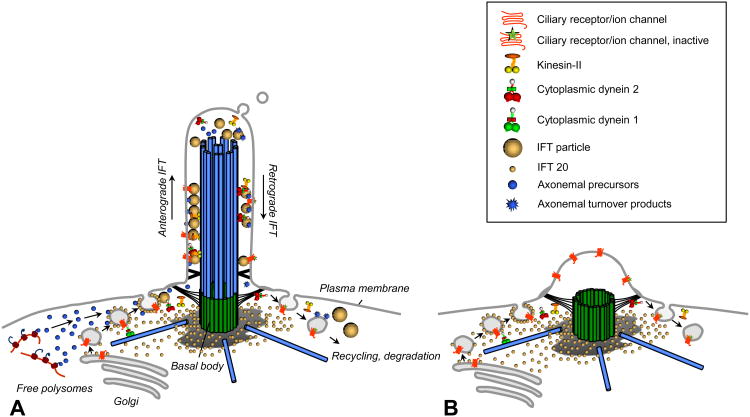
Recently published information on the role of intraflagellar transport (IFT) polypeptides in vesicle exocytosis is reviewed, describing the formation of the immune synapse in nonciliated cells as an example. A hypothesis is detailed suggesting that all polypeptides which enter the cilium, both membrane and axonemal, do so in association, first, with cytoplasmic vesicles which exocytose adjacent to the ciliary basal body, and then with the ciliary membrane. Axonemal proteins are moved to the ciliary tip by peripheral association with the inner aspects of the ciliary membrane by cannonical ciliary IFT. At the tip, some polypeptides are released for axonemal assembly, and others are budded off as part of vesicular exosomes into the environment. It is proposed that the cilium, in addition to being a sensory and motile organelle, is also a secretory organelle.
Copyright 2009 Elsevier Ltd. All rights reserved.
Figures
References
-
- Pazour GJ, Rosenbaum J. Intraflagellar transport and cilia-dependent diseases. Trends Cell Biol. 2002;12:551–555. - PubMed
-
- Christensen ST, Pedersen LB, Schneider L, Satir P. Sensory cilia and integration of signal transduction in human health and disease. 2007;8:97–109. - PubMed
-
- Sharma N, Berbari N, Yoder B. Ciliary dysfunction in developmental abnormalities and diseases. Curr Top Dev Biol. 2008;85:371–427. - PubMed
-
- Quinlan RJ, Tobin JL, Beales PL. Modeling ciliopathies: Primary cilia in development and disease. Curr Top Dev Biol. 2008;84:249–310. - PubMed
Publication types
MeSH terms
Substances
Grants and funding
LinkOut - more resources
Full Text Sources
