


Review
doi: 10.1016/j.smim.2009.11.001.
Epub 2009 Dec 4.
A double-edged sword: the role of NKT cells in malaria and HIV infection and immunity
Affiliations
- PMID: 19962909
- PMCID: PMC3603358
- DOI: 10.1016/j.smim.2009.11.001
Item in Clipboard
Review
A double-edged sword: the role of NKT cells in malaria and HIV infection and immunity
Semin Immunol.
2010 Apr.
Abstract
NKT cells are known to play a role against certain microbial infections, including malaria and HIV, two major global infectious diseases. NKT cells exhibit either protective or pathogenic role against malaria. They are depleted by HIV infection and have a direct pathogenic role against many opportunistic infections common in end-stage AIDS. This review discusses the various features of the interaction between NKT cells and malaria parasites and HIV, and the potential to harness this interaction for therapeutic and vaccine strategies.
Figures
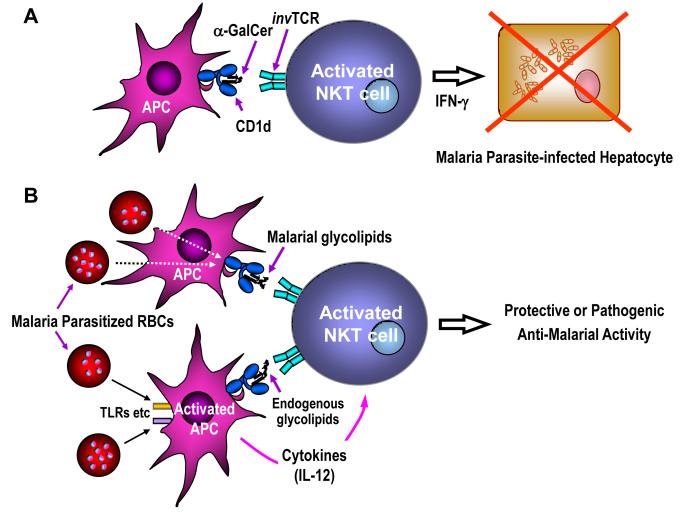
Interaction between NKT cells and malaria parasites. A: NKT cells activated by a CD1d-binding glycolipid, α-GalCer, can exhibit inhibitory activity against the development of the liver stages of malaria, which is mediated by IFN-γ. B: NKT cells may get activated directly by plasmodial glycolipids/phospholipids that bind CD1d. Alternatively, plasmodial lipids may cause up-regulation of CD1d-binding endogenous glycolipids by stimulating antigen presenting cells (APCs) through toll-like receptors (TLRs) and other receptors. The endogenous glycolipids together with IL-12 secreted by stimulated APCs may, in turn, induce activation of NKT cells. Upon activation, NKT cells may exhibit protective or pathogenic anti-malarial activity.
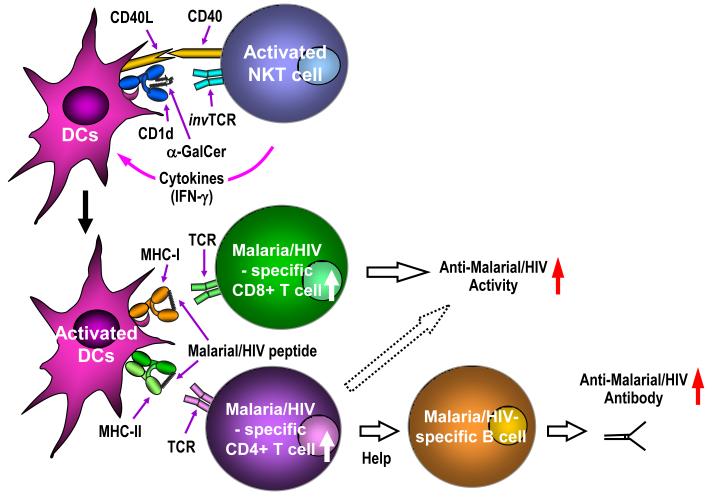
Role of NKT cells in adaptive immunity against malaria and HIV. In the context of CD1d molecules, α-galactosyl ceramide (α-GalCer) stimulates NKT cells through their invariant T cell receptor (invTCR). Upon activation, NKT cells rapidly secrete cytokines such as IFN-γ, and together with CD40-CD40L interaction, induce activation and maturation of dendritic cells (DCs). Thus, co-administration of α-GalCer with vaccines expressing malaria or HIV antigens are able to enhance the efficacy of the vaccines by augmenting the levels of antigen-specific T cell and humoral responses.
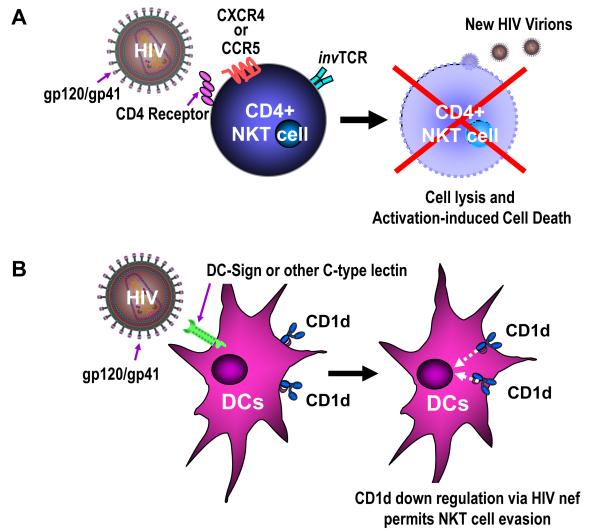
Two primary mechanisms of HIV evasion against NKT cells. A: HIV directly infects CD4+ NKT cells in the same manner as conventional CD4+ T cells, via attachment of the gp120/gp41 envelope complex to the CD4 receptor, causing direct NKT cell lysis and/or activation-induced cell death. B: HIV can directly infect dendritic cells (DCs) through binding of DC-Sign or other C-type lectins on the DC surface. The HIV nef gene downregulates CD1d surface expression on the DC surface, impairing the ability for these antigen presenting cells (APCs) to bind glycolipids and activate NKT cells through binding of their invariant T cell receptor (invTCR) by the CD1d/glycolipid complex.
References
-
- Godfrey DI, Berzins SP. Control points in NKT-cell development. Nat Rev Immunol. 2007;7:505–18. - PubMed
-
- Smyth MJ, Crowe NY, Hayakawa Y, Takeda K, Yagita H, Godfrey DI. NKT cells - conductors of tumor immunity? Curr Opin Immunol. 2002;14:165–71. - PubMed
-
- Smyth MJ, Crowe NY, Godfrey DI. NK cells and NKT cells collaborate in host protection from methylcholanthrene-induced fibrosarcoma. Int Immunol. 2001;13:459–63. - PubMed
-
- Kobayashi E, Motoki K, Uchida T, Fukushima H, Koezuka Y. KRN7000, a novel immunomodulator, and its antitumor activities. Oncol Res. 1995;7:529–34. - PubMed
-
- Giaccone G, Punt CJ, Ando Y, Ruijter R, Nishi N, Peters M, et al. A phase I study of the natural killer T-cell ligand alpha-galactosylceramide (KRN7000) in patients with solid tumors. Clin Cancer Res. 2002;8:3702–9. - PubMed
Publication types
MeSH terms
Substances
Grants and funding
LinkOut - more resources
Full Text Sources
Medical
