


Progesterone reduces depressive behavior of young ovariectomized, aged progestin receptor knockout, and aged wild type mice in the tail suspension test
- PMID: 19965943
- PMCID: PMC3608207
- DOI: 10.1177/0269881109349836
Progesterone reduces depressive behavior of young ovariectomized, aged progestin receptor knockout, and aged wild type mice in the tail suspension test
Abstract
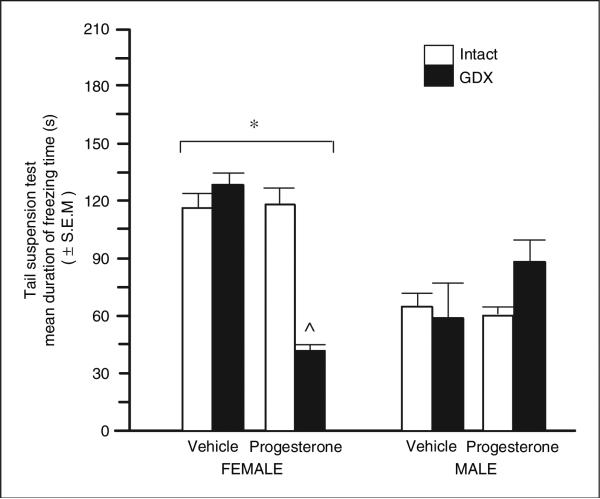
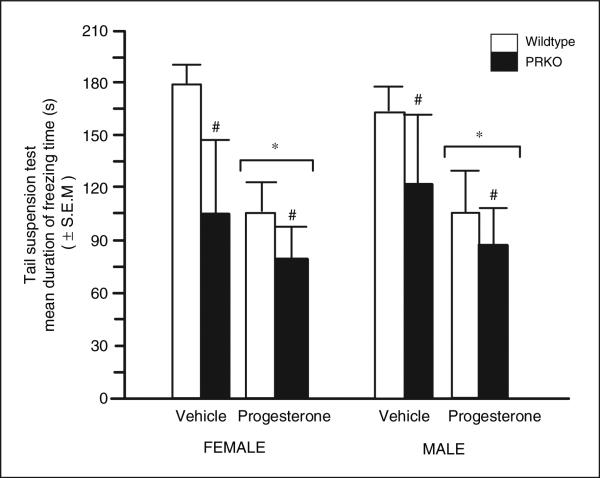
Progestins may have effects to reduce depressive behavior, in part through actions of its metabolite, 5α-pregnan-3α-ol-20-one (3α,5α-THP) at GABA(A) receptors, rather than through intracellular progestin receptors. In this study, we examined the effects of progesterone (10 mg/kg, subcutaneous injection) versus vehicle control (propylene glycol) on the depressive behavior of young and aged mice in the tail suspension test. In Experiment 1, we first characterized progesterone's anti-depressant effects by utilizing young (4-6-month-old) intact or ovariectomized female, and intact or gonadectomized male, C57BL/6 mice. Young female mice showed more depressive behavior than the young male mice. Compared with vehicle administration, progesterone reduced depressive behavior of ovariectomized female, but not male or intact female mice. In Experiment 2, mice were aged (20-24-month-old) intact wild type or progestin receptor knockout mice. Progestin receptor knockout mice showed less depressive behavior than wild type mice. Administration of progesterone to wild type and progestin receptor knockout mice reduced depressive behavior. Together, these data suggest that progesterone can decrease depressive behavior of young adult ovariectomized female, aged wild type and progestin receptor knockout mice. Thus, progesterone's effect to reduce depressive behavior of aged mice may not require actions at the intracellular progestin receptors.
Figures
References
-
- Angst J, Sellaro R, Merikangas KR, Endicott J. The epidemiology of premenstrual psychological symptoms. Acta Psychiatr Scand. 2001;104:110–116. - PubMed
-
- Backstrom T, Andreen L, Birzniece V, et al. The role of hormones and hormonal treatments in premenstrual syndrome. CNS Drugs. 2003;17:325–342. - PubMed
-
- Ballinger CB, Browning MC, Smith AH. Hormone profiles and psychological symptoms in peri-menopausal women. Maturitas. 1987;9:235–251. - PubMed
-
- Barros HM, Ferigolo M. Ethopharmacology of imipramine in the forced-swimming test: gender differences. Neurosci Biobehav Rev. 1998;23:279–286. - PubMed
-
- Becker J, Cha J. Estrous cycle-dependent variation in amphetamine-induced behaviors and striatal dopamine release assessed with microdialysis. Behav Brain Res. 1989;35:117–125. - PubMed
Publication types
MeSH terms
Substances
Grants and funding
LinkOut - more resources
Full Text Sources
Medical
