


Case Reports
doi: 10.1038/ng.497.
Epub 2009 Dec 6.
A restricted spectrum of NRAS mutations causes Noonan syndrome
Affiliations
- PMID: 19966803
- PMCID: PMC3118669
- DOI: 10.1038/ng.497
Item in Clipboard
Case Reports
A restricted spectrum of NRAS mutations causes Noonan syndrome
Nat Genet.
2010 Jan.
Abstract
Noonan syndrome, a developmental disorder characterized by congenital heart defects, reduced growth, facial dysmorphism and variable cognitive deficits, is caused by constitutional dysregulation of the RAS-MAPK signaling pathway. Here we report that germline NRAS mutations conferring enhanced stimulus-dependent MAPK activation account for some cases of this disorder. These findings provide evidence for an obligate dependency on proper NRAS function in human development and growth.
Figures
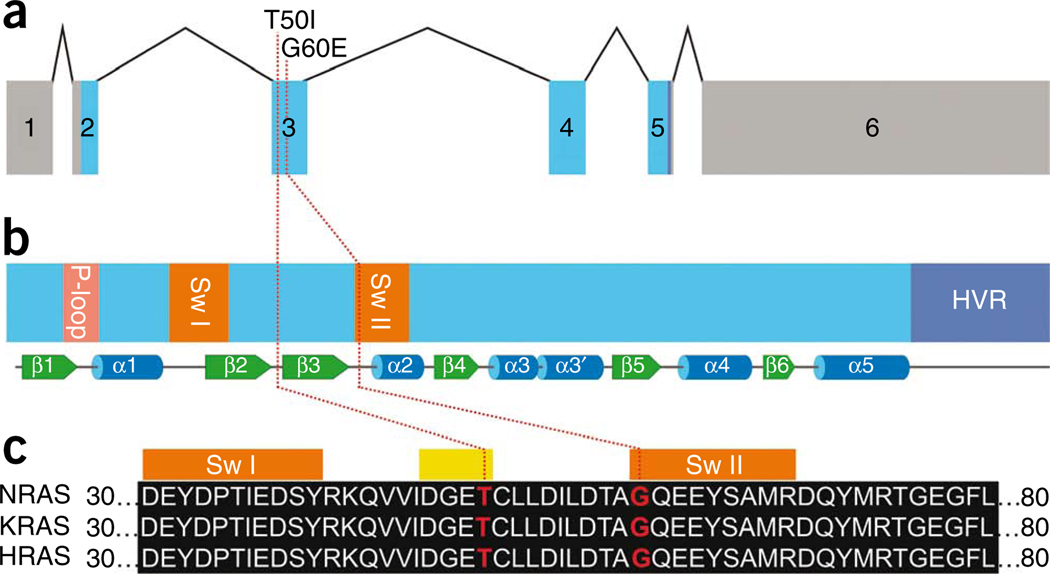
NRAS genomic organization and protein structure and position of Noonan syndrome–causing NRAS mutations. (a) Exon-intron structure of the human NRAS gene showing untranslated regions as gray boxes and coding exons as blue boxes. (b) Motifs and secondary structures of the NRAS protein. Functional motifs including the P-loop, switch I (Sw I), switch II (Sw II) and the hypervariable region (HVR) are highlighted. Underneath, secondary structural elements are shown as green arrows and blue cylinders representing β-sheets and α-helices, respectively. (c) Partial amino acid sequence alignment of human NRAS, KRAS and HRAS showing conservation of Thr50 and Gly60 (red). Orange boxes on top of the alignment mark amino acids comprising the switch I and II regions, and the yellow box marks the four amino acids of the β2−β3 loop. Red dotted lines in panels a to c indicate the positions of nucleotides and amino acids, respectively, affected by Noonan syndrome-causing mutations.
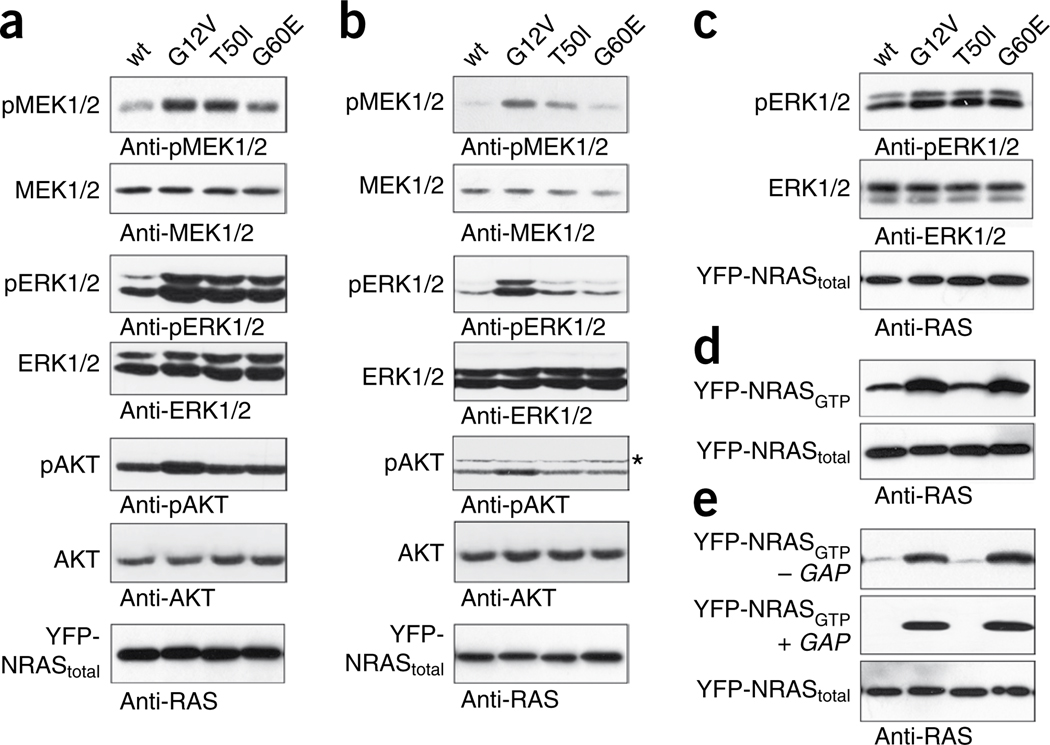
Biochemical characterization of the Noonan syndrome–causing T50I and G60E NRAS mutants. (a,b) Determination of MEK, ERK and AKT phosphorylation levels in transiently transfected COS-7 cells cultured in medium with serum (a) or in basal medium (b). Expression of each of the three NRAS mutants (G12V, G60E and T50I) resulted in enhanced MEK and ERK phosphorylation in the presence of serum, whereas only the oncogenic G12V substitution substantially stimulated phosphorylation of MEK and ERK in serum-deprived cells. Contrasting with what was observed for the G12V change, no effect on AKT phosphorylation was detectable in cells expressing the Noonan syndrome–causing T50I or G60E mutant under both culture conditions. Asterisk beside the pAKT blot marks artifactual bands (Supplementary Fig. 7). Total amounts of MEK, ERK and AKT in cell lysates are shown for equal protein expression and loading. (c) EGF stimulation of serum-starved cells reproduced the effects on ERK phosphorylation observed in the presence of serum. (d) Determination of GTP-bound NRAS levels in COS-7 cells transiently expressing wild-type NRAS or each mutant in the presence of serum. Similar to the oncogenic G12V mutant, G60E, but not T50I, accumulated in the GTP-bound form. (e) The same experiment was performed under serum-free conditions. Both the G12V and G60E mutants were predominantly present in the active GTP-bound form, whereas the T50I mutant was not. Addition of purified RasGAP left GTP-bound levels of the G12V and G60E mutants unaffected, demonstrating GAP resistance of these mutants, in contrast to the T50I mutant. Total amounts of exogenous (yellow fluorescent protein-tagged) NRAS in cell lysates are shown for each experiment (a–e). Specificity of the antibody employed in each experiment is indicated below each panel. Wt, wild type.
References
Publication types
MeSH terms
Substances
Grants and funding
LinkOut - more resources
Full Text Sources
Medical
Molecular Biology Databases
Miscellaneous
