


Meta-analyses of hypnotics and infections: eszopiclone, ramelteon, zaleplon, and zolpidem
- PMID: 19968019
- PMCID: PMC2725260
Meta-analyses of hypnotics and infections: eszopiclone, ramelteon, zaleplon, and zolpidem
Abstract
Study objectives: Recent meta-analyses raising concern about risks of hypnotics suggest a need for more clarification of these risks.
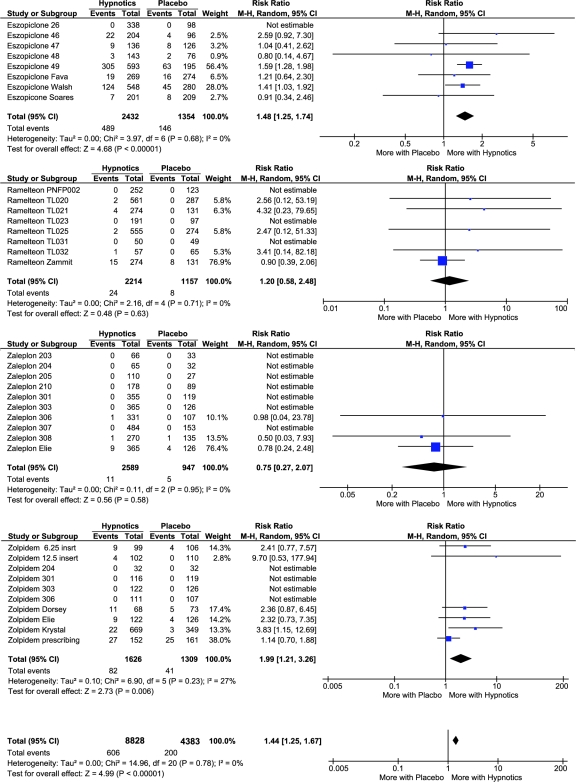
Methods: Because of preliminary suggestions that eszopiclone causes infections, we studied US Food and Drug Administration files on the 4 most-recently approved hypnotics, combined with published studies, to compile the risk ratios of infections for groups randomly assigned to receive hypnotics versus those assigned to receive placebos in controlled trials. Parallel controlled clinical trials of eszopiclone, ramelteon, zaleplon, and zolpidem were included when data on subjects, duration of exposure, and adverse effects were available. Results of trials were combined by meta-analyses.
Results: Of 8828 participants assigned to the 4 hypnotics and 4383 participants who randomly received placebos, 606 in the hypnotics groups and 200 in the placebo groups were reported to develop some kind of infection (risk ratio = 1.44, 95% confidence interval 1.25-1.64, p < 0.00001). Most infections were apparently mild and did not lead to dropouts. Subanalyses for individual drugs indicated that eszopiclone and zolpidem individually were associated with reported infections. There were insufficient data concerning individual studies of zaleplon and ramelteon for valid secondary meta-analyses of zaleplon or ramelteon by themselves.
Conclusions: Research is needed to objectively determine whether the use of hypnotics increases the risk of infections. Immune compromise or esophageal reflux and aspiration should be studied as possible mechanisms.
Figures
References
-
- Saul S. Some sleeping pill users range far beyond bed. [Accessed July 24, 2008];New York Times. 2006 Mar 8; at http://www.nytimes.com/2006/03/08/business/08ambien.html?scp=1&sq=ambien....
-
- Kripke DF. Risks of chronic hypnotic use. In: Lader M, Cardinali DP, Pandi-Perumal SR, editors. Sleep and Sleep Disorders: a Neuropsychopharmacological Approach. Georgetown, TX: Landes Bioscience; 2004. Available at http://www.ncbi.nlm.nih.gov/books/bv.fcgi?rid=eurekah.chapter.28842.
-
- Kripke DF, Garfinkel L, Wingard DL, Klauber MR, Marler MR. Mortality associated with sleep duration and insomnia. Arch Gen Psychiatry. 2002;59:131–6. - PubMed
Publication types
MeSH terms
Substances
LinkOut - more resources
Full Text Sources
Other Literature Sources