


Surgery for knee osteoarthritis in younger patients
- PMID: 19968599
- PMCID: PMC2852150
- DOI: 10.3109/17453670903413186
Surgery for knee osteoarthritis in younger patients
Abstract
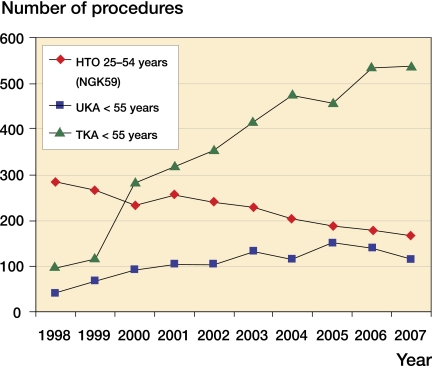
Background and purpose: In Sweden, surgery for knee osteoarthritis (OA) in patients younger than 55 years of age has doubled during the last 10 years. We evaluated the use of 3 surgical alternatives: high tibial osteotomy (HTO), unicompartmental arthroplasty (UKA), and total knee arthroplasty (TKA). We also examined the outcome, expressed by rate of revision.
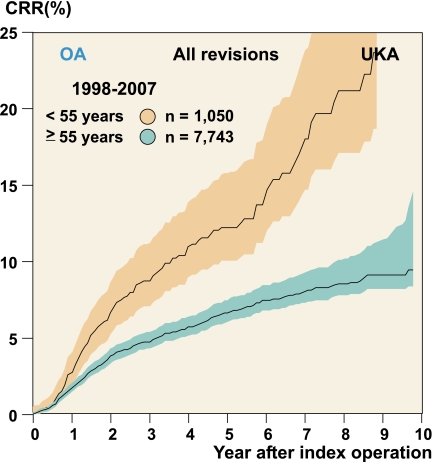
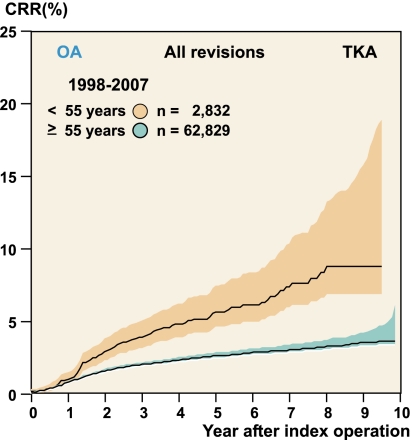
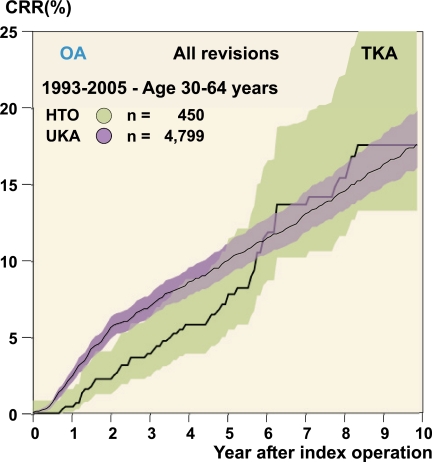
Methods: The numbers of all procedures during 1998-2007 were obtained from the Swedish Knee Arthroplasty Register (SKAR) (UKA < 55 years: n = 1,050; UKA > or = 55 years: n = 7,743; TKA < 55 years: n = 2,832; TKA > or = 55 years: n = 62,829) and the National Board of Health and Welfare (NHW) (HTO 25-55 years: n = 2,266). The revision rate (presented as life tables) was based on the SKAR material for arthroplasties. For HTOs, a single institutional series of 450 patients aged 30-64 years was used to calculate the revision rate and to compare it to that for UKAs (n = 4,799; age 30-64 years).
Results: During the 10 years, the use of TKA in patients younger than 55 years increased fivefold. While UKA increased threefold, its use diminished in the last 2 years. Although the use of HTO halved during the period, it is still used more often than UKA. The risk of revision increased in patients younger than 55 years and was lower for TKA (9%) than for UKA (24%). The revision rate was similar for HTO (17%) and for UKA (17%) in patients aged 30-64 years.
Interpretation: TKA is the preferred method for young OA patients in Sweden today. The use of HTO and UKA has diminished, and as the few operations are spread over many hospitals, there is a risk of gradual loss of experience with respect to patient selection and surgical routine-with a negative effect on outcome. Thus, there is a risk that these treatment alternatives for younger patients will eventually be abandoned.
Figures
References
-
- Australian Orthopedic Association National Joint Replacement Registry (AOANJRR) Annual report http://www.dmac.adelaide.edu.au/ 2008
-
- Robertsson O, Lidgren L. The short-term results of 3 common UKA implants during different periods in Sweden. J Arthroplasty. 2008;23((6)):801–7. - PubMed
-
- Robertsson O, Knutson K, Lewold S, Lidgren L. The routine of surgical management reduces failure after unicompartmental knee arthroplasty. J Bone Joint Surg (Br) 2001;83((1)):45–9. - PubMed
-
- Swedish Knee Arthroplasty Register (SKAR) www.knee.se 2008
-
- The Medical Product Agency (MPA), Sweden Treatment of osteoarthritis. Treatment recommendations. 2004
Publication types
MeSH terms
LinkOut - more resources
Full Text Sources