. 2010 Jan;75(2):394-412.
doi: 10.1111/j.1365-2958.2009.06987.x. Epub 2009 Dec 4.

Asymmetric cross-regulation between the nitrate-responsive NarX-NarL and NarQ-NarP two-component regulatory systems from Escherichia coli K-12

Affiliations

Asymmetric cross-regulation between the nitrate-responsive NarX-NarL and NarQ-NarP two-component regulatory systems from Escherichia coli K-12

Chris E Noriega et al. Mol Microbiol. 2010 Jan.

Abstract

The NarX-NarL and NarQ-NarP sensor-response regulator pairs control Escherichia coli gene expression in response to nitrate and nitrite. Previous analysis suggests that the Nar two-component systems form a cross-regulation network in vivo. Here we report on the kinetics of phosphoryl transfer between different sensor-regulator combinations in vitro. NarX exhibited a noticeable kinetic preference for NarL over NarP, whereas NarQ exhibited a relatively slight kinetic preference for NarL. These findings were substantiated in reactions containing one sensor and both response regulators, or with two sensors and a single response regulator. We isolated 21 NarX mutants with missense substitutions in the cytoplasmic central and transmitter modules. These confer phenotypes that reflect defects in phospho-NarL dephosphorylation. Five of these mutants, all with substitutions in the transmitter DHp domain, also exhibited NarP-blind phenotypes. Phosphoryl transfer assays in vitro confirmed that these NarX mutants have defects in catalysing NarP phosphorylation. By contrast, the corresponding NarQ mutants conferred phenotypes indicating comparable interactions with both NarP and NarL. Our overall results reveal asymmetry in the Nar cross-regulation network, such that NarQ interacts similarly with both response regulators, whereas NarX interacts preferentially with NarL.


Figures
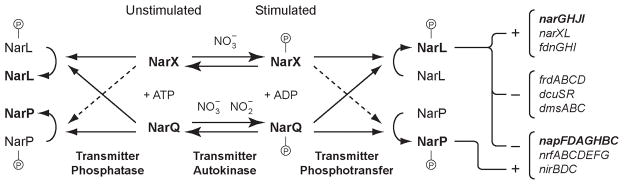
Fig. 1
Fig. 1
Model for asymmetry in the NarX-NarL and NarQ-NarP cross regulation network. Dashed arrows represent relatively slow reactions. The NarX and NarQ sensor populations are hypothesized to be in a two-state equilibrium determined by stimulus (ligand binding). Phospho-sensors catalyze response regulator phosphorylation, whereas dephospho-sensors catalyze regulator dephosphorylation. Phospho-regulators activate (+) or repress (−) transcription; representative target operons are shown.
Fig. 2
Fig. 2
Single-round phosphoryl-transfer between Nar sensors and response regulators in the absence of nucleotides. ○, Phospho-MBP-NarX227; □, phospho-MBP-NarQ226; ●, phospho-His6-NarL; ■, phospho-His6-NarP. Sensors (0.5 μM dimers), prepared from gel-filtration, were incubated with 32P-ATP for autophosphorylation, and then nucleotides were removed by filtration through a spin column. Response regulators (10 μM monomers) were added at time = 0, and time-point samples were resolved by Laemmli gel electrophoresis. Panels A-D show results for the indicated combinations. Panel E shows phosphorimages of the gels used for these plots.
Fig. 3
Fig. 3
Multiple-round phosphoryl-transfer between Nar sensors and response regulators in the presence of nucleotides. Results are from a single representative experiment; others not shown generated similar patterns. ○, Phospho-MBP-NarX227; □, phospho-MBP-NarQ226; ●, phospho-His6-NarL; ■, phospho-His6-NarP. Sensors (0.5 μM dimers), prepared from gel filtration, were incubated with 32P-ATP for autophosphorylation in the presence of ATP regeneration. Response regulators (10 μM monomers) were added at time = 0, and time-point samples were resolved by Laemmli gel electrophoresis. Panels A–F show results for the indicated combinations.
Fig. 4
Fig. 4
Multiple-round phosphoryl-transfer between Nar sensors and response regulators in the presence of nucleotides. Results are from a single representative experiment; others not shown generated similar patterns. ○, Phospho-MBP-NarX227; □, phospho-MBP-NarQ226; ✕, phospho-MBP-Nar Sensor (when both were present); ●, phospho-His6-NarL; ■, phospho-His6-NarP. Sensors (0.5 μM dimers), prepared from gel filtration, were incubated with 32P-ATP for autophosphorylation in the presence of ATP regeneration. Response regulators (10 μM monomers) were added at time = 0, and time-point samples were resolved by Laemmli gel electrophoresis. At the 5 min time point, the indicated component (buffer or MBP-Sensor dimers, 0.5 μM final concentration) was added.
Fig. 5
Fig. 5
Autophosphorylation of wild-type and NarP-blind MBP-NarX proteins. Panels A and B show results from assays conducted in the presence and absence of ATP regeneration, respectively. Incorporated radiolabel was quantified by filter-binding as described in Experimental Procedures. Approximately 2.5 pmol of MBP-NarX dimers were present in each reaction. Results are from a single representative experiment; others not shown generated similar patterns. ○, Phospho-MBP-NarX; ▼, phospho-MBP-NarX(M411T); ▲, phospho-MBP-NarX(W442R); ◆, phospho-MBP-NarX(Q412R+M413V); △, phospho-MBP-NarX(K410E); and ▽, phospho-MBP-NarX(F452Y).
Fig. 6
Fig. 6
Phosphoryl-transfer between Nar sensors and response regulators at 4°C. Results are from a single representative experiment; others not shown generated similar patterns. ○, Phospho-MBP-NarX; ▼, phospho-MBP-NarX(M411T); ▲, phospho-MBP-NarX(W442R); ◆, phospho-MBP-NarX(Q412R+M413V); △, phospho-MBP-NarX(K410E); ▽, phospho-MBP-NarX(F452Y); ●, phospho-His6-NarL; and ■, phospho-His6-NarP. Sensors (0.5 μM dimers) were incubated at 19°C with 32P-ATP for autophosphorylation in the presence of ATP regeneration. After equilibration to 4°Cm response regulators (10 μM monomers) were added at time = 0, and time-point samples were resolved by Laemmli gel electrophoresis. Panels A-F show results for the indicated combinations.
Fig. 7
Fig. 7
NarX and NarQ DHp domains. The NarP-blind substitutions are denoted with boldface letters above the E. coli NarX sequence. Numbers above and below the E. coli sequences show positions of mutational alterations described in this study, as well as the phosphoaccepting His residue (His-399 in NarX and His-370 in NarQ). Sequences are from Escherichia coli K-12 (GenBank accession number NC_000913), Citrobacter rodentium ICC168 (http://www.sanger.ac.uk), and Salmonella enterica LT-2 (NC_009137). The H box and X box motifs are defined in references (Wolanin et al., 2002) and (Hsing et al., 1998), respectively. Residues identical in all six sequences are indicated with black background, whereas residues identical in all three NarX or NarQ sequences are indicated with gray background. Lower-case letters between the NarX and NarQ sequences show the coiled-coil heptad positions from the DesK X-ray structure (Albanesi et al., 2009). The phosphoaccepting His residue occupies a skip position denoted here as “x” within the heptad repeats. Numbers to the left and right indicate positions of the terminal residues in the full-length sequences, which span 598 residues for NarX and 566 residues for NarQ.

References

    1. Albanesi D, Martin M, Trajtenberg F, Mansilla MC, Haouz A, Alzari PM, et al. Structural plasticity and catalysis regulation of a thermosensor histidine kinase. Proc Natl Acad Sci USA. 2009;106:16185–16190. - PMC - PubMed
    1. Alves R, Savageau MA. Comparative analysis of prototype two-component systems with either bifunctional or monofunctional sensors: differences in molecular structure and physiological function. Mol Microbiol. 2003;48:25–51. - PubMed
    1. Appleman JA, Stewart V. Mutational analysis of a conserved signal-transducing element: the HAMP linker of the Escherichia coli nitrate sensor NarX. J Bacteriol. 2003;185:89–97. - PMC - PubMed
    1. Atkinson MR, Ninfa AJ. Characterization of Escherichia coli glnL mutations affecting nitrogen regulation. J Bacteriol. 1992;174:4538–4548. - PMC - PubMed
    1. Cai SJ, Inouye M. EnvZ-OmpR interaction and osmoregulation in Escherichia coli. J Biol Chem. 2002;277:24155–24161. - PubMed

Publication types

MeSH terms

LinkOut - more resources
