


Anti-Müllerian hormone and inhibin B variability during normal menstrual cycles
- PMID: 19969291
- PMCID: PMC2891288
- DOI: 10.1016/j.fertnstert.2009.07.1674
Anti-Müllerian hormone and inhibin B variability during normal menstrual cycles
Abstract
Objective: To describe anti-Müllerian hormone (AMH) variation across normal menstrual cycles.
Design: Cohort study.
Setting: Academic environment.
Patient(s): Twenty regularly menstruating women.
Intervention(s): Serum AMH and inhibin B assayed daily during one normal menstrual cycle.
Main outcome measure(s): Intracycle variability of AMH and inhibin B.
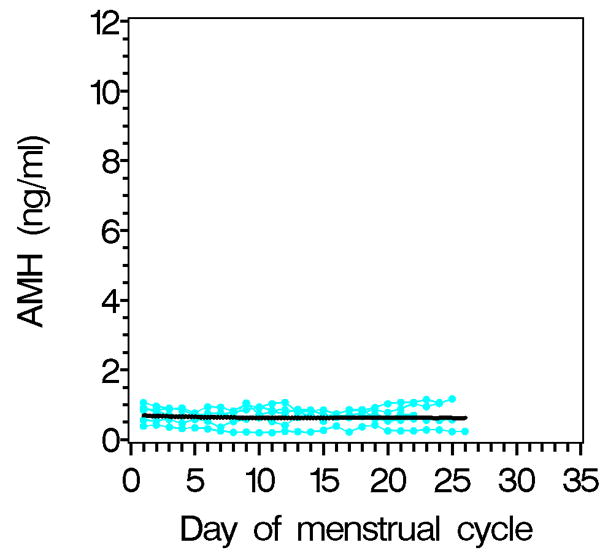
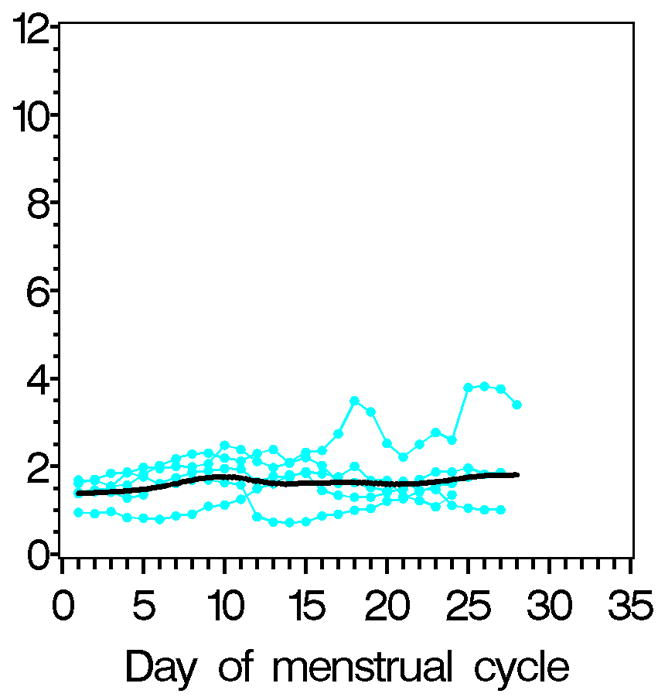
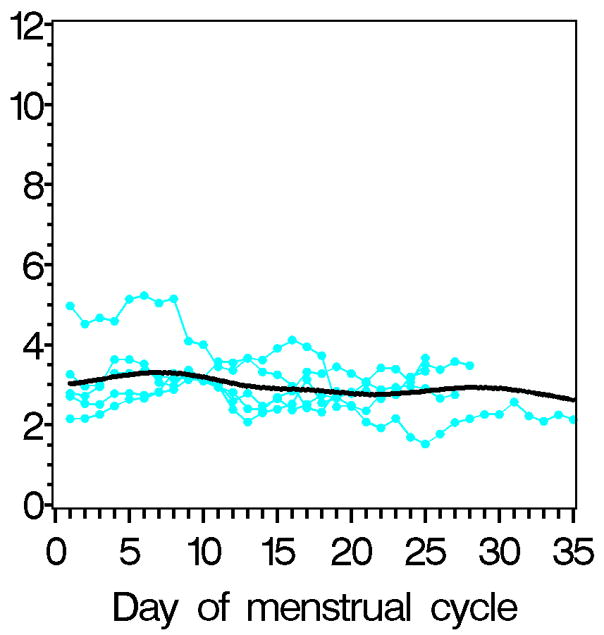
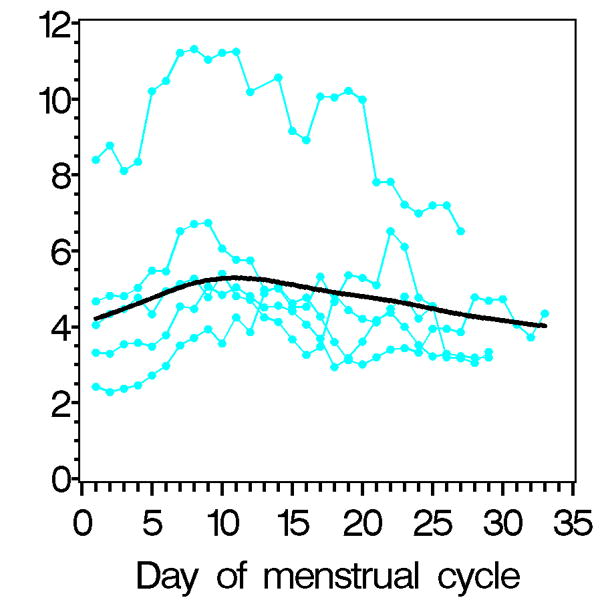
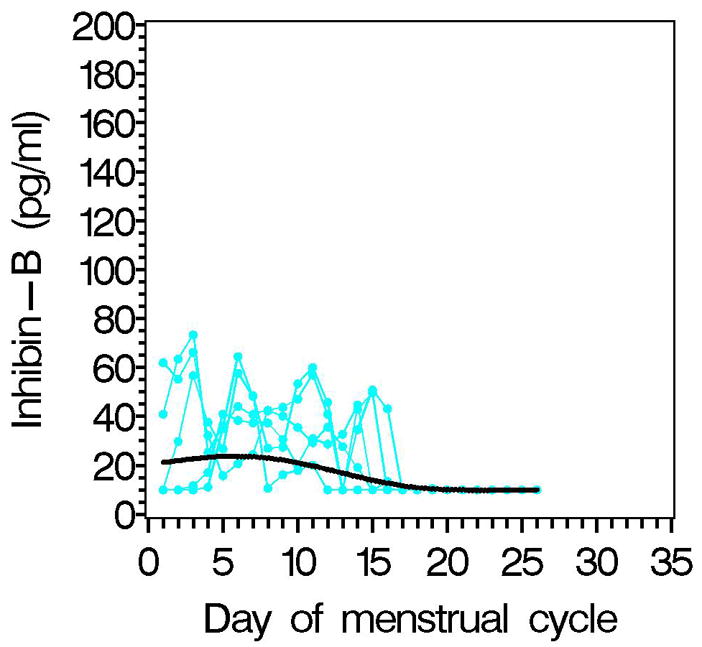
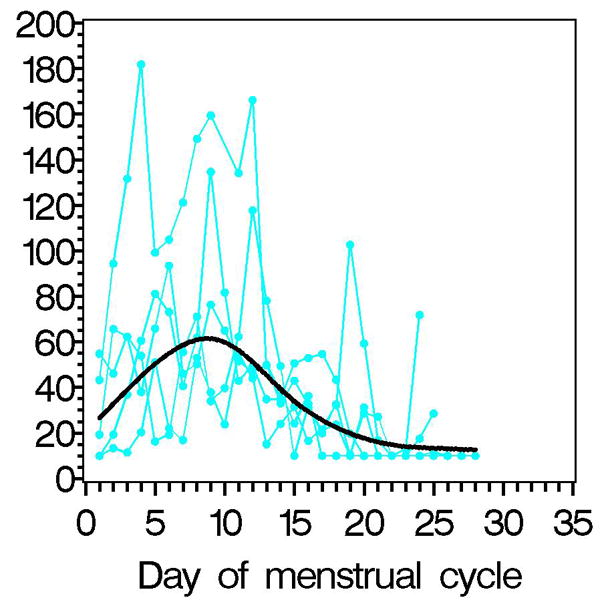
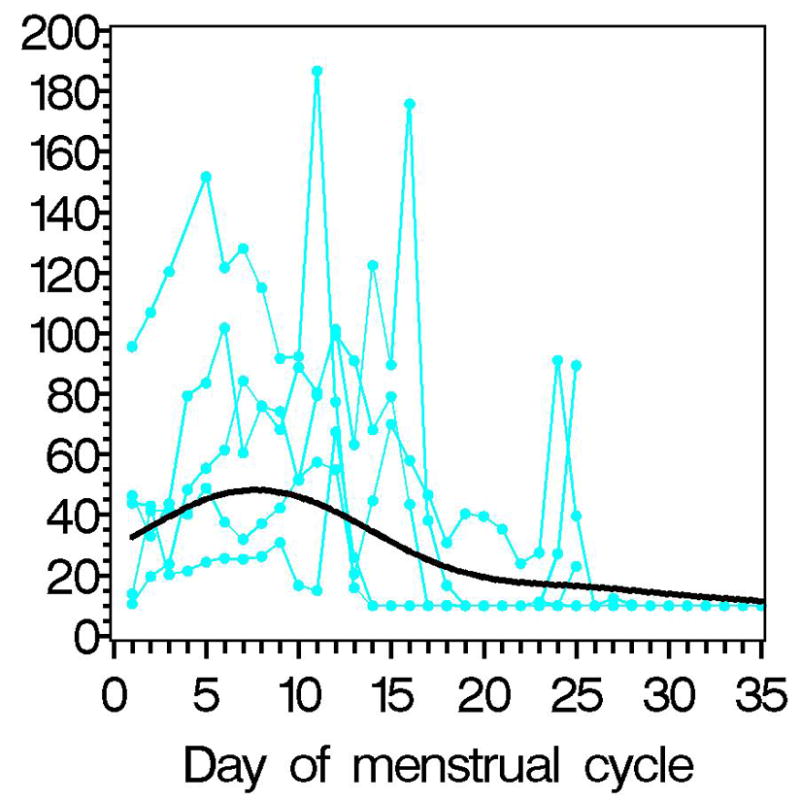
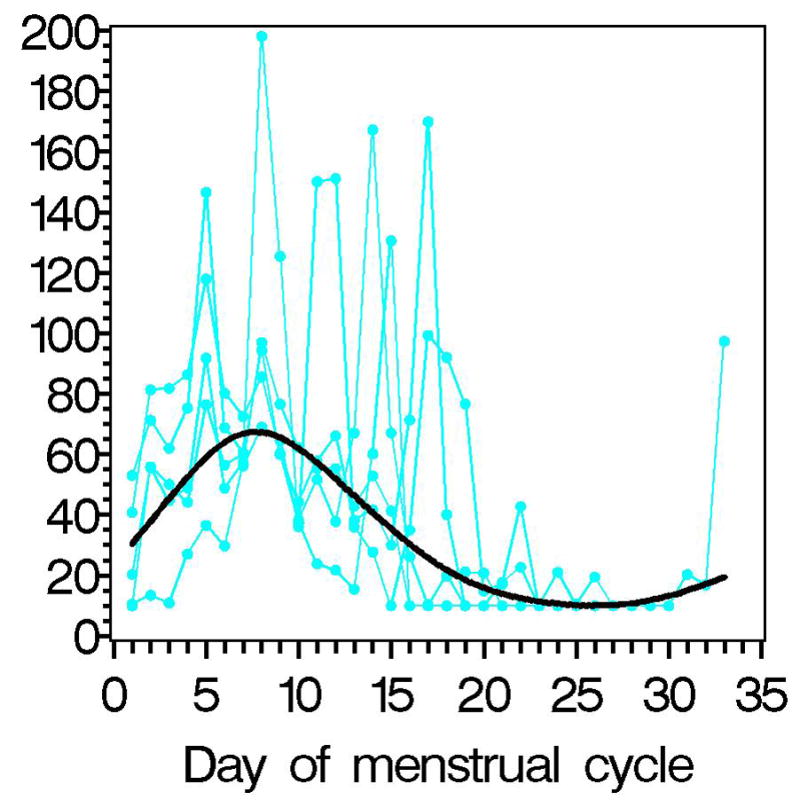
Result(s): Data were classified into quartiles of AMH area-under-the-curve (AUCs). Mean AMH AUC was 15.7 ng/mL for quartile 1 versus 43.5, 80.9 and 144.9 ng/mL for quartiles 2, 3, and 4. Mean AMH levels (ng/mL) were 0.67, 1.71, 3.02, and 5.33, respectively. There was no variation in quartile 1 AMH rate of change from stochastic modeling, but in quartiles 2 to 4, there were increased rates of change in days 2 to 7. Women in quartile 1 had the lowest mean inhibin B (24.2 pg/mL vs. 44.3, 43.2, and 42.2 pg/mL), and had shorter menstrual cycles (24.6 days) than women in quartiles 3 and 4 (28.2 and 28.4 days).
Conclusion(s): There were two menstrual cycle patterns of AMH. The "aging ovary" pattern included low AMH levels with little variation, lower inhibin B, and shorter cycle lengths. The "younger ovary" pattern included higher AMH levels with significant variation days 2 to 7, suggesting that for women with AMH>1 ng/mL, the interpretation of AMH levels is contingent upon the day of the menstrual cycle on which the specimen is obtained.
Copyright (c) 2010 American Society for Reproductive Medicine. Published by Elsevier Inc. All rights reserved.
Conflict of interest statement
Figures
Comment in
-
Variability in anti-Müllerian hormone levels: a comment on Sowers et al., Anti-Müllerian hormone and inhibin B variability during normal menstrual cycles.Fertil Steril. 2010 Sep;94(4):e59. doi: 10.1016/j.fertnstert.2010.06.016. Epub 2010 Jul 14. Fertil Steril. 2010. PMID: 20633878 No abstract available.
References
-
- Steiner AZ. Clinical implications of ovarian reserve testing. Obstet Gynecol Surv. 2009;64:120–8. - PubMed
-
- Kligman I, Rosenwaks Z. Differentiating clinical profiles: Predicting good responders, poor responders, and hyperresponders. Fertil Steril. 2001;76:1185–90. - PubMed
-
- Robertson DM, Hale GE, Fraser IS, Hughes CL, Burger HG. A proposed classification system for menstrual cycles in the menopausal transition based on changes in serum profiles. Menopause. 2008;15:1139–44. - PubMed
-
- Hale GE, Zhao X, Hughes CL, Burger HG, Robertson DM, Fraser IS. Endocrine features of menstrual cycles in middle and late reproductive age and the menopausal transition classified according to the staging of reproductive aging workshop (STRAW) staging system. J Clin Endocrinol Metab. 2007;92:3060–7. - PubMed
-
- Knight PG, Glister C. TGF-beta superfamily members and ovarian follicle development. Reproduction. 2006;132:191–206. - PubMed
Publication types
MeSH terms
Substances
Grants and funding
LinkOut - more resources
Full Text Sources
Other Literature Sources
Medical
