


The radiation response of cells from 9L gliosarcoma tumours is correlated with [F18]-EF5 uptake
- PMID: 19995239
- PMCID: PMC4110891
- DOI: 10.3109/09553000903242172
The radiation response of cells from 9L gliosarcoma tumours is correlated with [F18]-EF5 uptake
Abstract
Purpose: Tumour hypoxia affects cancer biology and therapy-resistance in both animals and humans. The purpose of this study was to determine whether EF5 ([2-(2-nitro-1-H-imidazol-1-yl)-N-(2,2,3,3,3-pentafluoropropyl)-acetamide]) binding and/or radioactive drug uptake correlated with single-dose radiation response in 9L gliosarcoma tumours.
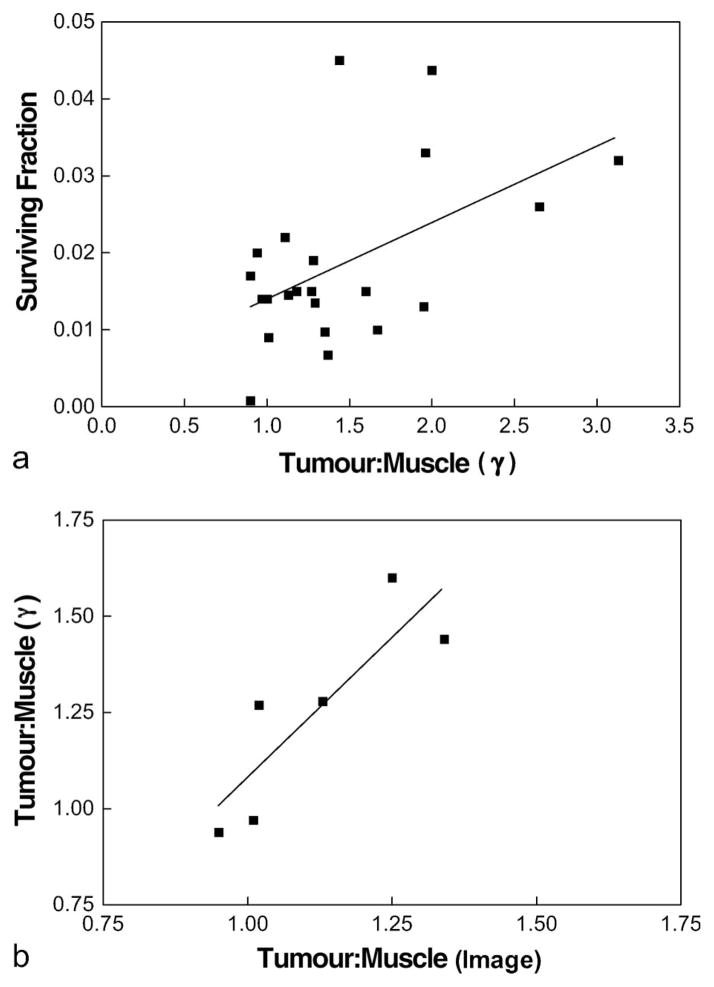
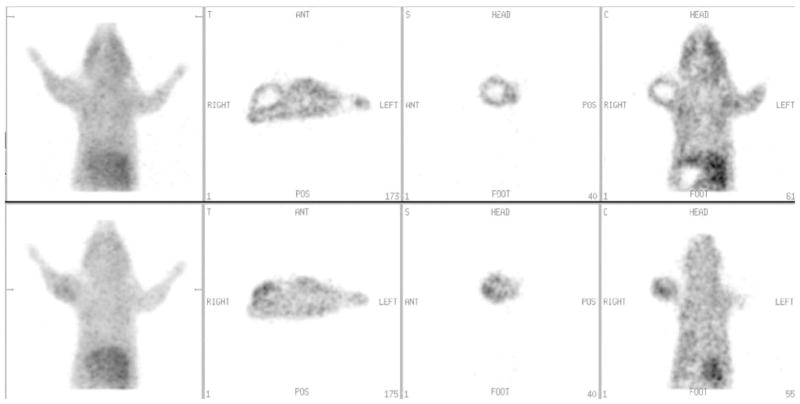
Materials and methods: Twenty-two 9L tumours were grown in male Fischer rats. Rats were administered low specific activity (18)F-EF5 and their tumours irradiated and assessed for cell survival and hypoxia. Hypoxia assays included EF5 binding measured by antibodies against bound-drug adducts and gamma counts of (18)F-EF5 tumour uptake compared with uptake by normal muscle and blood. These assays were compared with cellular radiation response (in vivo to in vitro assay). In six cases, uptake of tumour versus muscle was also assayed using images from a PET (positron emission tomography) camera (PENN G-PET).
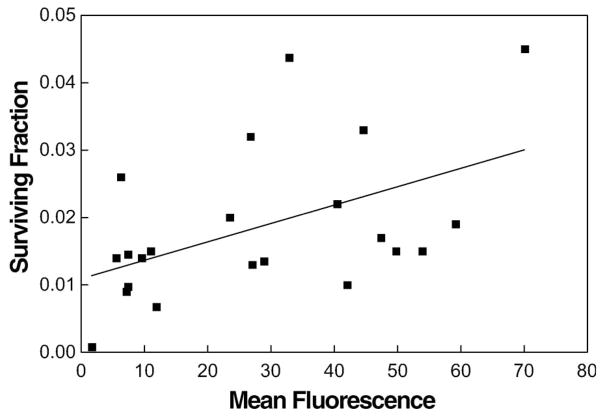
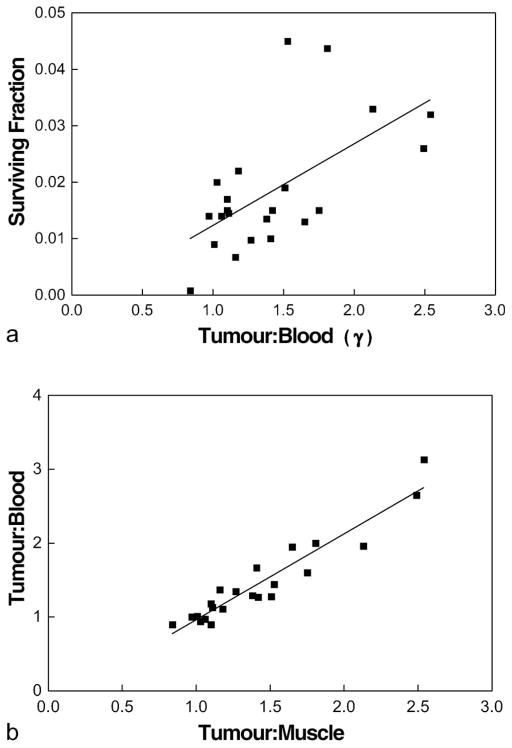
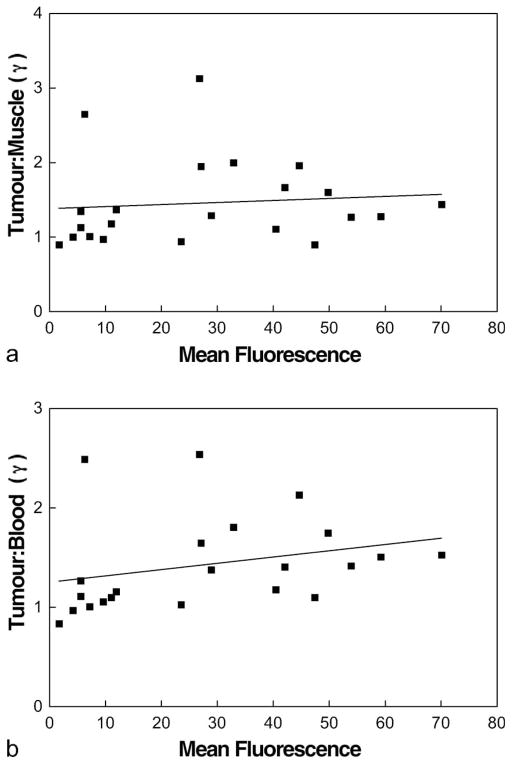
Results: The intertumoural variation in radiation response of 9L tumour-cells was significantly correlated with uptake of (18)F-labelled EF5 (i.e., including both bound and non-bound drug) using either tumour to muscle or tumour to blood gamma count ratios. In the tumours where imaging was performed, there was a significant correlation between the image analysis and gamma count analysis. Intertumoural variation in cellular radiation response of the same 22 tumours was also correlated with mean flow cytometry signal due to EF5 binding.
Conclusion: To our knowledge, this is the first animal model/drug combination demonstrating a correlation of radioresponse for tumour-cells from individual tumours with drug metabolism using either immunohistochemical or non-invasive techniques.
Conflict of interest statement
Figures
References
-
- Arbeit JM, Brown JM, Chao KSC, Chapman JD, Eckelman WC, Fyles AW, Giaccia AJ, Hill RP, Koch CJ, Krishna MC, Krohn KA, Lewis JS, Mason RP, Melillo G, Padhani AR, Powis G, Rajendran JG, Reba R, Robinson SP, Semenza GL, Swartz HM, Vaupel P, Yang D. Hypoxia: Importance in tumor biology, noninvasive measurement by imaging, and value of its measurement in the management of cancer therapy. International Journal of Radiation Biology. 2006;82:699–757. - PubMed
-
- Ballinger JR. Imaging hypoxia in tumors. Seminars in Nuclear Medicine. 2001;31:321–329. - PubMed
-
- Beck R, Roper B, Carlsen JM, Huisman MC, Lebschi JA, Andratschke M, Picchio M, Souvatzoglou M, Machulla H-J, Piert M. Pretreatment 18F-FAZA PET predicts success of hypoxia-directed radiochemotherapy using tirapazamine. Journal of Nuclear Medicine. 2007;48:973–980. - PubMed
-
- Bergman J, Solin O. Fluorine-18-labeled fluorine gas for synthesis of tracer molecules. Nuclear Medicine and Biology. 1997;24:677–683. - PubMed
Publication types
MeSH terms
Substances
Grants and funding
LinkOut - more resources
Full Text Sources
