. 2009 Dec 21;206(13):2869-77.
doi: 10.1084/jem.20090845. Epub 2009 Dec 7.

Maternal TLR signaling is required for prenatal asthma protection by the nonpathogenic microbe Acinetobacter lwoffii F78

Affiliations

Maternal TLR signaling is required for prenatal asthma protection by the nonpathogenic microbe Acinetobacter lwoffii F78

Melanie L Conrad et al. J Exp Med. .

Abstract

The pre- and postnatal environment may represent a window of opportunity for allergy and asthma prevention, and the hygiene hypothesis implies that microbial agents may play an important role in this regard. Using the cowshed-derived bacterium Acinetobacter lwoffii F78 together with a mouse model of experimental allergic airway inflammation, this study investigated the hygiene hypothesis, maternal (prenatal) microbial exposure, and the involvement of Toll-like receptor (TLR) signaling in prenatal protection from asthma. Maternal intranasal exposure to A. lwoffii F78 protected against the development of experimental asthma in the progeny. Maternally, A. lwoffii F78 exposure resulted in a transient increase in lung and serum proinflammatory cytokine production and up-regulation of lung TLR messenger RNA. Conversely, suppression of TLRs was observed in placental tissue. To investigate further, the functional relevance of maternal TLR signaling was tested in TLR2/3/4/7/9(-/-) knockout mice. The asthma-preventive effect was completely abolished in heterozygous offspring from A. lwoffii F78-treated TLR2/3/4/7/9(-/-) homozygous mother mice. Furthermore, the mild local and systemic inflammatory response was also absent in these A. lwoffii F78-exposed mothers. These data establish a direct relationship between maternal bacterial exposures, functional maternal TLR signaling, and asthma protection in the progeny.


Figures
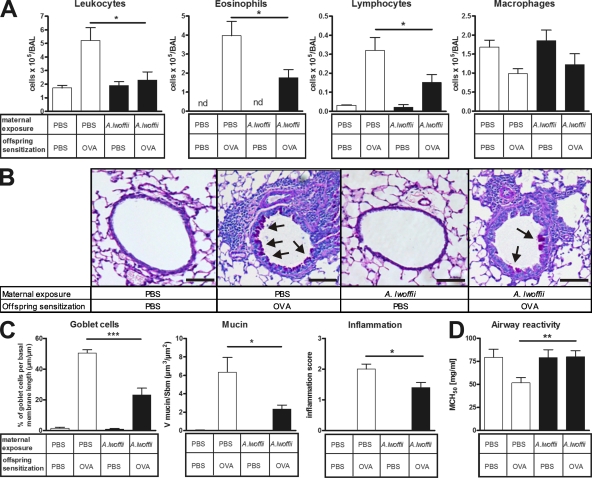
Figure 1.
Figure 1.
Prenatal A. lwoffii F78 exposure significantly prevented the extent of the asthmatic phenotype in the offspring. White bars represent offspring exposed prenatally to control PBS, and black bars represent offspring exposed prenatally to A. lwoffii F78. (A) Differential leukocyte numbers in the BAL of offspring. (B) Representative lung tissue cross sections stained with PAS to visualize mucus-producing goblet cells (arrows) and airway inflammation in offspring. Bars, 100 µm. (C) Quantification of mucus-producing goblet cells, mucus volume, and inflammation in offspring airways. (D) Offspring airway responsiveness to MCh. Results represent one out of two independently performed experiments with similar outcomes (n ≥ 8 per group). Means ± SEM are shown. *, P < 0.05; **, P < 0.01; ***, P < 0.001.
Figure 2.
Figure 2.
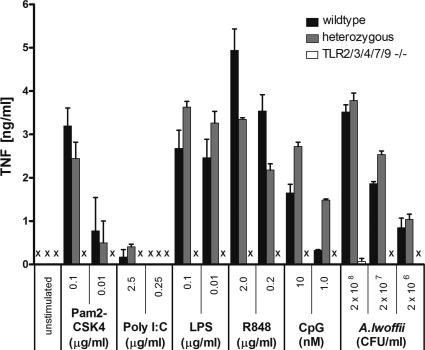
Heterozygous TLR2/3/4/7/9+/− mice respond similarly to TLR agonists as wild-type mice. Macrophages prepared from BM cells of wild-type, heterozygous, and homozygous TLR2/3/4/7/9−/− mice were in vitro stimulated with specific TLR agonists or A. lwoffii F78, as indicated. Pam2CSK4, Poly I:C, LPS, R848, and CpG specifically stimulate TLR2, 3, 4, 7, and 9, respectively. Results are from one experiment performed in duplicate (n = 2 per group). Means ± SEM are shown. X, not detectable.
Figure 3.
Figure 3.
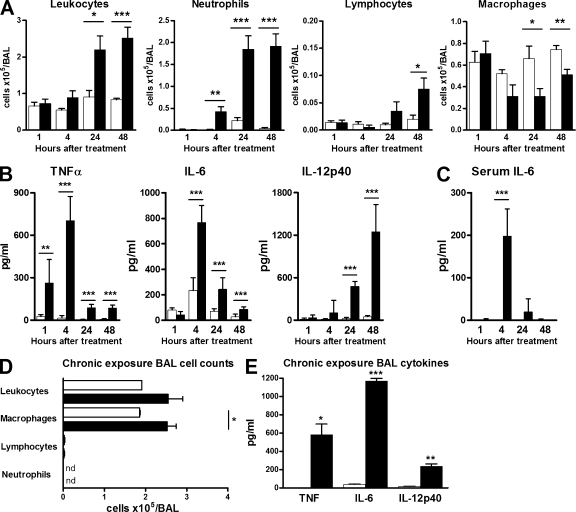
Single or chronic A. lwoffii F78 exposure induces local and systemic innate immune responses. All animals used were age equivalent to breeding mothers. White bars represent PBS control exposure, and black bars represent A. lwoffii F78 exposure. (A–C) Single-exposure kinetic. Results represent one out of two independently performed experiments with similar outcomes (n ≥ 7 per group). (A) Differential leukocyte numbers in the BAL. (B) Local concentration of proinflammatory cytokines in BAL fluid. (C) Serum IL-6 concentration. (D and E) Chronic exposure three times per week for 5 wk. Results represent one out of two independently performed experiments with similar outcomes (n = 4 per group). (D) Differential leukocyte numbers in BAL. (E) Local concentration of proinflammatory cytokines in BAL fluid after chronic exposure to A. lwoffii F78. Means ± SEM are shown. *, P < 0.05; **, P < 0.01; ***, P < 0.001. nd, not detectable.
Figure 4.
Figure 4.
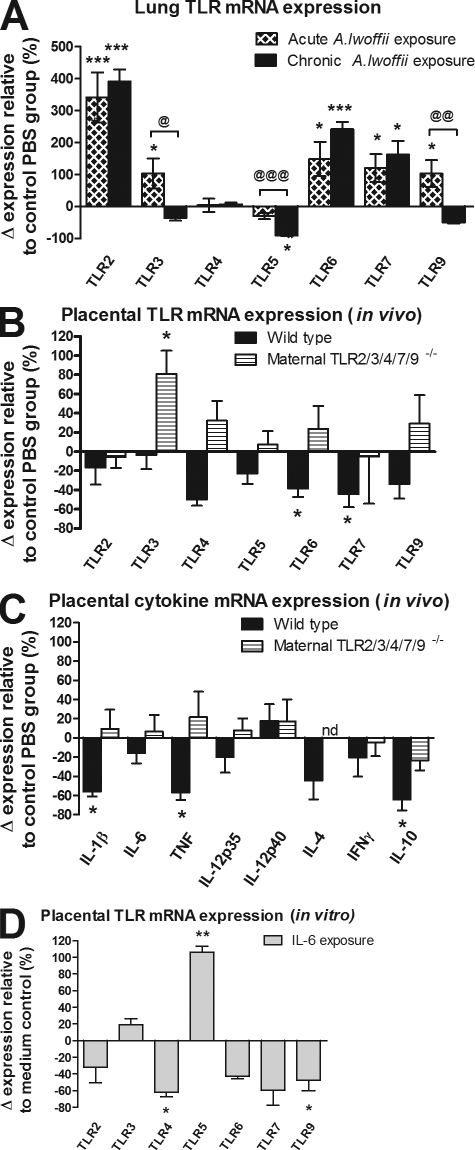
Maternal treatment with A. lwoffii F78 modulates expression of immune-relevant genes in lung and placental tissue. Bars represent the relative change in mRNA expression in the treated compared with the control group. All mRNA expression levels were calculated by setting the mRNA expression of the control group as 100% and individually calculating the Δ expression for each mRNA sample. The calculated change in mRNA expression for each noncontrol individual was then plotted, and the mean and SEM calculated. (A) TLR mRNA expression in the wild-type maternal lung 4 h after intranasal A. lwoffii F78 exposure for both a single acute exposure and a 5-wk chronic exposure. (B) TLR mRNA expression in placentas from both wild-type and TLR2/3/4/7/9−/− mice on day 18 of gestation. (C) Cytokine mRNA expression in placentas from both wild-type and TLR2/3/4/7/9−/− mice on day 18 of gestation. (D) TLR mRNA expression from wild-type primary placental cell culture incubated with IL-6. In vivo results are from two independently performed experiments with similar outcomes (n ≥ 5 animals per group with two placentas per animal). In vitro results are from one experiment performed in triplicate (n = 3 per group). Means ± SEM are shown. *, P < 0.05; **, P < 0.01; and ***, P < 0.001 for the treated group compared with control. @, P < 0.05; @@, P < 0.01; and @@@, P < 0.001 for acute versus chronic treatment. nd, not detectable.
Figure 5.
Figure 5.
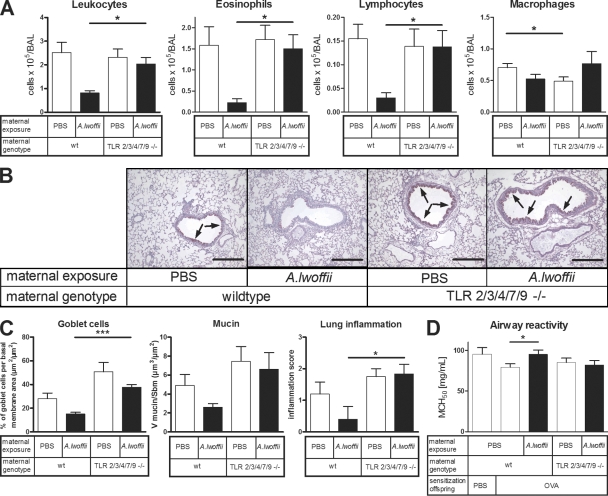
Asthma-protective effects of prenatal A. lwoffii F78 treatment are dependent on maternal TLRs. White bars represent offspring exposed prenatally to control PBS, and black bars represent offspring exposed prenatally to A. lwoffii F78. All offspring were sensitized and challenged with OVA. (A) Differential leukocyte numbers in the BAL of offspring. (B) Representative lung tissue cross sections stained with PAS to visualize mucus-producing goblet cells (arrows) and airway inflammation in offspring. Bars, 200 µm. (C) Quantification of mucus-producing goblet cells, mucus volume, and inflammation in offspring. (D) Offspring airway responsiveness to MCh. Results represent two individually performed experiments (WT mother–PBS, n = 13 OVA-treated offspring; WT mother–A. lwoffii F78, n = 11 OVA-treated offspring; TLR KO mother–PBS, n = 10 OVA-treated offspring; and TLR KO mother–PBS A. lwoffii F78, n = 16 OVA-treated offspring). Means ± SEM are shown. *, P < 0.05; ***, P < 0.001.

References

    1. Blümer N., Herz U., Wegmann M., Renz H. 2005. Prenatal lipopolysaccharide-exposure prevents allergic sensitization and airway inflammation, but not airway responsiveness in a murine model of experimental asthma. Clin. Exp. Allergy. 35:397–402 10.1111/j.1365-2222.2005.02184.x - DOI - PubMed
    1. Blümer N., Sel S., Virna S., Patrascan C.C., Zimmermann S., Herz U., Renz H., Garn H. 2007. Perinatal maternal application of Lactobacillus rhamnosus GG suppresses allergic airway inflammation in mouse offspring. Clin. Exp. Allergy. 37:348–357 10.1111/j.1365-2222.2007.02671.x - DOI - PubMed
    1. Brewer J.M., Conacher M., Hunter C.A., Mohrs M., Brombacher F., Alexander J. 1999. Aluminium hydroxide adjuvant initiates strong antigen-specific Th2 responses in the absence of IL-4- or IL-13-mediated signaling. J. Immunol. 163:6448–6454 - PubMed
    1. Conrad M.L., Yildirim A.O., Sonar S.S., Kiliç A., Sudowe S., Lunow M., Teich R., Renz H., Garn H. 2009. Comparison of adjuvant and adjuvant-free murine experimental asthma models. Clin. Exp. Allergy. 39:1246–1254 10.1111/j.1365-2222.2009.03260.x - DOI - PMC - PubMed
    1. Debarry J., Garn H., Hanuszkiewicz A., Dickgreber N., Blümer N., von Mutius E., Bufe A., Gatermann S., Renz H., Holst O., Heine H. 2007. Acinetobacter lwoffii and Lactococcus lactis strains isolated from farm cowsheds possess strong allergy-protective properties. J. Allergy Clin. Immunol. 119:1514–1521 10.1016/j.jaci.2007.03.023 - DOI - PubMed

Publication types