


The aryl hydrocarbon receptor functions as a tumor suppressor of liver carcinogenesis
- PMID: 19996281
- PMCID: PMC2939500
- DOI: 10.1158/0008-5472.CAN-09-3090
The aryl hydrocarbon receptor functions as a tumor suppressor of liver carcinogenesis
Abstract
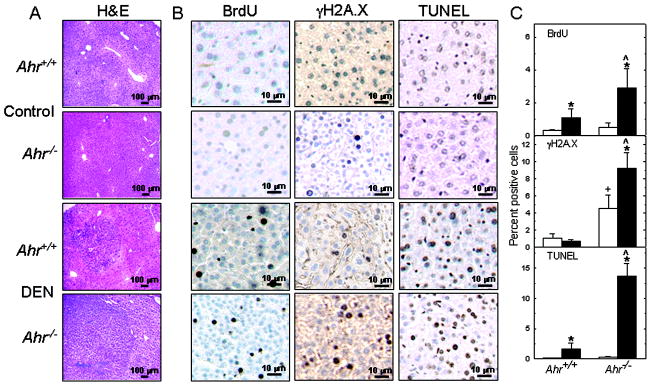
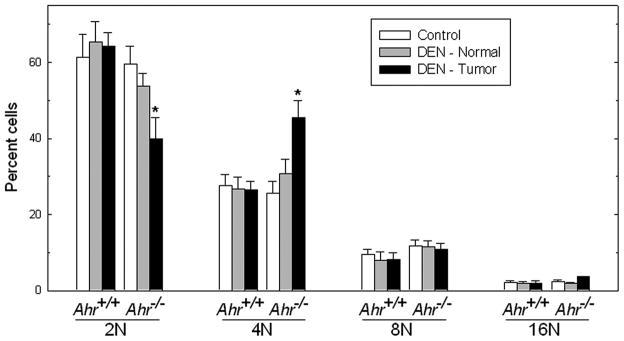
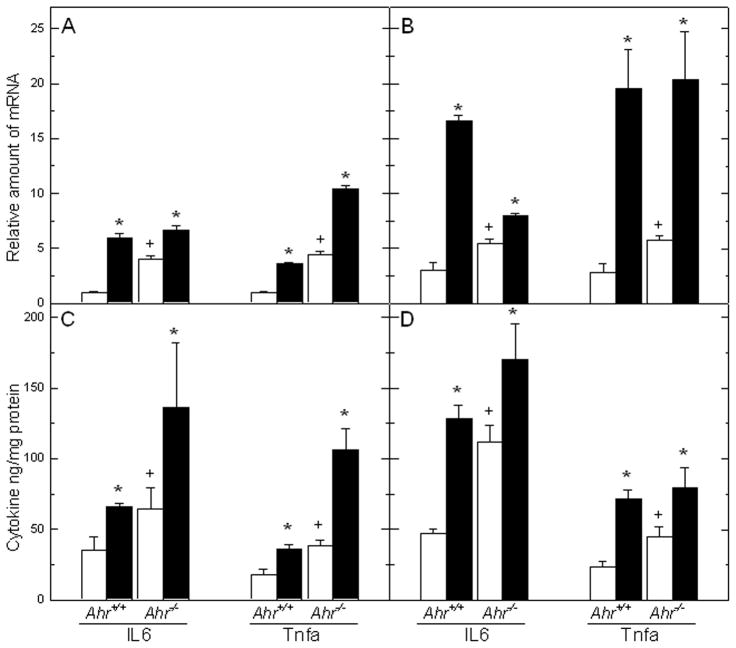
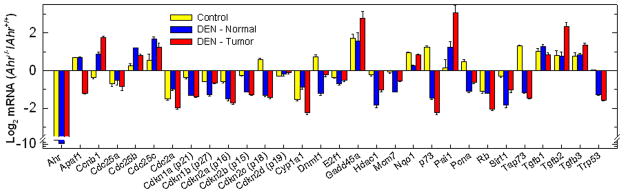
The aryl hydrocarbon receptor (AHR) is a ligand-activated transcription factor that mediates the biological and toxic effects of its xenobiotic ligands. Previous cell culture studies have shown that, in addition to controlling the xenobiotic detoxification response, AHR activation leads to G0-G1 arrest, diminished capacity for DNA replication, and inhibition of cell proliferation. In fact, recent work from our own and from other laboratories suggests that AHR may function as a tumor suppressor gene that becomes silenced during the process of tumor formation. To test this hypothesis and determine whether the mouse Ahr gene acts as a tumor suppressor gene in vivo, we have examined the role of Ahr ablation in liver tumorigenesis induced by the genotoxic chemical diethylnitrosamine (DEN), a hepatic carcinogen that is not an AHR ligand. In mice given a single i.p. injection of DEN, AHR antagonized liver tumor formation and growth by regulating cell proliferation, inflammatory cytokine expression, and DNA damage, parameters which were significantly elevated in the livers of control and, more so, of DEN-exposed Ahr-/- mice. Ahr-/- hepatocytes also showed significantly higher numbers of 4N cells, increased expression of proliferative markers, and repression of tumor suppressor genes. These data support the concept that in its basal state in the absence of a xenobiotic ligand, the Ahr gene functions as a tumor suppressor gene, and that its silencing may be associated with cancer progression.
Conflict of interest statement
The authors declare no conflicts of interest.
Figures
References
-
- Pocar P, Fischer B, Klonisch T, Hombach-Klonisch S. Molecular interactions of the aryl hydrocarbon receptor and its biological and toxicological relevance for reproduction. Reproduction. 2005;129:379–89. - PubMed
-
- Crews ST, Fan CM. Remembrance of things PAS: regulation of development by bHLH-PAS proteins. Curr Opin Genet Dev. 1999;9:580–7. - PubMed
-
- Schmidt JV, Bradfield CA. Ah receptor signaling pathways. Annu Rev Cell Dev Biol. 1996;12:55–89. - PubMed
-
- Denison MS, Pandini A, Nagy SR, Baldwin EP, Bonati L. Ligand binding and activation of the Ah receptor. Chem Biol Interact. 2002;141:3–24. - PubMed
-
- Hankinson O. The aryl hydrocarbon receptor complex. Annu Rev Pharmacol Toxicol. 1995;35:307–40. - PubMed
Publication types
MeSH terms
Substances
Grants and funding
LinkOut - more resources
Full Text Sources
Medical
Molecular Biology Databases
