De novo structure generation using chemical shifts for proteins with high-sequence identity but different folds
- PMID: 19998407
- PMCID: PMC2865713
- DOI: 10.1002/pro.303
De novo structure generation using chemical shifts for proteins with high-sequence identity but different folds
Abstract
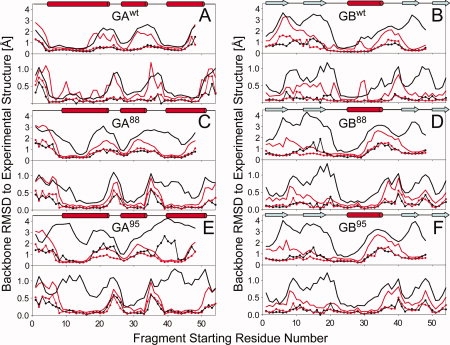
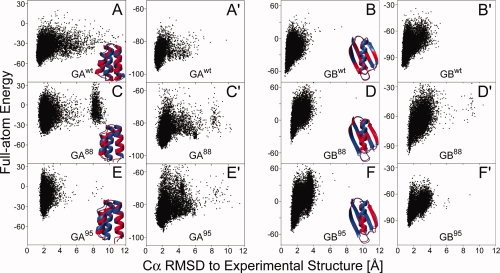
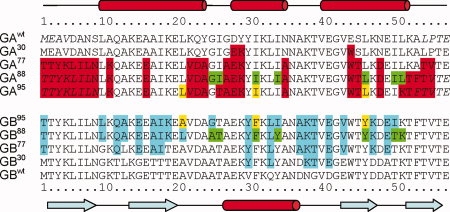
Proteins with high-sequence identity but very different folds present a special challenge to sequence-based protein structure prediction methods. In particular, a 56-residue three-helical bundle protein (GA(95)) and an alpha/beta-fold protein (GB(95)), which share 95% sequence identity, were targets in the CASP-8 structure prediction contest. With only 12 out of 300 submitted server-CASP8 models for GA(95) exhibiting the correct fold, this protein proved particularly challenging despite its small size. Here, we demonstrate that the information contained in NMR chemical shifts can readily be exploited by the CS-Rosetta structure prediction program and yields adequate convergence, even when input chemical shifts are limited to just amide (1)H(N) and (15)N or (1)H(N) and (1)H(alpha) values.
Figures
Similar articles
-
Protein structure prediction of CASP5 comparative modeling and fold recognition targets using consensus alignment approach and 3D assessment.Proteins. 2003;53 Suppl 6:410-7. doi: 10.1002/prot.10548. Proteins. 2003. PMID: 14579329
-
Novel sequences propel familiar folds.Structure. 2002 Apr;10(4):447-54. doi: 10.1016/s0969-2126(02)00750-5. Structure. 2002. PMID: 11937049 Review.
-
Protein structure prediction by threading methods: evaluation of current techniques.Proteins. 1995 Nov;23(3):337-55. doi: 10.1002/prot.340230308. Proteins. 1995. PMID: 8710827
-
Sequence and structural analysis of two designed proteins with 88% identity adopting different folds.Protein Eng Des Sel. 2010 Dec;23(12):911-8. doi: 10.1093/protein/gzq070. Epub 2010 Oct 15. Protein Eng Des Sel. 2010. PMID: 20952437
-
De novo and inverse folding predictions of protein structure and dynamics.J Comput Aided Mol Des. 1993 Aug;7(4):397-438. doi: 10.1007/BF02337559. J Comput Aided Mol Des. 1993. PMID: 8229093 Review.
Cited by
-
Modeling proteins using a super-secondary structure library and NMR chemical shift information.Structure. 2013 Jun 4;21(6):891-9. doi: 10.1016/j.str.2013.04.012. Epub 2013 May 16. Structure. 2013. PMID: 23685209 Free PMC article.
-
Design and characterization of a protein fold switching network.Nat Commun. 2023 Jan 26;14(1):431. doi: 10.1038/s41467-023-36065-3. Nat Commun. 2023. PMID: 36702827 Free PMC article.
-
Utility of 1H NMR chemical shifts in determining RNA structure and dynamics.J Phys Chem B. 2013 Feb 21;117(7):2045-52. doi: 10.1021/jp310863c. Epub 2013 Feb 7. J Phys Chem B. 2013. PMID: 23320790 Free PMC article.
-
Examination of the quality of various force fields and solvation models for the equilibrium simulations of GA88 and GB88.J Mol Model. 2016 Aug;22(8):177. doi: 10.1007/s00894-016-3027-8. Epub 2016 Jul 8. J Mol Model. 2016. PMID: 27392746
-
Structure and dynamics of cationic membrane peptides and proteins: insights from solid-state NMR.Protein Sci. 2011 Apr;20(4):641-55. doi: 10.1002/pro.600. Epub 2011 Mar 7. Protein Sci. 2011. PMID: 21344534 Free PMC article.
References
-
- Burley SK. An overview of structural genomics. Nat Struct Biol. 2000;7:932–934. - PubMed
-
- Marti-Renom MA, Stuart AC, Fiser A, Sanchez R, Melo F, Sali A. Comparative protein structure modeling of genes and genomes. Annu Rev Biophys Biomol Struct. 2000;29:291–325. - PubMed
-
- Domingues FS, Lackner P, Andreeva A, Sippl MJ. Structure-based evaluation of sequence comparison and fold recognition alignment accuracy. J Mol Biol. 2000;297:1003–1013. - PubMed
-
- Baker D, Sali A. Protein structure prediction and structural genomics. Science. 2001;294:93–96. - PubMed
-
- Das R, Baker D. Macromolecular modeling with Rosetta. Annu Rev Biochem. 2008;77:363–382. - PubMed
Publication types
MeSH terms
Substances
Grants and funding
LinkOut - more resources
Full Text Sources
Miscellaneous