


Potential utility and limitations of thyroid cancer cell lines as models for studying thyroid cancer
- PMID: 20001716
- PMCID: PMC2833173
- DOI: 10.1089/thy.2009.0195
Potential utility and limitations of thyroid cancer cell lines as models for studying thyroid cancer
Abstract
Background: Tumor-derived cell lines are widely used to study the mechanisms involved in thyroid carcinogenesis but recent studies have reported redundancy among thyroid cancer cell lines and identification of some "thyroid cell lines" that are likely not of thyroid origin.
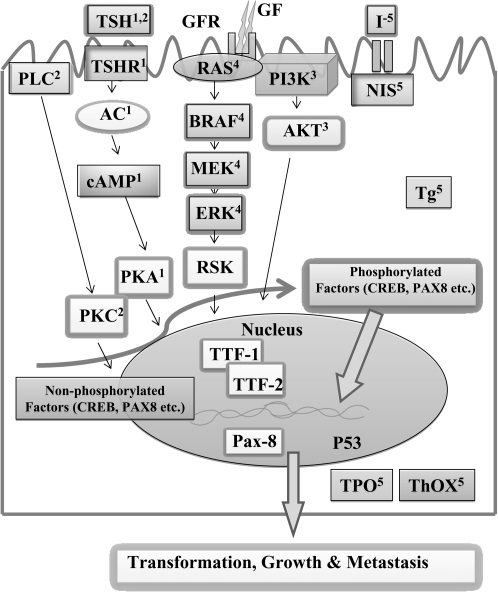
Summary: In this review, we have summarized the uses, the limitations, and the existing problems associated with the available follicular cell-derived thyroid cancer cell lines. There are some limitations to the use of cell lines as a model to "mimic" in vivo tumors. Based on the gene expression profiles of thyroid cell lines originating from tumors of different types it has become apparent that some of the cell lines are closely related to each other and to those of undifferentiated carcinomas. Further, many cell lines have lost the expression of thyroid-specific genes and have altered karyotypes, while they exhibit activation of several oncogenes (BRAF, v-raf murine sarcoma viral oncogene homolog B1; RAS, rat sarcoma; and RET/PTC, rearranged in transformation/papillary thyroid carcinoma) and inactivation of tumor suppressor gene (TP53) which is known to be important for thyroid tumorigenesis.
Conclusions: A careful selection of thyroid cancer cell lines that reflect the major characteristics of a particular type of thyroid cancer being investigated could be used as a good model system to analyze the signaling pathways that may be important in thyroid carcinogenesis. Further, the review of literature also suggests that some of the limitations can be overcome by using multiple cell lines derived from the same type of tumor.
Figures
References
-
- Davies L. Welch HG. Increasing incidence of thyroid cancer in the United States, 1973–2002. JAMA. 2006;29:2164–2167. - PubMed
-
- Leenhardt L. Grosclaude P. Cherie-Challine L. Increased incidence of thyroid carcinoma in France: a true epidemic or thyroid nodule management effects? Report from the French Thyroid Cancer Committee. Thyroid. 2004;14:1056–1060. - PubMed
-
- Pacini F. Cetani F. Miccoli P. Mancusi F. Ceccarelli C. Lippi F. Martino E. Pinchera A. Outcome of 309 patients with metastatic differentiated thyroid carcinoma treated with radioiodine. World J Surg. 1994;18:600–604. - PubMed
-
- Yano Y. Uematsu N. Yashiro T. Hara H. Ueno E. Miwa M. Tsujimoto G. Aiyoshi Y. Uchida K. Gene expression profiling identifies platelet-derived growth factor as a diagnostic molecular marker for papillary thyroid carcinoma. Clin Cancer Res. 2004;10:2035–2043. - PubMed
-
- Kebebew E. Peng M. Reiff E. Duh QY. Clark OH. McMillan A. Diagnostic and prognostic value of cell-cycle regulatory genes in malignant thyroid neoplasms. World J Surg. 2006;30:767–774. - PubMed
Publication types
MeSH terms
Substances
Grants and funding
LinkOut - more resources
Full Text Sources
Medical
Research Materials
Miscellaneous
