. 2010 Apr;129(4):525-35.
doi: 10.1111/j.1365-2567.2009.03205.x. Epub 2009 Nov 25.

Dendritic cells treated with resveratrol during differentiation from monocytes gain substantial tolerogenic properties upon activation

Affiliations

Dendritic cells treated with resveratrol during differentiation from monocytes gain substantial tolerogenic properties upon activation

Urban Svajger et al. Immunology. 2010 Apr.

Abstract

Resveratrol is a polyphenol that acts on multiple molecular targets important for cell differentiation and activation. Dendritic cells (DCs) are a functionally diverse cell type and represent the most potent antigen-presenting cells of the immune system. In this study, we investigated resveratrol-induced effects on DCs during their differentiation and maturation. Our results show that resveratrol induces DC-associated tolerance, particularly when applied during DC differentiation. Costimulatory molecules CD40, CD80 and CD86 were down-regulated, as was the expression of major histocompatibility complex (MHC) class II molecules. Surface expression of inhibitory immunoglobulin-like transcript 3 (ILT3) and ILT4 molecules was induced, while human leucocyte antigen (HLA)-G expression was not affected. Resveratrol-treated DCs lost the ability to produce interleukin (IL)-12p70 after activation, but had an increased ability to produce IL-10. Such DCs were poor stimulators of allogeneic T cells and had lowered ability to induce CD4(+) T-cell migration. Furthermore, treated cells were able to generate allogeneic IL-10-secreting T cells, but were not competent in inducing FoxP3 expression These tolerogenic effects are probably associated with the effect of resveratrol on multiple molecular targets through which it interferes with DC differentiation and nuclear factor (NF)-kappaB translocation. Our data provide new insights into the molecular and functional mechanisms of the tolerogenic effects that resveratrol exerts on DCs.


Figures
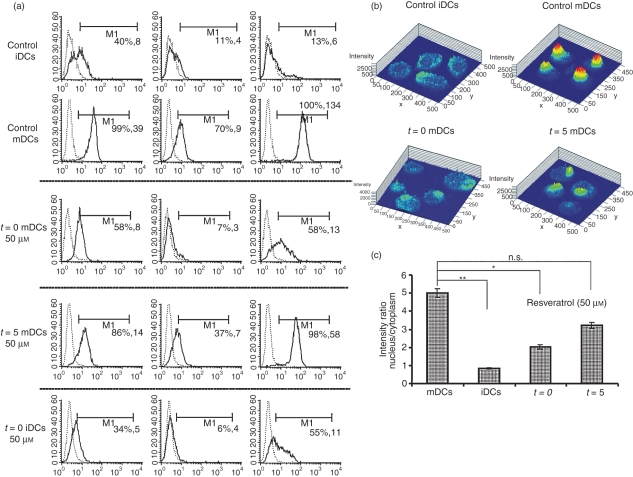
Figure 1
Figure 1
Resveratrol down-regulates the expression of costimulatory molecules and reduces nuclear factor (NF)-κB translocation. Dendritic cells (DCs) were prepared as described in the Materials and methods. Resveratrol was added to DC cultures at the start of differentiation from monocytes until the end of maturation (t = 0), or DCs were incubated with resveratrol 45 min prior to maturation (t = 5). (a) Flow cytometric analysis of CD83 and costimulatory molecules either on day 5, when DCs were immature [immature DCs (iDCs)], or on day 7, 48 hr after the addition of lipopolysaccharide (LPS) [mature DCs (mDCs)]. The dashed line represents isotypic controls and the solid line represents the depicted surface marker. The first number in brackets shows the percentage of positively stained cells, and the second shows the mean fluorescence intensity (MFI) values. Results are from one representative experiment out of four performed. (b) NF-κB translocation was assessed by confocal microscopy as described in the Materials and methods. A clear reduction in nuclear translocation of NF-κB can be seen with resveratrol-treated DCs compared with mature controls. (c) Activation of NF-κB was determined as the ratio of the MFIs of nucleus and cytoplasm. *, P ≤ 0·05; **, P ≤ 0·01; n.s., not significant.
Figure 2
Figure 2
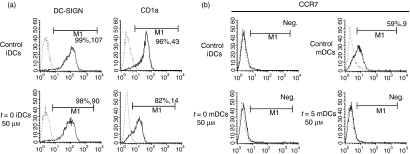
Resveratrol prevents the expression of lipopolysaccharide (LPS)-induced CCR7 and down-regulates CD1a expression, while retaining the expression of DC-SIGN (CD209). Dendritic cells (DCs) were differentiated from human peripheral monocytes using granulocyte–macrophage colony-stimulating factor (GM-CSF) and interleukin (IL)-4 for 5 days and further stimulated to mature with LPS. In some cases, DCs were treated with 50 μm resveratrol (at this concentration the greatest effects were documented in the context of costimulatory, inhibitory and differentiation markers) either throughout the differentiation and maturation stage (t = 0) or just 45 min prior to maturation (t = 5). Cells were stained on day 5 [immature DCs (iDCs)] and day 7 [mature DCs (mDCs)] and analysed by flow cytometry. The dashed line represents isotypic controls and the solid line represents the depicted surface marker. (a) Surface expression of CD1a and DC-SIGN on control iDCs and resveratrol-treated differentiated iDCs is shown. (b) Expression of CCR7 on resveratrol-treated DCs at either t = 0 or t = 5 in comparison to control iDCs and mDCs. The first number in brackets shows the percentage of positively stained cells, and the second number shows the mean fluorescence intensity (MFI) values. One representative experiment out of three is shown.
Figure 3
Figure 3
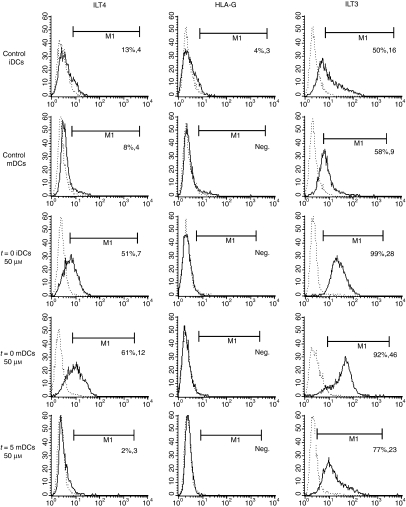
Resveratrol treatment induces expression of inhibitory molecules immunoglobulin-like transcript 3 (ILT3) and ILT4 on dendritic cells (DCs), while it does not affect the expression of human leucocyte antigen (HLA)-G. DCs were prepared from human monocytes as described in the Materials and methods. Resveratrol was used in some cases to treat DC cultures either from the start of differentiation and during maturation (t = 0) or just 45 min prior to maturation (t = 5) at concentrations of 10 and 50 μm, as depicted in the charts. Flow cytometric analysis was performed on cells stained with fluoroscently labelled anti-ILT3, anti-ILT4 and anti-HLA-G either on day 5 [immature DCs (iDCs)] or on day 7, 48 hr after lipopolysaccharide (LPS) activation (t = 5). Solid lines represent the surface marker in question, and dashed lines are isotypic controls. The first number in brackets is the percentage of positively stained cells, and the second number represents the mean fluorescence intensity (MFI) value. One representative experiment out of four performed is shown.
Figure 4
Figure 4
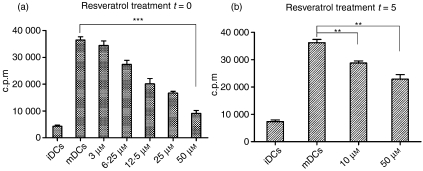
Resveratrol-treated dendritic cells (DCs) are poor stimulators of allogeneic CD4+ T cells. DCs were prepared as described in the Materials and methods and in some cultures resveratrol was added at various concentrations (from 3 to 50 μm), depending on the experiment. Treated DCs and controls were used to stimulate allogeneic T cells for 4 days, when [3H]thymidine was added for 18 hr, and proliferation was measured by liquid scintillation counting on day 5. (a) Resveratrol can greatly suppress the ability of lipopolysaccharide (LPS)-activated DCs to stimulate CD4+ T cells in mixed lymphocyte reactions (MLRs) when added at t = 0, as described above. At 50 μm concentrations, DCs were approximately four times less capable of inducing proliferation in responding T cells compared with controls (P < 0·0001). (b) Control DCs and DCs treated just prior to maturation were used as stimulators. Resveratrol suppressed the stimulatory capacity of DCs but only by about 40% in comparison to cases where it was already present during DC differentiation. Data represent the mean ± standard deviation of three independent experiments. *, P ≤ 0·05; **, P ≤ 0·01; ***, P ≤ 0·001 (Student’s t-test for independent samples).
Figure 5
Figure 5
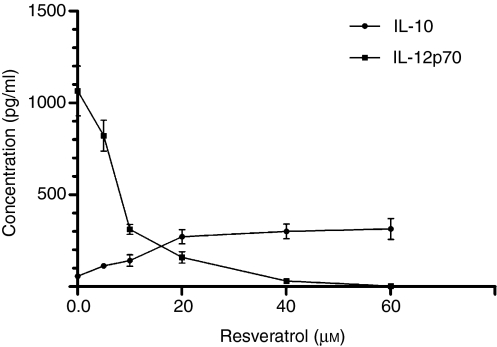
Levels of interleukin (IL)-12p70 and IL-10 were determined in supernatants of resveratrol-treated dendritic cells (DCs) and controls after 48 hr of lipopolysaccharide (LPS) stimulation. DCs were prepared as described in the Materials and methods and treated with various doses of resveratrol (from 3 to 50 μm) from t = 0. Even at low doses, resveratrol markedly inhibited the ability of DCs to produce IL-12p70, and completely inhibited LPS-induced IL-12p70 production at 50 μm. Simultaneously with dose-dependent inhibition of IL-12p70, treated DCs dose-dependently produced more IL-10. Data presented are the mean ± standard deviation of three independent experiments.
Figure 6
Figure 6
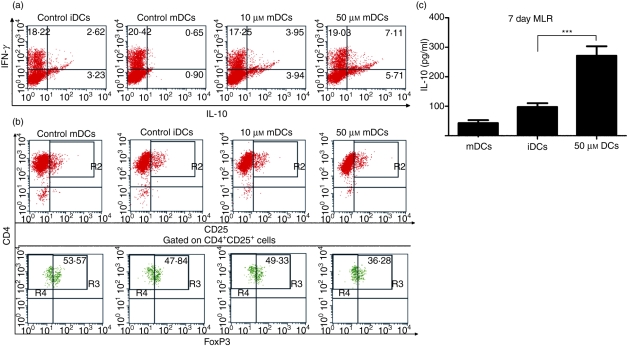
Resveratrol treatment generates dendritic cells (DCs) capable of inducing allogeneic interleukin (IL)-10-secreting CD4+ T cells, but not FoxP3+ T cells. DCs were prepared as described in the Materials and methods and then left untreated or treated with various doses of resveratrol during their differentiation and maturation stages. (a) We analysed FoxP3 expression in CD4 T cells by flow cytometry staining. After 5 days, cells were collected and stained for CD4 and CD25 and intracellularly for expression of FoxP3. Numbers in quadrants represent the percentage of positive cells (Fig. 6a,b). (b) DCs were used in allogeneic mixed cultures with CD4+ CD45RA+ naïve T cells for 14 days, with the addition of 20 U/ml of IL-2 on day 7. After 14 days, cells positive for interferon (IFN)-γ and IL-10 were determined by intracellular staining with anti-IFN-γ and anti-IL-10 and analysed by flow cytometry. (c) In parallel experiments, to determine earlier cytokine profiles and to quantitatively analyse cytokine production, CD4+ cells were collected after 7 days and stimulated for 24 hr with ionomycin and phorbol myristate acetate (PMA). After this time, supernatants were analysed for IL-10. DCs treated with 50 μm resveratrol induced T cells producing significantly greater quantities of IL-10 than controls. ***, P ≤ 0·001.

References

    1. Hung LM, Chen JK, Huang SS, Lee RS, Su MJ. Cardioprotective effect of resveratrol, a natural antioxidant derived from grapes. Cardiovasc Res. 2000;47:549–55. - PubMed
    1. Lu R, Serrero G. Resveratrol, a natural product derived from grape, exhibits antiestrogenic activity and inhibits the growth of human breast cancer cells. J Cell Physiol. 1999;179:297–304. - PubMed
    1. Mitchell SH, Zhu W, Young CY. Resveratrol inhibits the expression and function of the androgen receptor in LNCaP prostate cancer cells. Cancer Res. 1999;59:5892–5. - PubMed
    1. Hwang JT, Kwak DW, Lin SK, Kim HM, Kim YM, Park OJ. Resveratrol induces apoptosis in chemoresistant cancer cells via modulation of AMPK signaling pathway. Ann N Y Acad Sci. 2007;1095:441–8. - PubMed
    1. Narayanan NK, Nargi D, Randolph C, Narayanan BA. Liposome encapsulation of curcumin and resveratrol in combination reduces prostate cancer incidence in PTEN knockout mice. Int J Cancer. 2009;125:1–8. - PubMed

Publication types

MeSH terms