


Lopinavir protein binding in HIV-1-infected pregnant women
- PMID: 20002783
- PMCID: PMC2874627
- DOI: 10.1111/j.1468-1293.2009.00767.x
Lopinavir protein binding in HIV-1-infected pregnant women
Abstract
Background: Pregnancy may alter protein binding (PB) of highly bound protease inhibitors due to changes in plasma concentrations of albumin and alpha-1 acid glycoprotein (AAG). Small changes in PB can greatly impact the fraction of drug unbound (FU) exerting pharmacological effect. We report lopinavir (LPV) PB during third trimester (antepartum, AP) compared to > or =1.7 weeks postpartum (PP) to determine if FU changes compensate for reduced total concentrations reported previously.
Methods: P1026s enrolled women receiving LPV/ritonavir, soft gel capsules 400/100 mg or 533/133 mg twice daily. LPV FU, albumin and AAG were determined AP and PP.
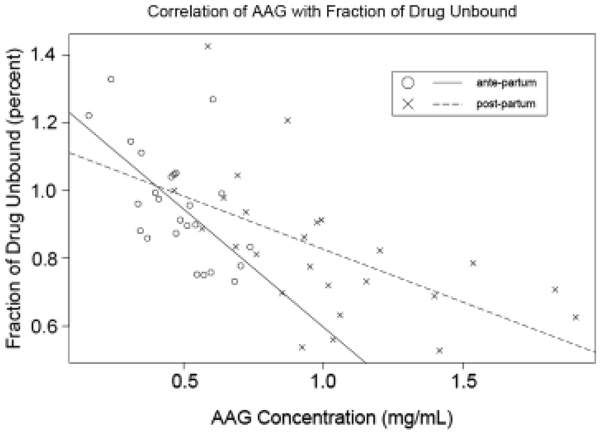
Results: AP/PP samples were available from 29/25 women respectively with all but one woman receiving the same dose AP/PP. LPV FU was increased 18% AP vs. PP (mean 0.96+/-0.16% AP vs. 0.82+/-0.21% PP, P=0.001). Mean protein concentrations were reduced AP (AAG=477 mg/L; albumin=3.28 mg/dL) vs. PP (AAG=1007 mg/L; albumin=3.85 mg/dL) (P<0.0001 for each comparison). AAG concentration correlated with LPV binding. Total LPV concentration did not correlate with LPV FU AP or PP. However, higher LPV concentration PP was associated with reduced PB and higher FU after adjustment for AAG.
Conclusions: LPV FU was higher and AAG lower AP vs. PP. The 18% increase in LPV FU AP is smaller than the reduction in total LPV concentration reported previously and is not of sufficient magnitude to eliminate the need for an increased dose during pregnancy.
Figures
References
-
- [accessed 29 April 2009];USPHS Task Force Recommendations for the use of antiretroviral drugs in HIV-infected pregnant women for maternal health and interventions to reduce perinatal HIV transmission in the US. Available at http://aidsinfo.nih.gov/contentfiles/PerinatalGL.pdf.
-
- Tracy TS, Venkataramanan R, Glover DD, et al. Temporal changes in drug metabolism (CYP1A2, CYP2D6 and CYP3A activity) during pregnancy. Am J Obstet Gynecol. 2005;192:633–639. - PubMed
-
- Krauer B, Krauer F, Hytten FE. Drug disposition and pharmacokinetics in the maternal-placental-fetal unit. Pharmacol Ther. 1980;10:301–328. - PubMed
-
- Stek AM, Mirochnick M, Capparelli E, et al. Reduced lopinavir exposure during pregnancy. AIDS. 2006;20:1931–1939. - PubMed
Publication types
MeSH terms
Substances
Grants and funding
- U01-HD-031318-11/HD/NICHD NIH HHS/United States
- U01 AI068632/AI/NIAID NIH HHS/United States
- M01 RR000533/RR/NCRR NIH HHS/United States
- U01 HD031318/HD/NICHD NIH HHS/United States
- M01 RR001271/RR/NCRR NIH HHS/United States
- UM1 AI069477/AI/NIAID NIH HHS/United States
- U01 AI068616/AI/NIAID NIH HHS/United States
- M01 RR00533/RR/NCRR NIH HHS/United States
- U01AI068632/AI/NIAID NIH HHS/United States
- 5 M01 RR01271/RR/NCRR NIH HHS/United States
- 1 U01 AI068616/AI/NIAID NIH HHS/United States
- N01-HD-3-3365/HD/NICHD NIH HHS/United States
LinkOut - more resources
Full Text Sources
Medical
Miscellaneous
