. 2009 Dec 9:8:65.
doi: 10.1186/1475-2859-8-65.

Macromolecular and elemental composition analysis and extracellular metabolite balances of Pichia pastoris growing at different oxygen levels

Affiliations

Macromolecular and elemental composition analysis and extracellular metabolite balances of Pichia pastoris growing at different oxygen levels

Marc Carnicer et al. Microb Cell Fact. .

Abstract

Background: Analysis of the cell operation at the metabolic level requires collecting data of different types and to determine their confidence level. In addition, the acquired information has to be combined in order to obtain a consistent operational view. In the case of Pichia pastoris, information of its biomass composition at macromolecular and elemental level is scarce particularly when different environmental conditions, such as oxygen availability or, genetic backgrounds (e.g. recombinant protein production vs. non production conditions) are compared.

Results: P. pastoris cells growing in carbon-limited chemostat cultures under different oxygenation conditions (% O2 in the bioreactor inlet gas: 21%, 11% and 8%, corresponding to normoxic, oxygen-limiting and hypoxic conditions, respectively), as well as under recombinant protein (antibody fragment, Fab) producing and non-producing conditions, were analyzed from different points of view. On the one hand, the macromolecular and elemental composition of the biomass was measured using different techniques at the different experimental conditions and proper reconciliation techniques were applied for gross error detection of the measured substrates and products conversion rates. On the other hand, fermentation data was analyzed applying elemental mass balances. This allowed detecting a previously missed by-product secreted under hypoxic conditions, identified as arabinitol (aka. arabitol). After identification of this C5 sugar alcohol as a fermentation by-product, the mass balances of the fermentation experiments were validated.

Conclusions: After application of a range of analytical and statistical techniques, a consistent view of growth parameters and compositional data of P. pastoris cells growing under different oxygenation conditions was obtained. The obtained data provides a first view of the effects of oxygen limitation on the physiology of this microorganism, while recombinant Fab production seems to have little or no impact at this level of analysis. Furthermore, the results will be highly useful in other complementary quantitative studies of P. pastoris physiology, such as metabolic flux analysis.


Figures
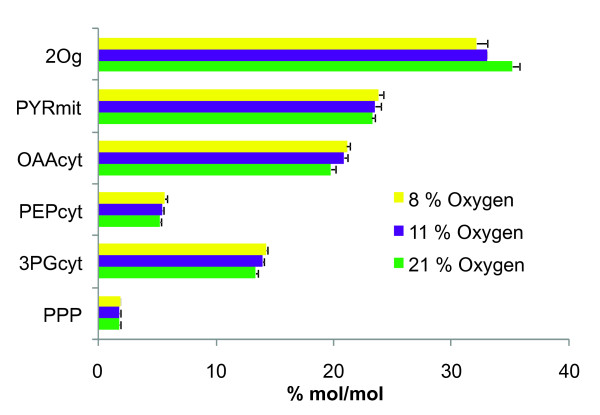
Figure 1
Figure 1
Amount of key precursors required for protein generation at each experimental condition. Using the average amino acid compositional data provided in Table 2, a calculation of the amounts of precursors consumed for protein generation was done. Nomenclature: α-keto-glutarate: 2Og, mitochondrial pyruvate: PYRmit, cytosolic oxalacetate: OAAcyt, cytosolic phosphoenolpyruvate: PEPcyt, cytosolic 3-phophoglycerate: 3PGcyt, pentose phosphate pathway: PPP.
Figure 2
Figure 2
Summary of the macromolecular biomass composition results obtained for the different experimental conditions and the final reconciled value, Top left: Protein content, given as percentage of dry weight, measured using the Lowry method and calculated as the sum of extracted amino acids (A.a.), together with its reconciled value. Top right: Carbohydrate content % dry weight together with its reconciled value. Bottom left: RNA content given as percentage of dry weight together with its reconciled value. Bottom right: DNA content given as percentage of dry weight together with its reconciled value. S.c.: S. cerevisiae. * Data from Lange and Heijnen 2001 [11] for S. cerevisiae in blue bars.
Figure 3
Figure 3
Effect of decreasing oxygen supply on Fab heterologous protein production. Measured Fab content in soluble cell extracts and in the extracellular medium of chemostat cultures of the Fab-producing strain growing under the different oxygenation conditions.
Figure 4
Figure 4
Principal carbohydrates. Total carbohydrate, glycogen and trehalose amounts measured for each strain and oxygenation condition. * Data from Forster et al. 2003 [3] for S. cerevisiae.
Figure 5
Figure 5
Substrates consumed and metabolites generated for the different experimental conditions. Top row: measured values for the Fab-expressing strain (left) and for the control strain (right). Bottom row reconciled values for the Fab-expressing strain (left) and for the control strain (right). Negative values represent substrate consumed, while positive values represent products generated. OUR, oxygen uptake rate; CER, CO2 exchange rate.

References

    1. Lee SY, Lee DY, Kim TY. Systems biotechnology for strain improvement. TRENDS Biotechnol. 2005;23:349–358. doi: 10.1016/j.tibtech.2005.05.003. - DOI - PubMed
    1. Graf A, Dragosits M, Gasser B, Mattanovich D. Yeast systems biotechnology for the production of heterologous proteins. FEMS Yeast Res. 2009;9:335–348. doi: 10.1111/j.1567-1364.2009.00507.x. - DOI - PubMed
    1. Covert MW, Knight EM, Reed JL, Herrgard MJ, Palsson BO. Integrating high-throughput and computational data elucidates bacterial networks. Nature. 2004;429:92–96. doi: 10.1038/nature02456. - DOI - PubMed
    1. Forster J, Famili I, Fu PC, Palsson BO, Nielsen J. Genome-scale reconstruction of the Saccharomyces cerevisiae metabolic network. Genome Res. 2003;13:244–253. doi: 10.1101/gr.234503. - DOI - PMC - PubMed
    1. Feist AM, Palsson BO. The growing scope of applications of genome-scale metabolic reconstructions using Escherichia coli . Nat Biotechnol. 2008;26:659–667. doi: 10.1038/nbt1401. - DOI - PMC - PubMed

Publication types

LinkOut - more resources
