


A malaria outbreak in Naxalbari, Darjeeling district, West Bengal, India, 2005: weaknesses in disease control, important risk factors
- PMID: 20003288
- PMCID: PMC2797808
- DOI: 10.1186/1475-2875-8-288
A malaria outbreak in Naxalbari, Darjeeling district, West Bengal, India, 2005: weaknesses in disease control, important risk factors
Abstract
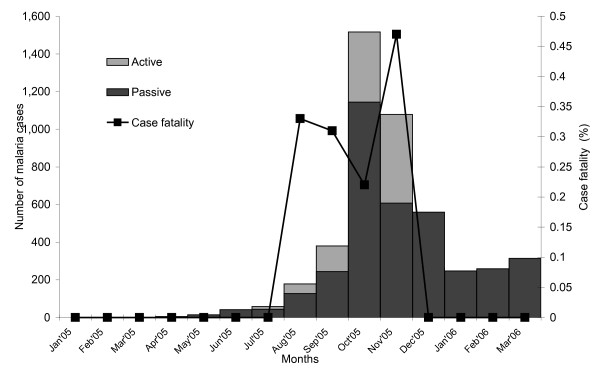
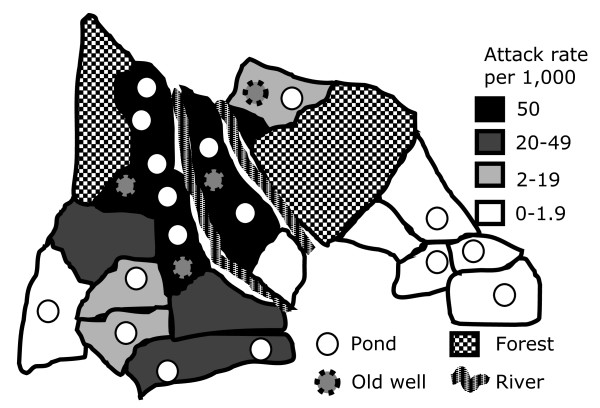
An outbreak of malaria in Naxalbari, West Bengal, India, in 2005 was investigated to understand determinants and propose control measures. Malaria cases were slide-confirmed. Methods included calculation of annual blood examination rates (ABER, number of slides examined/population), collection of water specimens from potential vector-breeding sites, sorting of villages in categories depending on the number of abandoned wells within two kilometers radius and review of the DDT spray coverage. Cases were compared with matched neighbourhood controls in terms of personal protection using matched odds ratios (MOR). 7,303 cases and 17 deaths were reported between April 2005 and March 2006 with a peak during October rains (Attack rate: 50 per 1,000, case fatality: 0.2%). The attack rate increased according to the number of abandoned wells within 2 kilometres radius (P < 0.0001, Chi-square for trend). Abandoned wells were Anopheles breeding sites. Compared with controls, cases were more likely to sleep outdoors (MOR: 3.8) and less likely to use of mosquito nets and repellents (MOR: 0.3 and 0.1, respectively). DDT spray coverage and ABER were 39% and 3.5%, below the recommended 85% and 10%, respectively. Overall, this outbreak resulted from weaknesses in malaria control measures and a combination of factors, including vector breeding, low implementation of personal protection and weak case detection.
Figures
References
-
- World Health Organization. World Malaria Report 2005. Geneva, Switzerland. http://whqlibdoc.who.int/publications/2005/9241593199_eng.pdf accessed on 28 November 2009.
-
- Najera JA, Kouznetsov RL, Delacollette C. Malaria epidemics detection and control forecasting and prevention. WHO/MAL/98.1084.
-
- Khera AK, Jain DC, Datta KK. Profile of epidemic emergencies in India during 1991-95. J Commun Dis. 1996;28:129–138. - PubMed
-
- Yadav RL, Sharma RS. Malaria problem and its control in north-eastern states of India. J Commun Dis. 1995;27:262–266. - PubMed
-
- Mohapatra PK, Prakash A, Bhattacharyya DR, Mahanta I. Malaria situation in north-eastern region of India. ICMR Bull. 1998;28:21–30.
Publication types
MeSH terms
LinkOut - more resources
Full Text Sources
Medical
Miscellaneous
