. 2009 Dec 15:2:7.
doi: 10.1186/1755-1536-2-7.

Focus on collagen: in vitro systems to study fibrogenesis and antifibrosis state of the art

Affiliations

Focus on collagen: in vitro systems to study fibrogenesis and antifibrosis state of the art

Clarice Zc Chen et al. Fibrogenesis Tissue Repair. .

Abstract

Fibrosis represents a major global disease burden, yet a potent antifibrotic compound is still not in sight. Part of the explanation for this situation is the difficulties that both academic laboratories and research and development departments in the pharmaceutical industry have been facing in re-enacting the fibrotic process in vitro for screening procedures prior to animal testing. Effective in vitro characterization of antifibrotic compounds has been hampered by cell culture settings that are lacking crucial cofactors or are not holistic representations of the biosynthetic and depositional pathway leading to the formation of an insoluble pericellular collagen matrix. In order to appreciate the task which in vitro screening of antifibrotics is up against, we will first review the fibrotic process by categorizing it into events that are upstream of collagen biosynthesis and the actual biosynthetic and depositional cascade of collagen I. We point out oversights such as the omission of vitamin C, a vital cofactor for the production of stable procollagen molecules, as well as the little known in vitro tardy procollagen processing by collagen C-proteinase/BMP-1, another reason for minimal collagen deposition in cell culture. We review current methods of cell culture and collagen quantitation vis-à-vis the high content options and requirements for normalization against cell number for meaningful data retrieval. Only when collagen has formed a fibrillar matrix that becomes cross-linked, invested with ligands, and can be remodelled and resorbed, the complete picture of fibrogenesis can be reflected in vitro. We show here how this can be achieved. A well thought-out in vitro fibrogenesis system represents the missing link between brute force chemical library screens and rational animal experimentation, thus providing both cost-effectiveness and streamlined procedures towards the development of better antifibrotic drugs.


Figures
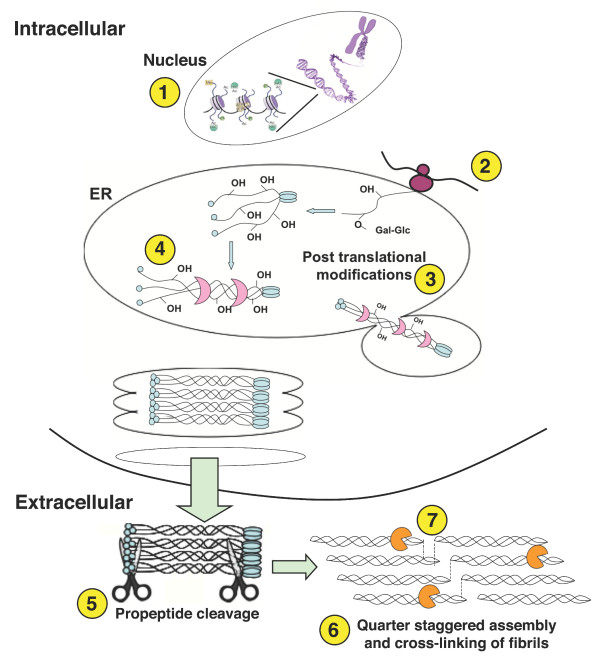
Figure 1
Figure 1
Potential points of interference along the collagen biosynthesis pathway. (1) Epigenetic level: HDAC inhibitors. (2) Post-transcriptional level: mRNA translation is reduced by miRNAs/siRNAs. (3) Post-translational level: prolyl-4-hydroxylase inhibitors reduce the stability of the procollagen triple helix. (4) Reduction/inhibition of the collagen chaperone hsp47 (pink crescent symbol) also reduces stability of the procollagen triple helices, resulting in intracellular retention and degradation. (5) Post-secretional level: Inhibition of procollagen proteinases (scissors symbol) prevents deposition of insoluble collagen molecules on the cell layer. (6) Collagen crosslinking: Inhibition of lysyl oxidase (LOX) hypothetically renders the collagen more susceptible to degradation. 7) An increase of MMP1 (orange Pacman symbol) results in faster collagen degradation and turnover.
Figure 2
Figure 2
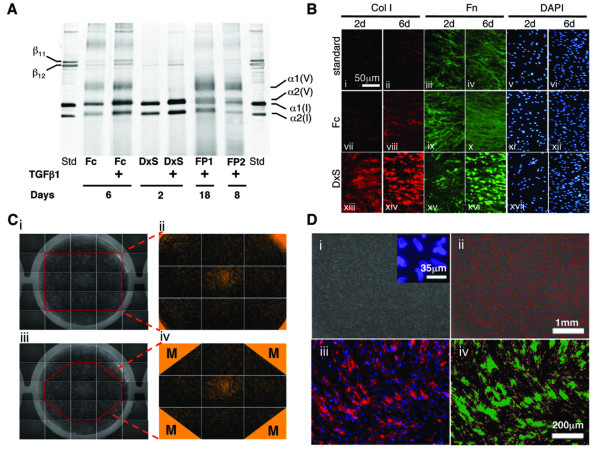
The Scar-in-the-Jar system combines enhanced collagen deposition with optical analysis for in situ quantitation. (A) Cell layers were pepsin digested, resolved by sodium dodecyl sulphate - polyacrylamide and silver stained. In comparison with fibroplasia models (FP1: Ref [61], FP2: Ref [45]), macromolecular crowding increased matrix formation including stronger lysyl oxidase-mediated cross-linking in both deposition modes (rapid: dextran sulphate [DxS]; accelerated: Ficoll cocktail [Fc]), within a shorter time frame. Note: the presence of collagen V in FP and the accelerated deposition mode and its absence in the rapid deposition mode. Collagen V is usually absent from fibrotic tissue; hence, the extracellular matrix obtained in the rapid deposition mode will probably be more similar to a fibrotic matrix. (B) Cell layers were immunostained for collagen I and fibronectin. Cell nuclei were stained with 4', 6-diamidino-2-phenylindoldilactate (DAPI). The rapid deposition mode (negatively charged, DxS) produces granular collagen I and fibronectin within 2 days, and the accelerated mode (neutral, Fc) produces collagen I with a reticular deposition pattern within 6 days. Therefore, the amount, velocity and morphology of deposited collagen can be manipulated depending on the macromolecules used. (C) Optical analysis of deposited collagen I using a 2× objective, eliminated corner auto-fluorescence in the four corner fields with triangular masks to conceal these regions during quantitation. (D) Cytometry and quantitation of the area of deposited collagen I in a 24-well multiplate format enabled identification of antifibrotic substances that perturb the collagen biosynthesis pathway resulting in a net reduction of deposited collagen I. (i) DAPI-stained nuclei at 20× total magnification in monochrome pseudocolour, 600× magnification (inset). (ii) Red scored nuclei by Count Nuclei module for cytometry. (iii) Immunostained deposited collagen I. (iv) Regions with fluorescent pixel intensity above a selected value based on controls are demarcated by the software in green for quantitation of deposited collagen I area at 100× magnification. This figure is reproduced with permission (Ref [59]).

References

    1. Meltzer EB, Noble PW. Idiopathic pulmonary fibrosis. Orphanet J Rare Dis. 2008;3:8. doi: 10.1186/1750-1172-3-8. - DOI - PMC - PubMed
    1. WHO. The Global Burden of Disease 2004 Update. Geneva: World Health Organization; 2004.
    1. Cleutjens JP, Kandala JC, Guarda E, Guntaka RV, Weber KT. Regulation of collagen degradation in the rat myocardium after infarction. J Mol Cell Cardiol. 1995;27:1281–1292. doi: 10.1016/S0022-2828(05)82390-9. - DOI - PubMed
    1. Schmermund A, Schwartz RS, Adamzik M, Sangiorgi G, Pfeifer EA, Rumberger JA, Burke AP, Farb A, Virmani R. Coronary atherosclerosis in unheralded sudden coronary death under age 50: histo-pathologic comparison with 'healthy' subjects dying out of hospital. Atherosclerosis. 2001;155:499–508. doi: 10.1016/S0021-9150(00)00598-0. - DOI - PubMed
    1. Ratner BD, Bryant SJ. Biomaterials: where we have been and where we are going. Ann Rev Biomed Engineering. 2004;6:41–75. doi: 10.1146/annurev.bioeng.6.040803.140027. - DOI - PubMed

LinkOut - more resources