


Review
doi: 10.1016/j.smim.2009.11.006.
Epub 2009 Dec 8.
Recognition of additional roles for immunoglobulin domains in immune function
Affiliations
- PMID: 20004115
- PMCID: PMC2823954
- DOI: 10.1016/j.smim.2009.11.006
Item in Clipboard
Review
Recognition of additional roles for immunoglobulin domains in immune function
Semin Immunol.
2010 Feb.
Abstract
Characterization of immune receptors found in phylogenetically disparate species at the genetic, structural and functional levels has provided unique insight into the evolutionary acquisition of immune function. The roles of variable- and intermediate-type immunoglobulin (Ig) domains in direct recognition of ligands and other functions are far wider than previously anticipated. Common mechanisms of multigene family diversification and expansion as well as unique adaptations that relate to function continue to provide unique insight into the numerous patterns, processes and complex interactions that regulate the host response to infectious challenge.
(c) 2009 Elsevier Ltd. All rights reserved.
Figures
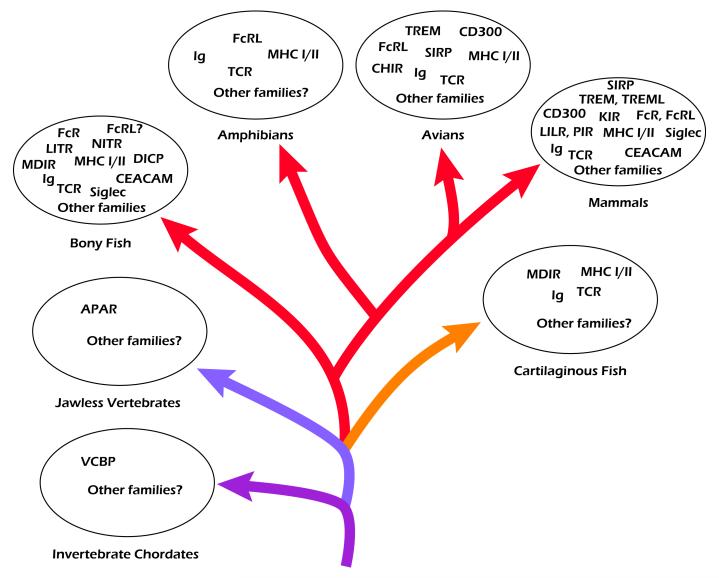
Phylogenetic distribution of representative immune-type molecules containing immunoglobulin superfamily (IgSF) domains in invertebrate (protochordate) and vertebrate (chordate) lineages. Arrows depict diversification of species over evolutionary time and are color-coded to illustrate the presence (or absence) of Ig and T cell antigen receptor (TCR) genes: red, combinatorial Ig and TCR; orange, combinatorial Ig and TCR plus noncombinatorial Ig; lavender, no definitive Ig or TCR but adaptive immune responses are mediated by variable lymphocyte receptors (VLRs); purple, no definitive Ig, TCR or VLR; variable region-containing chitin-binding protein (VCBP) is a putative antigen binding receptor. Select additional IgSF receptors and receptor families that are present in individual groups also are shown. Diversity of IgSF families among different chordate species is evident.
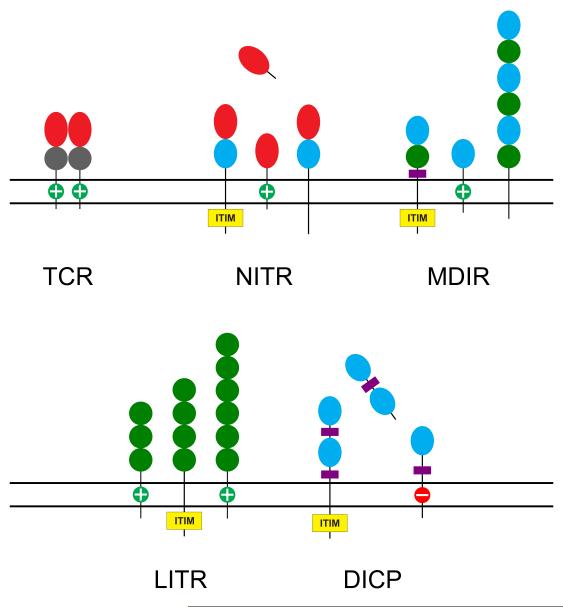
Graphical representation of the general forms of novel immune-type receptor (NITR), modular domain immune-type receptor (MDIR), leukocyte immune-type receptor (LITR), diversified intermediate domain containing protein (DICP) and variable region-containing chitin-binding protein (VCBP) molecules in comparison to the mammalian TCR. LITRs have been annotated in multiple species of bony fish. DICPs also appear to be widespread in teleost fish (unpublished observations). Ig variable (V) domains are indicated by red ovals, intermediate (I) domains by cyan ovals, constant type 1 (C1) domains by gray circles and C2 domains by green circles. “+” indicates a positively charged transmembrane region predicted to interact with an activating transmembrane adaptor molecule. ITIM, immunoreceptor tyrosine-based inhibitory motif.
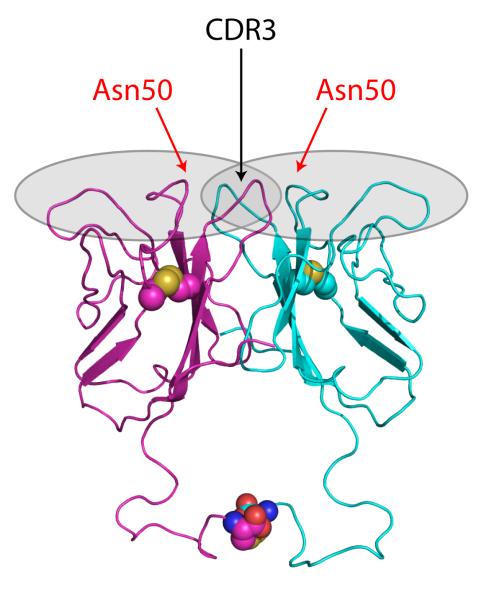
Solved structure of a dimer of a novel immune-type receptor (NITR). The position of Asn50, critical for interaction with ligand(s) in catfish NITR11, is indicated. Gray shading defines the conventional antigen binding receptor complementarity determining region (CDR)-corresponding regions; the position of CDR3 is specified further. Disulfide-linked cysteine residues are depicted by color-coded spheres (carbon, magenta and cyan; sulfur, yellow; nitrogen, blue; oxygen, red).
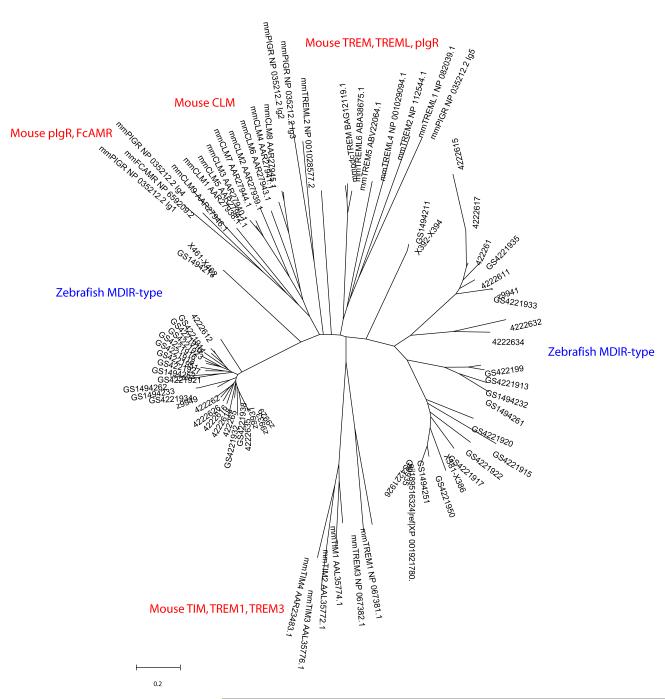
Diversity of MDIR-related domains encoded in the zebrafish genome. Neighbor-joining tree analyses depict phylogenetic relationships among (predicted) Ig I-type domains in MDIR-related sequences identified in zebrafish. Ensemble version 8 as well as additional alleles identified by our laboratory (not described previously) are included in the set of zebrafish sequences. MDIR domain sequences are compared to known reference mouse MDIR-related domains. Trees are unrooted. Certain groups of domains are specified.
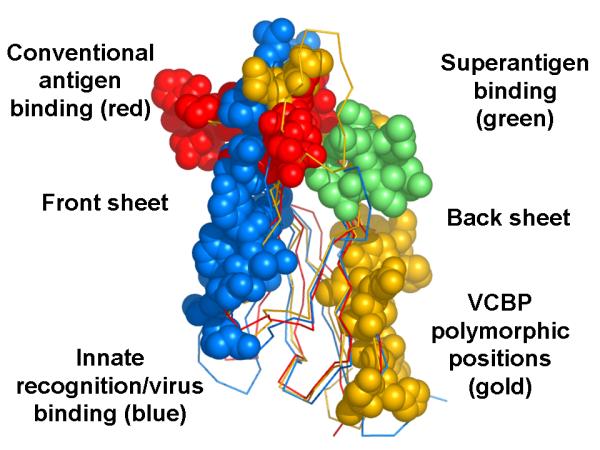
Functionally defined regions in the V-type fold of VCBP3. The diversity of recognition-interaction functions of the V domain and the diversity in defined and predicted (in this case VCBPs) binding sites are emphasized.
References
-
- Harpaz Y, Chothia C. Many of the immunoglobulin superfamily domains in cell adhesion molecules and surface receptors belong to a new structural set which is close to that containing variable domains. J Mol Biol. 1994;238:528–539. - PubMed
-
- Zhang S-M, Adema CM, Kepler TB, Loker ES. Diversification of Ig superfamily genes in an invertebrate. Science. 2004;305:251–254. - PubMed
-
- Cannon JP, Haire RN, Litman GW. Identification of diversified genes that contain immunoglobulin-like variable regions in a protochordate. Nat Immunol. 2002;3:1200–1207. - PubMed
-
- Cannon JP, Haire RN, Schnitker N, Mueller MG, Litman GW. Individual protochordates possess unique immune-type receptor repertoires. Curr Biol. 2004;14:R465–R466. - PubMed
Publication types
MeSH terms
Substances
Grants and funding
LinkOut - more resources
Full Text Sources
