


Differences in self-selected and fastest-comfortable walking in post-stroke hemiparetic persons
- PMID: 20006505
- PMCID: PMC2826561
- DOI: 10.1016/j.gaitpost.2009.11.011
Differences in self-selected and fastest-comfortable walking in post-stroke hemiparetic persons
Abstract
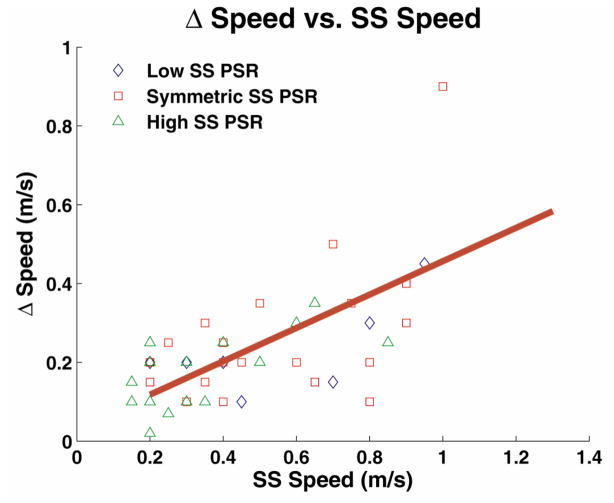
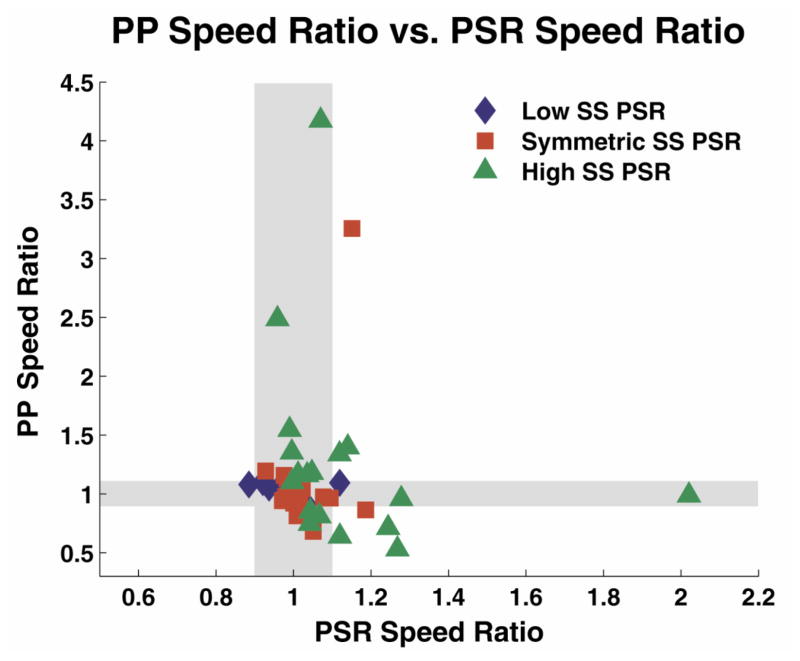
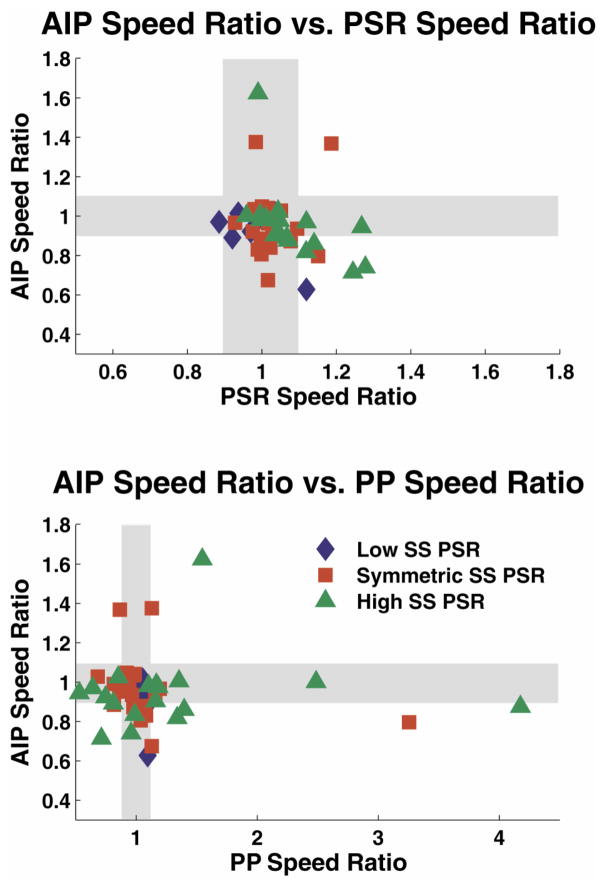
Post-stroke hemiparetic walking is typically asymmetric. Assessment of symmetry is often performed at either self-selected or fastest-comfortable walking speeds to gain insight into coordination deficits and compensatory mechanisms. However, how walking speed influences the level of asymmetry is unclear. This study analyzed relative changes in paretic and non-paretic leg symmetry to assess whether one speed is more effective at highlighting asymmetries in hemiparetic walking and whether there is a systematic effect of speed on asymmetry. Forty-six subjects with chronic hemiparesis walked at their self-selected and fastest-comfortable speeds on an instrumented split-belt treadmill. Relative proportions (paretic leg value/(paretic+non-paretic leg value)) were computed at each speed for step length (PSR), propulsion (PP), and joint moment impulses at the ankle and hip. Thirty-six subjects did not change their step length symmetry with speed, while three subjects changed their step length values toward increased asymmetry and seven changed toward increased symmetry. Propulsion symmetry did not change uniformly with speed for the group, with 15 subjects changing their propulsion values toward increased asymmetry while increasing speed from their self-selected to fastest-comfortable and 11 decreasing the asymmetry. Both step length and propulsion symmetry were correlated with ankle impulse proportion at self-selected and fastest-comfortable speed (cf., hip impulse proportion), but ratios (self-selected value/fastest-comfortable value) of the proportion measures (PSR and PP) showed that neither step length nor propulsion symmetry correlated with the ankle impulse proportions. Thus, the individual kinetic mechanisms used to increase speed could not be predicted from PSR or PP.
Copyright 2009 Elsevier B.V. All rights reserved.
Conflict of interest statement
None.
Figures
References
-
- Perry J, Garrett M, Gronley JK, Mulroy SJ. Classification of walking handicap in the stroke population. Stroke. 1995;26:982–9. - PubMed
-
- Richards CL, Malouin F, Dean C. Gait in stroke: assessment and rehabilitation. Clin Geriatr Med. 1999;15:833–55. - PubMed
-
- Turnbull GI, Charteris J, Wall JC. A comparison of the range of walking speeds between normal and hemiplegic subjects. Scand J Rehabil Med. 1995;27:175–82. - PubMed
-
- Kollen B, Kwakkel G, Lindeman E. Hemiplegic gait after stroke: is measurement of maximum speed required? Arch Phys Med Rehabil. 2006;87:358–63. - PubMed
-
- Bowden MG, Balasubramanian CK, Neptune RR, Kautz SA. Anterior-posterior ground reaction forces as a measure of paretic leg contribution in hemiparetic walking. Stroke. 2006;37:872–6. - PubMed
Publication types
MeSH terms
Grants and funding
LinkOut - more resources
Full Text Sources
Other Literature Sources
Medical
Miscellaneous
